Ancient Greek Painter Pausias
Pausias stands out as a distinguished figure in ancient Greek art, flourishing during the early 4th century BC. As a member of the Sicyonian school, his contributions significantly influenced the trajectory of Greek painting, blending technical innovation with profound thematic depth.
Birth and Training
Born in Sicyon, a city renowned for its artistic heritage, Pausias was immersed in a vibrant cultural milieu that fostered his development as a painter. The Sicyonian school, known for its emphasis on realism and detailed representation, provided an ideal environment for Pausias to hone his skills and experiment with new artistic methods. His upbringing in this setting likely nurtured his inclination towards pushing the boundaries of conventional painting practices.
Artistic expressions to ceilings
One of Pausias’ groundbreaking contributions was the introduction of ceiling painting within domestic architecture. Prior to his innovation, decorative efforts were predominantly confined to walls.
By extending artistic expression to ceilings, Pausias enabled a more comprehensive transformation of interior spaces, allowing homeowners to experience art from multiple perspectives.
This expansion not only enhanced the aesthetic appeal of residences but also demonstrated Pausias’ ability to adapt his techniques to different structural canvases, thereby broadening the functional scope of painting in everyday life.
Mastery of Perspective
Pausias was particularly renowned for his mastery of perspective, specifically through the use of foreshortening. This technique involves depicting objects or figures at angles that create an illusion of depth, making them appear three-dimensional despite being rendered on a flat surface.
His adept manipulation of perspective allowed him to present subjects with remarkable realism, as evidenced by his portrayal of a bull. Unlike traditional representations that favored profile views, Pausias opted for a frontal depiction to emphasize the animal’s length, a choice that showcased his ability to convey spatial dimensions convincingly.
Shading techniques and encaustic painting method
In addition to his expertise in perspective, Pausias revolutionized shading techniques. While his contemporaries relied on stark contrasts, using white for highlights and black for shadows to define forms, Pausias adopted a more subtle approach. He maintained a consistent dark tone across his subjects and crafted shadows by manipulating the existing hues.
This method added depth and volume without the need for exaggerated color contrasts, resulting in figures that seemed to emerge naturally from their backgrounds. His innovative shading techniques contributed to a more nuanced and lifelike representation of subjects, enhancing the overall visual impact of his paintings.
Pausias is also credited with pioneering the encaustic painting method, a technique involving the application of heated beeswax mixed with pigments. This approach allowed for vibrant color application and created durable finishes, ensuring the longevity and vividness of his artworks. The encaustic method provided Pausias with greater flexibility in color manipulation and texture creation, enabling him to achieve effects that were both visually striking and resilient against the passage of time.
Artistic Traits
Efficiency was another hallmark of Pausias’ craftsmanship. He took pride in his ability to complete paintings within a single day, a testament to his exceptional skill and dedication. This remarkable speed did not compromise the quality of his work; instead, it underscored his proficiency and deep understanding of his chosen techniques. His capacity to produce high-quality artwork swiftly made him a sought-after painter, capable of meeting the demands of various patrons and projects.
Among Pausias’ most celebrated works was a depiction of a bull titled “A Sacrifice.” This masterpiece gained further distinction through enhancements made by his son, Aristolaos, indicating a familial legacy of artistic excellence. The painting was prominently displayed in the Porticus Pompei in Rome, highlighting the widespread recognition and appreciation of Pausias’ artistry beyond Greek territories. Its presence in such a significant public space underscores the enduring appeal and high esteem in which his work was held.
Influence
Pausias’ influence extended to his contributions to public art, as documented in Pausanias’ “Description of Greece.” Notably, in the Tholos at Epidaurus, Pausias created a painting of Eros, the god of love, depicted laying down his bow and arrow to pick up a lyre. This imagery symbolized a transition from martial pursuits to artistic endeavors, reflecting broader cultural themes of harmony and creativity.
Additionally, he portrayed Drunkenness as a woman elegantly drinking from a crystal goblet, her visage visible through the vessel. These works demonstrated his ability to convey abstract concepts through human forms, blending narrative and symbolism with artistic finesse.
Pausias’ life and work exemplify the innovative spirit and technical mastery that defined the Sicyonian school of ancient Greek painting.
A particularly personal and renowned work by Pausias was his portrait of Glycera, a flower seller from his hometown. Their romantic connection inspired him to incorporate elements of her trade into the portrait, meticulously replicating the floral arrangements she crafted.
This integration of personal affection with artistic technique not only highlighted his emotional bond with the subject but also showcased his proficiency in botanical representation. The portrait, known as “Stephaneplocos” (garland-weaver) or “Stephanepolis” (garland-seller), achieved considerable acclaim and was widely recognized for its intricate detail and heartfelt portrayal.
Legacy
The enduring legacy of Pausias is further evidenced by the acquisition of a copy of Glycera’s portrait by the Roman general Lucullus at the Dionysia festival in Athens. This copy, referred to as an apographa, was purchased for a substantial sum, underscoring the high esteem in which Pausias’ work was held. The widespread admiration for his art reflects its lasting impact and the profound influence he had on subsequent generations of painters.
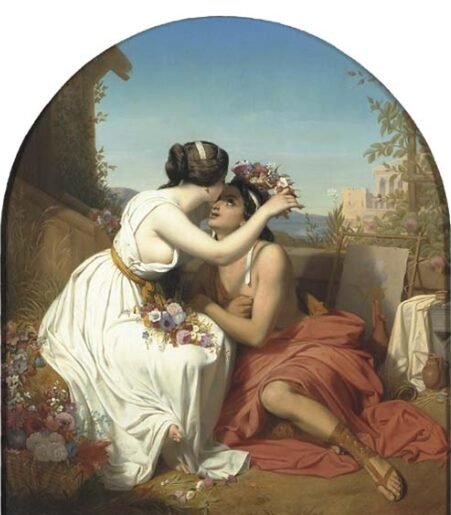
His pioneering techniques in perspective, shading, and encaustic painting, combined with his ability to infuse personal narrative into his art, established him as a pivotal figure in the history of Greek art. Image: Pausias and Glycera by Belgian painter Godfried Guffens
Frequently Asked Questions
Who was Pausias and with which artistic school was he associated?
Pausias was a prominent ancient Greek painter from the early 4th century BCE, associated with the esteemed Sicyonian school.
What innovative practice did Pausias introduce in ancient Greek domestic architecture?
He introduced the custom of painting ceilings in houses, transforming the aesthetic landscape of Greek homes with intricate and elaborate ceiling artwork.
For which artistic technique was Pausias particularly celebrated, as highlighted by Pliny the Elder?
Pausias was celebrated for his adept use of foreshortening, creating an illusion of depth by depicting objects or figures at angles that suggest three-dimensionality.
How did Pausias revolutionize shading techniques in his paintings?
Instead of using stark contrasts with white highlights and black shadows, Pausias maintained a consistent dark hue and subtly manipulated existing tones to add depth and volume.
What painting method is Pausias credited with inventing, and what are its characteristics?
Pausias is credited with inventing the encaustic painting method, which involves using heated beeswax mixed with pigments to achieve vibrant colors and durable finishes.
What was Pausias’ most renowned work, and where was it prominently displayed?
His most renowned work was a depiction of a bull titled “A Sacrifice,” which was displayed in the Porticus Pompei in Rome and later enhanced by his son Aristolaos.
Which of Pausias’ wall paintings are mentioned in Pausanias’ “Description of Greece”?
Pausias’ wall paintings mentioned include a portrayal of Eros laying down his bow and arrow to pick up a lyre in the Tholos at Epidaurus, and an allegorical representation of Drunkenness as a woman drinking from a crystal goblet.
Who was Glycera, and what is significant about Pausias’ portrait of her?
Glycera was a flower seller from Pausias’ hometown with whom he fell in love. His portrait of her, known as “Stephaneplocos” or “Stephanepolis,” integrated floral elements from her trade, showcasing his skill in botanical representation.
What is the significance of the copy of Glycera’s portrait purchased by Lucullus?
The copy, referred to as an apographa, was bought by the Roman general Lucullus at the Dionysia festival in Athens for a substantial sum, underscoring the high esteem and enduring appeal of Pausias’ work.
How did Pausias’ personal experiences influence his artistic techniques and subjects?
Pausias’ love for Glycera inspired him to incorporate floral arrangements into her portrait, blending personal affection with artistic technique and advancing his proficiency in depicting botanical subjects.