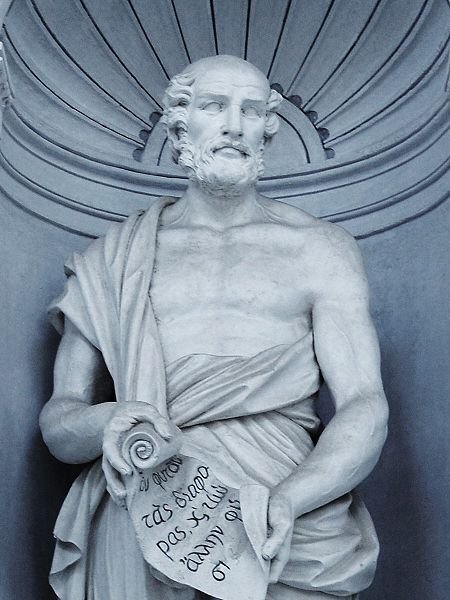
A statue of Theophrastus located at the Palermo Botanical Garden.
Theophrastus stands as a towering figure in the history of philosophy and natural science. His dedication to expanding Aristotle’s legacy and his pioneering work in botany underscore his intellectual brilliance. By integrating empirical observation with philosophical inquiry, Theophrastus established a methodology that resonates across centuries, making him a cornerstone of ancient Greek thought and scientific progress.
Early Life and Education
Theophrastus, born Tyrtamus around 371 BC in Eresos on the island of Lesbos, was a prominent philosopher and naturalist of ancient Greece. He acquired his renowned nickname, “Theophrastus,” meaning “divine speaker,” from Aristotle, reflecting his eloquent communication skills.
Initially studying under Alcippus in Lesbos, he later moved to Athens, where he joined Plato’s Academy. After Plato’s death, Theophrastus became a close associate of Aristotle, accompanying him during his studies and scientific endeavors.
Association with Aristotle
Theophrastus played a crucial role as Aristotle’s collaborator and successor. When Aristotle established the Lyceum in Athens, Theophrastus became one of its most prominent members. Following Aristotle’s departure and subsequent death, Theophrastus assumed leadership of the Peripatetic school. His stewardship of the Lyceum spanned 36 years, a period during which the institution flourished significantly, attracting up to 2,000 students.
Philosophical Contributions
Theophrastus expanded upon Aristotle’s ethical and metaphysical frameworks. He proposed that happiness depended not solely on virtue but also on external factors, challenging the Aristotelian notion of self-sufficiency. His inquiries into metaphysics addressed the nature of space, time, and motion. Unlike Aristotle, he viewed space as an arrangement of bodies and time as a byproduct of motion.
In logic, Theophrastus refined Aristotle’s theories, contributing to the development of syllogistic reasoning and the analysis of propositions. His studies on language emphasized grammar, metaphor, and the emotional impact of speech, bridging logic and rhetoric.
Contributions to Natural Science
Theophrastus is often called the “father of botany” for his seminal works, Enquiry into Plants and On the Causes of Plants. These treatises provided the first systematic classification of the plant kingdom based on growth patterns, habitats, and uses. His observations laid the groundwork for botanical science and influenced subsequent scholars during the Renaissance.
- Enquiry into Plants: Spanning nine surviving books, this work classified plants by their structural features, reproduction, and utility. It covered trees, shrubs, herbs, and plants with edible or medicinal properties.
- On the Causes of Plants: This text focused on plant physiology, examining growth conditions, soil preparation, and the economic applications of flora.
In addition to botany, Theophrastus delved into zoology and mineralogy. His treatise On Stones explored the properties, classifications, and practical uses of minerals. He correctly identified volcanic origins for pumice and described processes like fossilization and gemstone formation.
Scientific Method and Observational Approach
Theophrastus emphasized empirical observation and systematic study, a hallmark of Aristotelian science. His works demonstrate a keen attention to detail, often integrating reports from Alexander the Great’s expeditions. These accounts introduced exotic plants and minerals, such as cinnamon and frankincense, to Greek science.
Ethics and Character Studies
Theophrastus authored Characters, a collection of moral and psychological sketches that depict various human behaviors. These concise, often humorous vignettes were the first systematic attempt at character writing and inspired subsequent works by writers like Jean de La Bruyère and George Eliot.
Relationship with Students and Legacy
Theophrastus was a beloved teacher, mentoring figures like Menander, the comic playwright. His leadership fostered the growth of the Lyceum into a hub of intellectual activity. Despite facing accusations of impiety, he was widely respected and honored with a public funeral upon his death around 287 BC.
Theophrastus’s Influence on Science and Philosophy
The rediscovery of Theophrastus’s botanical and philosophical works during the Renaissance marked a turning point in the history of science. His emphasis on observation and classification provided a foundation for modern scientific methods.
While much of Theophrastus’s work is lost, fragments have survived through the writings of later scholars like Simplicius and Galen. His botanical treatises were preserved and translated into Latin, ensuring their influence on European science.
Key Works and Their Themes
Botanical Treatises
- Enquiry into Plants: Structural and functional analysis of plants.
- On the Causes of Plants: Examination of growth processes and agricultural practices.
Philosophical Texts
- On Sense Perception: Explores the nature and function of the senses.
- Metaphysics: Discusses motion, the soul, and the divine.
Scientific Writings
- On Stones: Classifies minerals and examines their practical applications.
- On Weather Phenomena: Describes natural occurrences like winds and storms.
Legacy and Recognition
Theophrastus’s contributions earned him enduring respect as a philosopher and scientist. His systematic approach to knowledge, particularly in botany, established him as a pioneer in scientific inquiry. The botanical genus Theophrasta and the standard abbreviation “Theophr.” in botanical nomenclature honor his influence.
Philosophical Divergences
Theophrastus occasionally departed from Aristotelian orthodoxy, particularly in metaphysics and ethics. He questioned Aristotle’s teleological explanations and advocated for a broader view of causality. In ethics, his emphasis on external factors in achieving happiness reflects a pragmatic approach.
Cultural Impact and Popular References
Theophrastus has been referenced in literature, philosophy, and even popular culture. His influence extends from the Renaissance to modern times, inspiring scholars, writers, and scientists. His name and works have been commemorated in various media, including games and literature.
Frequently Asked Questions
What is Theophrastus known as in botany?
He is often called the “father of botany” for his works Enquiry into Plants and On the Causes of Plants, which laid the foundation for botanical science.
What role did Theophrastus play in Aristotle’s Lyceum?
He succeeded Aristotle as the head of the Lyceum and led the school for 35 years, during which it flourished with over 2,000 students.
What are the key themes of Theophrastus’s botanical works?
Enquiry into Plants focuses on plant classification, reproduction, and uses, while On the Causes of Plants examines growth, climate influences, and agricultural practices.

Theophrastus portrayed as a medieval scholar.
What ethical stance did Theophrastus take on eating meat?
He opposed eating meat, arguing it was unjust as animals possess reasoning, senses, and feelings similar to humans.
What is Characters by Theophrastus?
It is a collection of 30 moral character sketches, considered the first systematic work in character writing.
How did Theophrastus view motion and space in physics?
He regarded motion as inherent to all activity and space as the arrangement and position of bodies, diverging from Aristotle’s views.





