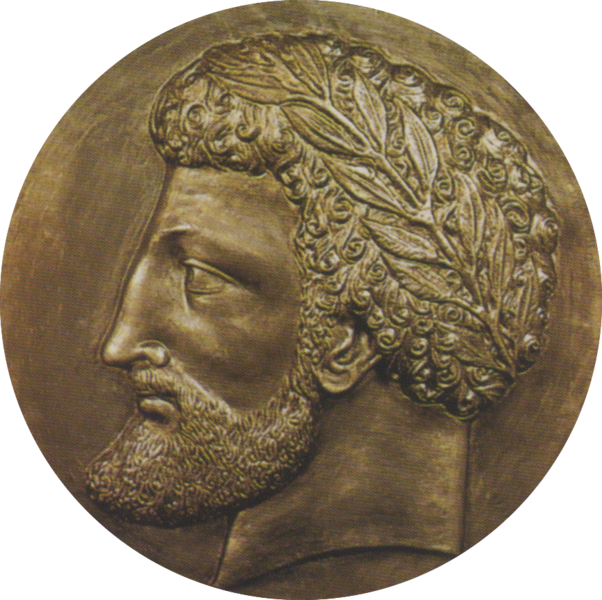
Massinissa
Masinissa (c. 238 BC – 148 BC), also spelled Massinissa, was a prominent Numidian king and a pivotal figure in North African and Mediterranean history during the Second Punic War and its aftermath. Known for uniting the Berber Massylii and Masaesyli tribes into the Kingdom of Numidia, he established a major regional power that aligned closely with Rome. His reign significantly influenced the geopolitical dynamics of the era.
Early Life and Background
Masinissa was born to Gaia, the chieftain of the Massylii tribe, who were allies of Carthage. He spent his youth in Carthage, gaining insight into their political and military systems. Around the age of 17, during the early phases of the Second Punic War (218–201 BC), Masinissa began his military career by leading a force of Numidian cavalry and Carthaginian auxiliaries against Syphax, king of the rival Masaesyli tribe. This early success solidified his reputation as a capable leader.
Masinissa in the Second Punic War
After defeating Syphax between 215 and 212 BC, Masinissa became a key commander of Carthage’s cavalry in Spain. He played a prominent role in victories such as the Battle of Castulo and Ilorca (211 BC). During these campaigns, Masinissa’s forces conducted effective guerrilla operations against Roman generals, notably Publius Cornelius Scipio (later Scipio Africanus).
The turning point in Masinissa’s allegiance came in 206 BC after the death of his father, Gaia. As internal disputes weakened the Massylii, Syphax expanded his influence. Masinissa, recognizing Rome’s growing dominance, defected to Scipio Africanus, offering to aid Rome’s invasion of Africa. His decision was strategic and timely, as it ensured his eventual control of Numidia.
Battle of the Great Plains and Capture of Syphax
In 203 BC, Masinissa’s alliance with Scipio led to success at the Battle of the Great Plains. Subsequently, Masinissa and Roman forces pursued and captured Syphax, who was delivered to Scipio. Masinissa’s marriage to Sophonisba, Syphax’s Carthaginian wife, further intertwined Numidian and Carthaginian politics. However, under Roman pressure, Masinissa sent Sophonisba poison to prevent her capture and humiliation in Rome.
Battle of Zama
At the decisive Battle of Zama in 202 BC, Masinissa commanded 9,000 cavalry alongside Scipio. His forces played a critical role in securing a Roman victory by attacking the rear of Hannibal’s army, leading to Carthage’s defeat. For his service, Masinissa was confirmed as king of a united Numidia, incorporating the territories of both the Massylii and Masaesyli tribes.
Reign of Masinissa
Masinissa’s reign lasted 54 years, during which he transformed Numidia into a stable and prosperous kingdom. He introduced agricultural reforms inspired by Carthaginian techniques, promoting settled farming over nomadic lifestyles. Under his guidance, Numidia became a vital grain supplier for Rome, earning its reputation as the “breadbasket of Rome.”
A staunch ally of Rome, Masinissa’s kingdom benefited from its support. The peace treaty of 201 BC between Rome and Carthage prohibited Carthage from engaging in warfare without Roman consent, giving Masinissa free rein to expand his territory. By provoking conflicts with Carthage, he weakened its power, paving the way for Rome’s ultimate destruction of the city in the Third Punic War (149–146 BC).

Coin featuring King Massinissa.
Provoking the Third Punic War
In his later years, Masinissa’s territorial ambitions led to continuous skirmishes with Carthage. The Numidian raids on Carthaginian lands escalated tensions, forcing Carthage to retaliate despite restrictions imposed by Rome. This defiance gave Rome a pretext to launch the Third Punic War. Although Masinissa died in 148 BC, his actions were instrumental in Carthage’s downfall, leaving Numidia as the dominant power in North Africa.
Legacy and Historical Impact
Masinissa’s reforms debunked the perception that Numidia was unsuitable for agriculture. By introducing irrigation and cultivation techniques, he laid the foundation for Numidia’s economic prosperity. Polybius praised him as the first ruler to demonstrate the agricultural potential of the region.
For the Berbers, Masinissa is a national hero and cultural icon, often regarded as the forefather of modern Berber identity. His unification of the tribes and establishment of a centralized state is celebrated as a milestone in North African history.
Polybius described Masinissa as “the best man of all the kings of our time,” praising his agricultural reforms and leadership in transforming Numidia.
Masinissa fathered 44 sons, ensuring a lasting dynasty. After his death, his son Micipsa succeeded him. Micipsa’s descendants, including Juba I and Juba II, continued to influence the region’s history. Numidia’s integration into the Roman Empire preserved elements of Masinissa’s legacy.
Masinissa in Literature and Art
Masinissa’s life and deeds have inspired numerous works:
- Africa (1330s): An epic poem by Petrarch.
- Sophonisbe (1680): A German play by Daniel Casper von Lohenstein.
- Cabiria (1914): A silent film featuring Masinissa as a character.
- Pride of Carthage (2005): A historical novel by David Anthony Durham.
Frequently Asked Questions about Masinissa
How did Masinissa unite the Numidian tribes?
With Roman support, Masinissa united the eastern Massylii and western Masaesyli tribes, forming the Kingdom of Numidia, a major regional power.
What was Masinissa’s relationship with Rome?
Masinissa was a staunch ally of Rome, supported in territorial disputes and military campaigns, ensuring his kingdom’s prominence while assisting Rome in weakening Carthage.
Why is Masinissa significant in North African history?
Masinissa is credited with transforming Numidia into a productive agricultural region and laying the foundation for its role as the “breadbasket of Rome.”

What role did Masinissa play in the Third Punic War?
Masinissa’s territorial provocations against Carthage escalated tensions, ultimately triggering the Third Punic War, which led to Carthage’s destruction in 146 BC.
What is known about Masinissa’s personal life and rule?
Masinissa ruled for about 54 years, fathered 44 sons, and remained active in governance and warfare until his death at age 90.
How did Masinissa influence cultural perceptions of the Berbers?
Many Berbers regard Masinissa as a national icon and forefather, celebrating his unification of Numidia and his enduring legacy.





