Archaeological sites and other sites of historical-cultural relevance to Haiti
Haiti, located on the western portion of the island of Hispaniola, boasts a deeply rich cultural and historical heritage. From pre-Columbian civilizations to the world’s first successful slave revolution, this nation’s past resonates in the forts, palaces, cathedrals, and monuments that dot its landscapes.
Each site contains layers of cultural intersections—from the indigenous Taíno presence and the colonial architecture of European powers, to the vestiges of the Haitian Revolution and subsequent republics.
These centuries of history have left behind a captivating collection of monuments and historical locations that serve not only as testaments to resilience, creativity, and freedom but also as living spaces that continue to shape the nation’s identity.
In this overview, World History Edu explores the prominent historical monuments and sites in Haiti.
The Citadel Henry (Citadelle Laferrière)
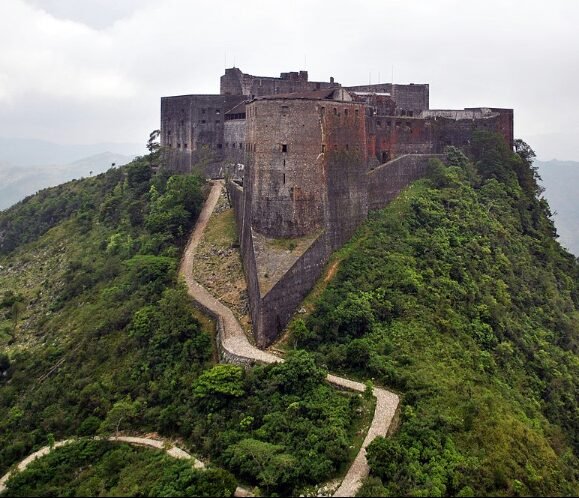
Commissioned by Haitian revolutionary Henri Christophe and constructed by former slaves, the 19th-century Citadelle Laferrière rises atop Bonnet à l’Évêque near Milot.
When discussing Haitian historical monuments, few are as iconic as the Citadel Henry, also called the Citadelle Laferrière. Built in the early 19th century under the reign of King Henri Christophe, this imposing fortress sits atop the Bonnet-à-L’Evêque mountain near the town of Milot in northern Haiti.
The Citadel’s primary purpose was to defend Haiti’s newly won independence from potential European invasions, particularly from the French, who might have sought to regain control of their former colony. Enormous stone walls, strategic artillery placements, and subterranean vaults characterize the architecture, reflecting Christophe’s determination to protect the fledgling nation.
Recognized as a UNESCO World Heritage Site along with the nearby Sans-Souci Palace and the Ramiers site, the Citadel stands as a symbol of Haitian pride, ingenuity, and sovereignty. Its dramatic silhouette dominates the surrounding landscape, and visitors who climb to its summit are rewarded with sweeping panoramas. Cannon balls, rusted artillery, and expansive courtyards underscore its military intent, while the fortress’s commanding position serves as a reminder of Haiti’s defiance against colonial powers.
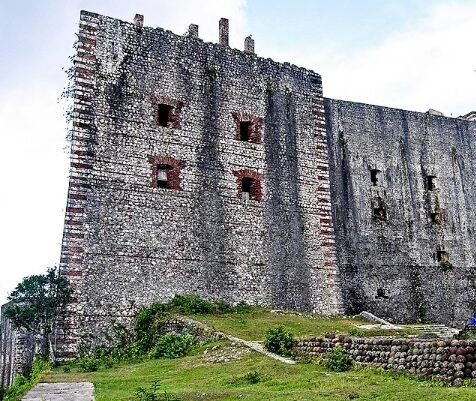
Designated by UNESCO with Sans-Souci Palace in 1982, Citadelle Laferrière still endures as Haiti’s principal African-inspired defensive stronghold and cherished national landmark. Image: Walls of Citadelle Laferrière
Rock Art and Petroglyphs
Along Haiti’s riverbanks and caves, archaeologists have documented ancient Taíno rock art. These petroglyphs depict stylized human faces, geometric shapes, and symbolic patterns that possibly represent their cosmology, rituals, or significant events. Certain locations, such as sites in the vicinity of Grand’Anse or in parts of the Central Plateau, hold particular importance. While the overall scale might be smaller than in some other Caribbean regions, the symbolic importance is substantial.
The petroglyphs require careful protection due to environmental erosion and human interference. Scholars and local advocates collaborate to research and raise awareness about these ancient markings. Although not always as frequently visited as other historical monuments, Taíno rock art remains a critical window into Haiti’s earliest cultural achievements.
Sans-Souci Palace
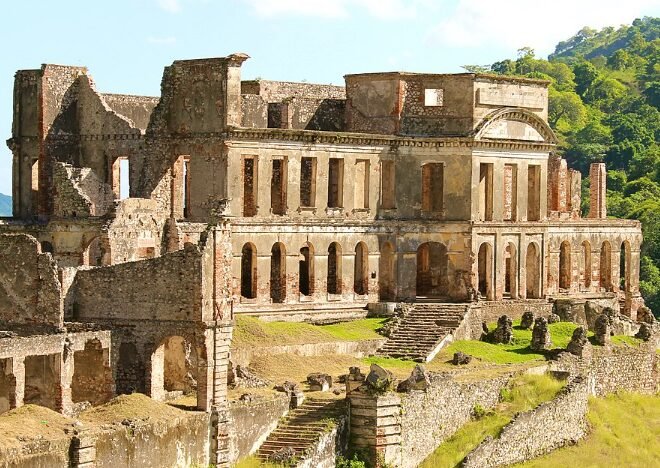
In tandem with the Citadel Henry, the Sans-Souci Palace underscores King Henri Christophe’s legacy and the collective Haitian resolve for self-determination.
Located at the base of the mountain, in the town of Milot, stands the magnificent Sans-Souci Palace, once King Henri Christophe’s principal royal residence.
Constructed between 1810 and 1813, Sans-Souci drew artistic inspiration from European baroque design, yet retained distinct Haitian elements. The palace’s name, meaning “without worry,” symbolizes a vision of regal splendor and resilience in the face of historical challenges.
Though partially ruined by an earthquake in 1842, the stately remains offer insight into the ambitions of Haiti’s early leaders who sought to create an enlightened monarchy emblematic of the country’s newfound freedom.
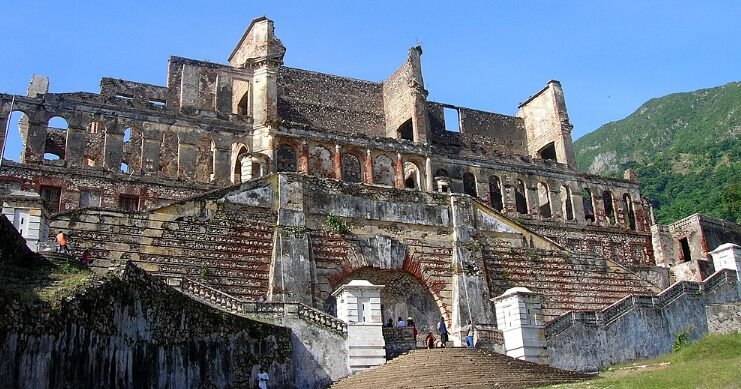
Front view of the Sans Souci Palace
Wandering through the palace grounds, one can observe arches, columns, balconies, and terraces that evoke the sophisticated aesthetics of early 19th-century architecture. The complex layout once encompassed grand reception halls, courtyards, and gardens.
Today, crumbling walls and overgrown vegetation lend a haunting beauty to the structure, reminding onlookers of the passage of time and nature’s reclamation of man-made edifices. Yet, Sans-Souci remains a vital piece of Haiti’s heritage—symbolizing independence, progress, and the complexities of post-revolution governance.
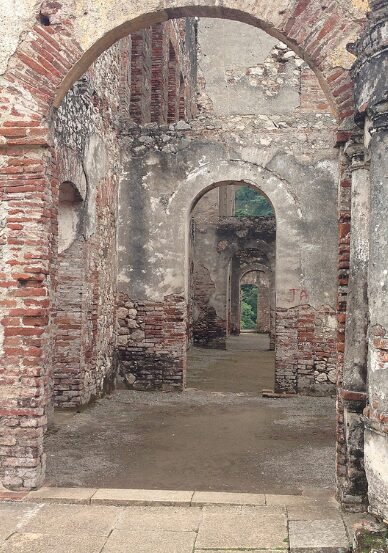
Inside the Sans Souci Palace
Fort Jacques and Fort Alexandre

Fort Jacques
Located on the heights above Port-au-Prince, Fort Jacques and Fort Alexandre were part of a network of defensive constructions commissioned by the Haitian revolutionary leader and first ruler, Jean-Jacques Dessalines, as well as other early Haitian governments. Their strategic position afforded sweeping views of the capital region and coastal areas, giving Haitian forces a vantage point in anticipation of foreign threat. Fort Jacques, named in honor of Dessalines, and Fort Alexandre, for Alexandre Pétion, serve as sentinel-like reminders of the young republic’s vigilance against reinvasion.

Fort Jacques in Haiti
While not as colossal as the Citadel Henry, these forts hold their own historic charm. Each is accessible to visitors who can discover the stone barracks, remnants of guard stations, and towering walls that once formed a formidable line of defense. The forested surroundings, coupled with cool mountain air, offer a refreshing retreat from the bustle of the capital, allowing tourists and history enthusiasts to immerse themselves in the Haitian revolutionary era.
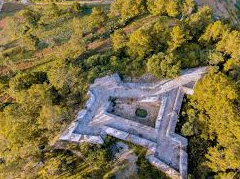
Aerial view of Fort Alexandre in Haiti
The Haitian Revolution: Origin Story, Causes, Outcome and Major Effects
The National Pantheon Museum (MUPANAH)

The National Pantheon Museum
Located in downtown Port-au-Prince, the National Pantheon Museum, often abbreviated as MUPANAH (Musée du Panthéon National Haïtien), is a modern monument dedicated to celebrating and immortalizing the history of Haiti and its founding fathers.
Designed in the 1980s, the building’s distinctive architectural style incorporates Haitian motifs, featuring circular galleries and open courtyards. Inside, visitors can see permanent exhibitions of documents, artifacts, and artistic depictions from key moments in Haitian history. The museum’s interpretive displays offer a chronological journey, from the pre-Columbian era through the Haitian Revolution and into modern-day developments.
Among the most significant features of MUPANAH is the symbolic cenotaph of Haiti’s founding fathers, including Jean-Jacques Dessalines, Henri Christophe, and Alexandre Pétion. The museum also showcases an anchor believed to be from the Santa María, one of Christopher Columbus’s ships. Through these exhibits, MUPANAH aspires to foster a deeper appreciation of Haitian heritage among both local citizens and international visitors.

Among the most significant features of MUPANAH is the symbolic cenotaph of Haiti’s founding fathers, including Jean-Jacques Dessalines, Henri Christophe, and Alexandre Pétion.
Statue of the Unknown Maroon

Designed by architect Albert Mangonès in 1967, this bronze statue stands in Port-au-Prince as a tribute to runaway slaves, the Haitian Revolution’s rallying cry, and black liberation, symbolizing Haiti’s quest for freedom.
Perhaps one of the most iconic national symbols of Haiti, the Statue of the Unknown Maroon (Le Marron Inconnu) stands proudly near the National Palace grounds in Port-au-Prince. Created by Haitian sculptor Albert Mangonès, the bronze monument depicts a maroon or runaway slave in a stance of defiance, conch shell at the lips, ready to signal revolt. Its unveiling in 1968 commemorated the maroons who challenged the colonial system and carried forth the revolutionary fervor that ultimately led to Haitian independence.
Beyond its aesthetic significance, the statue embodies Haiti’s emblematic themes of resistance, self-liberation, and perseverance. The unknown maroon is a unifying figure, representing all those who bravely resisted enslavement, sacrificed for collective freedom, and remained steadfast in the face of oppression. As a powerful piece of public art, it has become synonymous with the Haitian struggle for liberty.
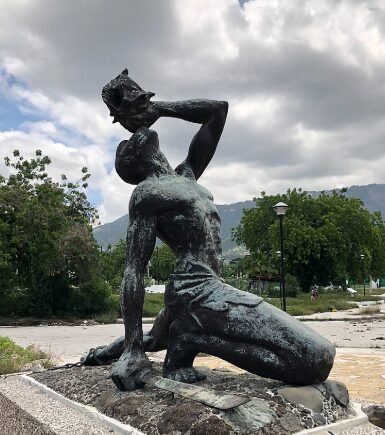
Many visitors and locals perceive the Statue of the Unknown Maroon as a timeless homage to the silent, nameless heroes who shaped the founding values of the Haitian Republic. Image: The sculpture Le Marron Inconnu in the city centre of Port-au-Prince, Haiti
Cathedral of Our Lady of the Assumption (Port-au-Prince Cathedral)
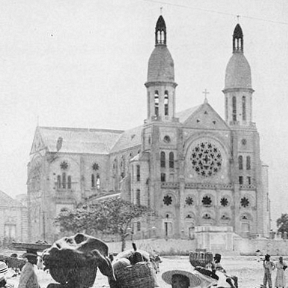
Cathedral of Our Lady of the Assumption in the early 20th century
Before the devastating earthquake of 2010, the Cathedral of Our Lady of the Assumption—commonly known as Port-au-Prince Cathedral—was a prominent landmark in the nation’s capital. Constructed in the late 19th and early 20th centuries, its Romanesque Revival style combined local and imported materials, reflecting a tapestry of religious and cultural influences. Though much of its structure was destroyed by the quake, its towering façade remains a symbol of Haitian faith and communal life. Restoration and renovation efforts have been slow but steady, reflecting Haiti’s broader challenges in post-disaster reconstruction.
Despite its current ruined state, the cathedral retains historical gravity. For many Haitians, it is a sacred site connected not only to Catholic liturgical traditions but also to family rituals, communal events, and spiritual solace. Plans to rebuild or restore the cathedral emphasize both preserving its past architectural character and creating a modern structure that can safely withstand future earthquakes.
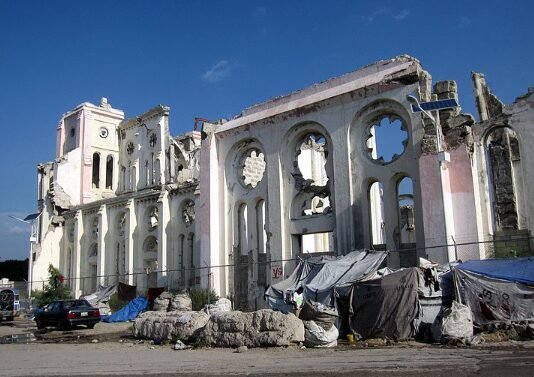
Remnants of the Cathedral of Our Lady of the Assumption
Notre-Dame de la Nativité Cathedral (Cap-Haïtien)
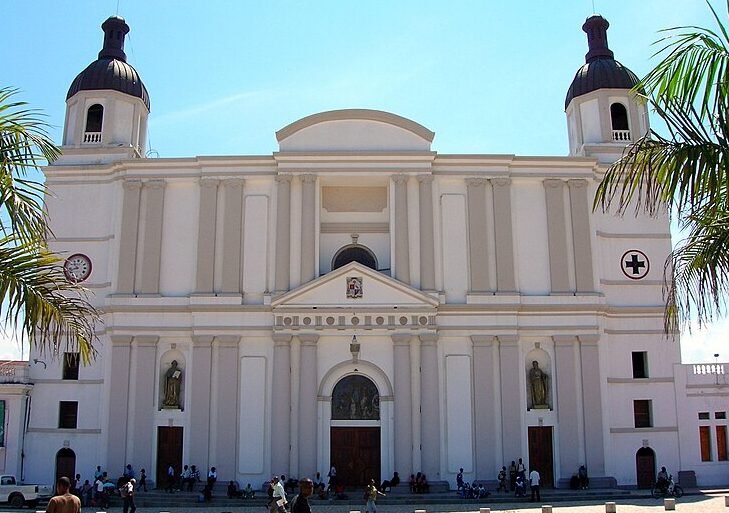
Notre-Dame de la Nativité thus exemplifies the enduring role of religious institutions in Haitian national life, both as spiritual sanctuaries and as guardians of communal memories.
In the northern city of Cap-Haïtien stands another important religious structure, Notre-Dame de la Nativité Cathedral. Built during the colonial era, it has undergone expansions and refurbishments across the centuries.
The architectural style of the cathedral merges French colonial influences with Haitian craftsmanship, reflecting Cap-Haïtien’s reputation as a cultural and historical gem. Positioned in the heart of the city, the cathedral’s picturesque façade and airy interior make it a focal point for local community events.
While religious services remain paramount, the cathedral’s cultural significance extends beyond liturgical practices. It serves as a civic gathering spot for festivals, parades, and historic commemorations. Renovation projects continue to focus on preserving artwork, stained glass, and structural integrity.
Visitors to Cap-Haïtien often include a stop at this cathedral, taking in its ambiance before venturing to nearby historical sites like the Citadel and Sans-Souci Palace.
Cap-Haïtien
Cap-Haïtien, often called the cultural capital of northern Haiti, hosts an array of smaller fortifications along its coast. Among these is Fort Picolet, overlooking the Bay of Cap-Haïtien. Constructed during the French colonial era, Fort Picolet was designed to protect the thriving port city from maritime incursions and pirate raids. Its stone ramparts, cannon placements, and strategic vantage points underscore its significance in safeguarding one of Haiti’s most crucial colonial-era harbors.
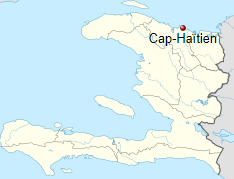
Cap-Haïtien is home to over 270,000 residents on Haiti’s scenic northern coast. Once known as Cap-Français and Cap-Henri, it was the colonial capital of Saint-Domingue and later capital of King Henri I’s Haitian kingdom. Image: Location of Cap-Haïtien in Haiti
Fort Picolet
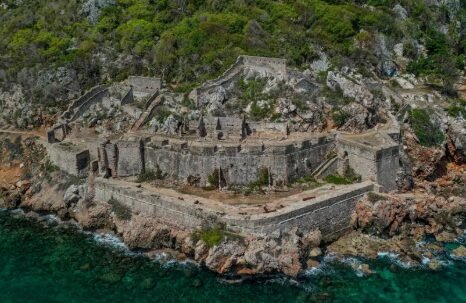
Although less imposing than the Citadel Henry, Fort Picolet boasts a dramatic setting on a rocky promontory. Visitors can ascend the fortress walls to enjoy panoramic ocean views, highlighting the blend of natural beauty and historical legacy that defines many Haitian fortifications. Conservation of the site remains challenging, as coastal erosion and limited resources threaten the structure’s foundations. Nevertheless, local authorities and heritage advocates persist in their endeavors to maintain Fort Picolet as a tangible link to the city’s vibrant past and the broader legacy of Haiti’s maritime defenses.
Champ de Mars (Port-au-Prince)
Champ de Mars, located in central Port-au-Prince, is a sprawling public space that hosts significant monuments and governmental structures. Once a social and ceremonial hotspot, the area faced considerable damage during the 2010 earthquake. Despite rebuilding challenges, it remains a focal point for political rallies, cultural celebrations, and everyday urban life. Visitors can encounter statues of Haitian heroes, war memorials, and sculptures that commemorate pivotal periods in the nation’s history.
Chief among these are the monuments to Haitian revolutionary leaders. The adjacent National Palace suffered severe damage in 2010 and was subsequently demolished, further emphasizing Champ de Mars’s evolving role in national identity. While attempts to re-envision the space have been stymied by political and economic hurdles, Champ de Mars persists as a living stage for Haiti’s modern social dramas.
Place d’Armes (Gonaïves)
Gonaïves, widely regarded as the “City of Independence,” holds a special place in Haitian history as the site where the Declaration of Independence was proclaimed on January 1, 1804. At the heart of the city is the Place d’Armes, a central square enveloped by public buildings, churches, and historical markers. Statues of Haitian patriots and plaques bearing revolutionary maxims dot the square, underscoring its profound place in national consciousness.
Throughout the year, ceremonial events, parades, and gatherings unfold in the Place d’Armes, particularly on Independence Day. The layout of the square encourages reflection on the city’s storied past, inviting people to contemplate the sacrifice and courage that birthed the first independent Black republic. While modernization efforts aim to update infrastructure, local organizations strive to maintain the square’s historical atmosphere.
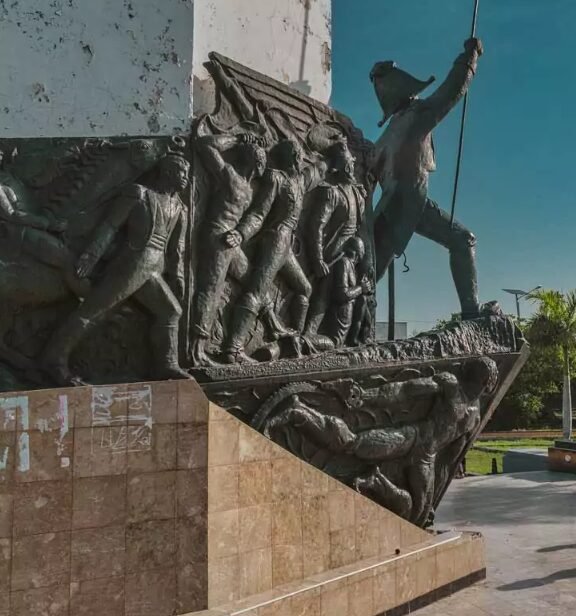
Balancing progress with preservation remains a defining challenge for Gonaïves, though the importance of Place d’Armes in the Haitian psyche remains undeniable. Image: Statue of Jean Jacques Dessalines on Place d’Armes
Bois Caïman
Regarded as the ignition point of the Haitian Revolution, Bois Caïman is a sacred site in northern Haiti. According to historical tradition, it was here in August 1791 that enslaved Africans and maroons gathered under the leadership of spiritual figures like Dutty Boukman and Cécile Fatiman to stage a Vodou ceremony that would spark a mass uprising. This event catalyzed a chain reaction, culminating in Haiti’s independence in 1804. Though documentary evidence remains sparse, the Bois Caïman ceremony lives on through oral tradition, cultural festivals, and symbolic commemorations.
Haiti’s historical sites Bois Caïman like provide tangible links to the revolutionary spirit that gave birth to an independent Black republic in 1804.
A modest monument marks the approximate location, reminding visitors of the spiritual and communal underpinnings of the revolution. Yearly rituals, pilgrimages, and ceremonies continue to honor the site’s significance.
Despite modernization and shifting land use, local communities and Haitian diaspora groups endeavor to protect Bois Caïman as a living testament to collective resistance, faith, and unity. In this sense, the site serves not only as a historical marker but also as a cherished spiritual and cultural locus that reinforces Haitian identity.
Conclusion
In the final analysis, Haiti’s historical sites stand as beacons urging visitors and locals to look beyond contemporary headlines and see the legacies of struggle and perseverance woven into Haitian identity.
Whether it is the imposing ramparts of the Citadel Henry, the graceful ruins of Sans-Souci, the understated solemnity of Bois Caïman, or the poignant memorials to modern atrocities, each location offers a chapter in the grand narrative of a people who have fought tirelessly for self-realization.





