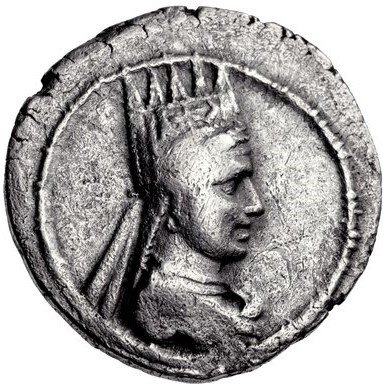
A drachm of Artavasdes II, depicting him wearing a tiara.
Artavasdes II, also known as Artavazd II, was the king of Armenia from 55 BC to 34 BC. He was a prominent member of the Artaxiad dynasty and the son of Tigranes the Great, one of Armenia’s most powerful rulers. His mother was Cleopatra of Pontus, linking him to Mithridates VI Eupator, the famous King of Pontus. Artavasdes II continued his father’s policies, maintaining the title of King of Kings, as evidenced by his coinage. However, his reign was marked by shifting alliances, conflicts with Rome and Parthia, and ultimately, a tragic downfall.
Name and Etymology
The name “Artavasdes” is a Latinized form of the Old Iranian Ṛtavazdah, which translates to “powerful/persevering through truth.” This name finds parallels in Avestan as Ašavazdah, emphasizing themes of righteousness and strength. In Armenian, his name appears as Artavazd, while in Greek sources, it has been recorded as Artaouásdēs, Artabázēs, Artábazos, and Artáozos. The variations in spelling and pronunciation across different cultures reflect the broad influences and interactions of the Armenian kingdom with Greek, Persian, and Roman civilizations.
Political and Military Alliances
Artavasdes II initially aligned himself with Rome, recognizing its growing power in the region. When Marcus Licinius Crassus, one of Rome’s triumvirs, prepared to invade Parthia in 54 BC, Artavasdes II advised him to take an alternative route through Armenia to avoid the open desert, where Parthian cavalry had a distinct advantage. He even offered substantial reinforcements— about 10,500 cavalry and 32,000 infantry—to support the Roman campaign. However, Crassus dismissed this strategy and marched directly into Mesopotamia, leading to his disastrous defeat at the Battle of Carrhae in 53 BC.
Artavasdes II’s reign was defined by shifting alliances, cultural patronage, and strategic miscalculations.
This loss significantly altered Armenia’s geopolitical standing. As the Parthian king Orodes II saw an opportunity to assert his influence over Armenia, he launched an invasion, forcing Artavasdes II to shift his allegiance. To secure peace, Artavasdes II agreed to a marriage alliance, giving his sister in marriage to Orodes II’s son, Pacorus I. This diplomatic maneuver helped stabilize his rule but also weakened his ties with Rome.
Cultural Patronage and Greek Influence
Despite his shifting political alliances, Artavasdes II was deeply engaged with Greek culture. He was a patron of Greek literature and was known to have composed Greek tragedies and histories himself. His admiration for Hellenistic traditions was evident when he and Orodes II watched a performance of Euripides’ The Bacchae at the Armenian court. During this event, news of Crassus’ defeat arrived, and in a gruesome act, the severed head of Crassus was incorporated into the play as a prop. This moment symbolized the intersection of Greek dramatic tradition with the brutal realities of ancient warfare.
The Decline of Parthian-Armenian Relations (38 BC)
The death of Pacorus I in 38 BC and the succession of his brother Phraates IV to the Parthian throne caused a deterioration in Armenian-Parthian relations. Without the marital alliance securing peace, tensions resurfaced.
Recognizing Rome’s renewed interest in the region, Artavasdes II once again shifted his allegiances, this time siding with the Roman general Mark Antony in his 36 BC Parthian campaign. According to Roman historian Plutarch, Artavasdes II was “the greatest of [Antony’s] allied kings” and contributed 6,000 cavalry and 7,000 infantry. However, his participation was conditional, as he also sought personal gain by encouraging Antony to attack his regional rival, Artavasdes of Atropatene.
Antony’s campaign ultimately faltered, and when he was forced to retreat, Artavasdes II abandoned him. His decision to withhold support in Antony’s moment of need created tensions between the two leaders, and Antony would later seek revenge.
Artavasdes II’s betrayal of Mark Antony, his imprisonment in Alexandria, and his ultimate execution highlight the precarious nature of Armenian politics in the face of two competing empires.
Capture and Imprisonment (34 BC)
In 34 BC, Antony launched a campaign into Armenia, accusing Artavasdes II of treachery. His first move was diplomatic—he sent Quintus Dellius to propose a marriage alliance between his young son, Alexander Helios, and Artavasdes’ daughter. When the Armenian king hesitated, Antony took direct military action.
Marching into Armenia, Antony quickly seized Artaxata, the Armenian capital, and took Artavasdes II captive. The Armenian king was paraded in golden chains and sent to Alexandria, where he was displayed as a war trophy in Antony and Cleopatra’s triumphal procession. Despite his humiliation, Artavasdes II refused to perform proskynesis—the act of bowing to Cleopatra—demonstrating his resistance even in captivity.
Relationship between Cleopatra and Antony and how it shaped the ancient world
Execution and Aftermath (31 BC)
After Antony’s defeat (by Octavian) at the Battle of Actium in 31 BC, Cleopatra, seeking to secure alliances, ordered Artavasdes II’s execution. He was beheaded, and his severed head was sent to Artavasdes I of Media Atropatene, a former enemy who had aligned with Antony. This act was likely an attempt to win Media Atropatene’s loyalty, though it ultimately had little strategic impact.
With Artavasdes II dead, his son, Artaxias II, attempted to reclaim the Armenian throne with Parthian assistance. However, Rome’s dominance in the region was growing, and Armenia would continue to be a contested buffer state between the Roman and Parthian empires.
Legacy and Cultural Memory
The capture and execution of Artavasdes II left a deep mark on Armenian historical memory. His fate was later transformed into a popular legend, as recorded by the Armenian historian Movses Khorenatsi. In the tale, Artavasdes is cursed by his father and imprisoned within Mount Ararat by supernatural beings known as k’ajk’. According to the myth, he remains trapped, awaiting the day of his return to free Armenia.
This legend reflects the broader Armenian tradition of linking historical figures with mystical narratives, demonstrating how the memory of Artavasdes II evolved into a symbol of national perseverance.
Artavasdes II navigated the turbulent politics of the late Hellenistic world, balancing relationships with Rome and Parthia while attempting to preserve Armenian sovereignty.
Hellenistic Kingdoms: What were they and what were some of their notable achievements?
Frequently Asked Questions
What was Artavasdes II’s role in the conflict between Rome and Parthia?
Initially allied with Rome, he advised Marcus Crassus to take an alternate route through Armenia in 54 BC to avoid Parthian cavalry. Crassus ignored the advice and suffered a major defeat at Carrhae, after which Artavasdes II aligned with the Parthians through a marriage alliance.
How did he demonstrate his cultural affinities?
He was well-versed in Greek literature and composed Greek tragedies and histories. He famously attended a performance of The Bacchae with the Parthian king Orodes II, where Crassus’ severed head was incorporated into the play.
Why did Artavasdes II switch alliances back to Rome during Antony’s Parthian campaign?
As relations with Parthia deteriorated after Pacorus I’s death, Artavasdes II allied with Mark Antony in 36 BC, supplying troops and urging an attack on his enemy, Artavasdes of Atropatene. However, he withdrew support when Antony’s campaign failed.
How and why was Artavasdes II captured?
In 34 BC, Antony invaded Armenia, accusing Artavasdes II of betrayal. He was captured in Artaxata and taken to Alexandria, where he was publicly humiliated in Antony and Cleopatra’s triumphal procession.
What was his fate after Antony’s defeat?
Following Antony’s defeat at Actium in 31 BC, Cleopatra had Artavasdes II executed by beheading. His severed head was sent to Artavasdes I of Media Atropatene in a political move to secure an alliance.
What happened to Armenia after Artavasdes II’s death?
His son, Artaxias II, took refuge with the Parthians and later reclaimed the Armenian throne with their support. Armenia remained a contested region between Rome and Parthia.





