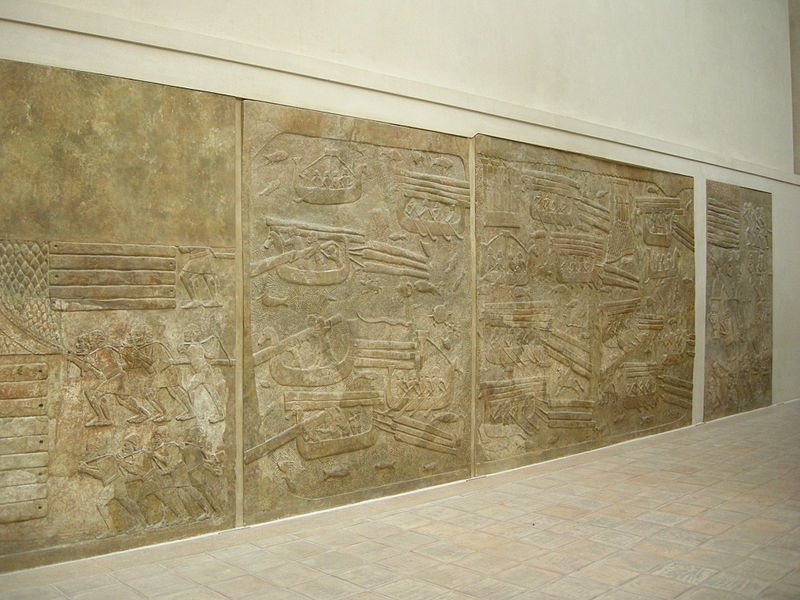
The sculpted reliefs displayed at the Louvre.
The Assyrian Timber Transportation Relief is a significant example of ancient Assyrian art, depicting the process of moving large timber logs, likely for construction purposes. This relief was discovered in the ruins of Dur-Sharrukin, the capital city established by Sargon II (reigned: circa 722–705 BCE). Currently housed in the Louvre Museum, it provides valuable insight into the engineering, logistics, and labor organization of the Neo-Assyrian Empire.
Discovery and Excavation
The relief was unearthed in 1844 by Paul-Émile Botta, a French archaeologist and diplomat. His excavation at Dur-Sharrukin, located in modern-day Iraq, was among the earliest European-led digs in the region. Botta’s work was instrumental in bringing Assyrian art and architecture to global attention. The relief was transported to France, where it became part of the Louvre’s collection of Mesopotamian artifacts. His illustrations from 1849 remain an essential reference for studying these artworks.
Context and Purpose of the Relief
The Timber Transportation Relief belonged to the decorative program of Sargon II’s palace. Like other Assyrian reliefs, it was designed not just for decoration but also for political propaganda. The depiction of timber transport emphasized the empire’s ability to command vast resources and mobilize labor for grand construction projects. Such materials were essential for building palaces, temples, and fortifications, as Assyria lacked extensive forests of its own.
The reliefs highlight the Assyrian Empire’s administrative efficiency, control over resources, and use of advanced transportation methods.
Artistic Features and Depiction
The relief displays detailed carvings of workers, boats, and large tree trunks being transported along a river. It exemplifies the advanced skills of Assyrian artisans, who meticulously represented depth, movement, and hierarchical composition in their works. The figures are shown in a structured manner, with laborers positioned according to their roles, ensuring the scene appears both orderly and dynamic.
One of the notable elements is the representation of boats carrying timber logs, an indication that rivers played a crucial role in Assyrian infrastructure projects. The boats were likely navigating the Tigris and Euphrates rivers, facilitating the movement of materials from distant regions. This method of transport was essential, as it allowed for the efficient delivery of heavy resources that would have been difficult to move overland.

Significance in Assyrian Economy and Administration
The relief provides valuable insights into the economic and administrative strategies of the Assyrians. The extraction and transportation of timber required a high level of organization, involving planners, laborers, and river navigators. This process underscores the strength of Assyrian bureaucracy, as successful large-scale construction projects depended on efficient logistics.
Moreover, the scene reflects the empire’s extensive trade networks. Assyria sourced timber from forests in the Levant, Anatolia, and the Zagros Mountains, regions that were either conquered or maintained as tributary states. This highlights the strategic importance of these lands, as they supplied materials essential for maintaining the empire’s infrastructure.
Symbolism and Imperial Power
Assyrian reliefs were not merely artistic expressions but also instruments of royal ideology. The depiction of large-scale timber transport symbolized the king’s authority, control over resources, and ability to mobilize labor. It reinforced the idea that the Assyrian ruler was a powerful figure, capable of orchestrating monumental projects across his vast domain.
The scale and intricacy of the artwork also served to impress visitors and dignitaries who entered Sargon II’s palace. Such reliefs conveyed the empire’s technological prowess and the divine favor believed to be granted to the Assyrian ruler, legitimizing his reign.
Preservation and Modern Interpretation
After its excavation, the relief was transported to the Louvre Museum, where it remains one of the key exhibits of Assyrian art. Scholars continue to study it for insights into Assyrian engineering techniques, economic structures, and artistic traditions. Botta’s illustrations from 1849 remain an essential historical record, particularly as excavation methods at the time did not prioritize detailed documentation as they do today.
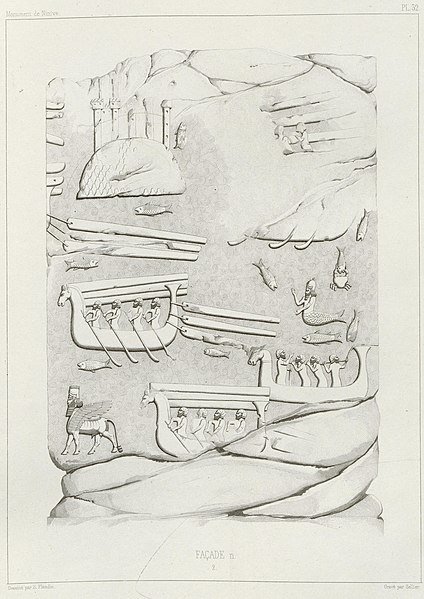
Botta illustration 1849
Today, the Timber Transportation Relief is recognized as an important artifact that sheds light on the technological and administrative capabilities of the Neo-Assyrian Empire.
Frequently Asked Questions