Bắc Thuộc: Times when Vietnam was under Chinese Rule
Vietnam’s history is profoundly shaped by periods of Chinese domination, collectively known as Bắc Thuộc (北屬), meaning “belonging to the north.” Spanning from around 111 BC to 939 AD, with a brief resurgence from 1407 to 1428 AD, these eras mark significant phases where various Chinese dynasties governed parts of what is now Northern Vietnam. This extensive period of foreign rule influenced Vietnam’s political structures, culture, and societal norms, laying the groundwork for the nation’s subsequent development and resistance movements.

Flag of Vietnam.
Historical Periods of Chinese Rule
First Era of Northern Domination (111 BC–AD 40)
The initial phase of Bắc Thuộc began in 111 BC when the Han Dynasty conquered the Nanyue Kingdom (Nam Việt). This expansion incorporated northern Vietnam and parts of southern China into the Han Empire, establishing administrative regions such as Jiaozhi and Jiaozhou.
The Han Dynasty’s rule introduced Chinese administrative practices, culture, and infrastructure to the region. This period was characterized by relative stability until the uprising led by the Trưng Sisters in AD 40, which temporarily disrupted Han control.
Second Era of Northern Domination (AD 43–544)
Following the suppression of the Trưng Sisters’ rebellion, Chinese authority was reinstated under the Eastern Han Dynasty. This era saw continued Sinicization, with increased Chinese migration and the establishment of more robust administrative systems. Over the centuries, successive Chinese dynasties, including the Eastern Wu, Western Jin, Eastern Jin, Liu Song, Southern Qi, and Liang dynasties, maintained control over northern Vietnam. The governance during this period involved significant integration of Chinese bureaucratic practices and cultural elements, although local resistance and intermittent rebellions persisted.

A depiction of the Trung sisters’ rebellion.
Third Era of Northern Domination (AD 602–939)
The third phase commenced with the Sui Dynasty’s reconquest of Vietnam, followed by the Tang Dynasty and briefly the Wu Zhou and Southern Han dynasties. This period entrenched Chinese administrative systems and further assimilated Vietnamese society into the broader Chinese cultural sphere.
The Tang Dynasty’s influence was particularly notable, as it established the Protectorate General to Pacify the South, which reinforced Chinese presence and governance. The era concluded in 939 AD when Ngô Quyền defeated the Southern Han forces at the Battle of Bạch Đằng River, marking the end of nearly a millennium of Chinese rule and the emergence of the independent Ngô Dynasty.
Fourth Era of Northern Domination (1407–1428)
Although often excluded from the primary periods of Bắc Thuộc, a brief fourth phase occurred when the Ming Dynasty of China invaded and occupied Vietnam from 1407 to 1428 AD. This period was marked by harsh administration and heavy taxation, prompting the Lam Sơn Uprising led by Lê Lợi, which successfully expelled the Ming forces and reestablished Vietnamese sovereignty under the Lê Dynasty.
Geographical Extent and Impact
The territories under Chinese rule during Bắc Thuộc primarily encompassed the Red River Delta and adjacent regions in present-day Northern Vietnam. The Han and subsequent dynasties focused their control on fertile river valleys, facilitating agriculture, trade, and administrative efficiency. This geographical focus did not align perfectly with modern Vietnam’s borders but laid the foundation for the cultural and demographic landscape of the region.
Chinese settlement introduced significant demographic changes, with a substantial influx of Han Chinese migrants. This migration resulted in a genetic blend and cultural exchange that deeply influenced local Vietnamese society. The introduction of Chinese language, religion, art, and administrative practices became integral to Vietnamese culture, persisting well into the post-colonial era. The integration of Chinese characters as the official script until the 20th century exemplifies the enduring impact of Chinese governance on Vietnamese identity.
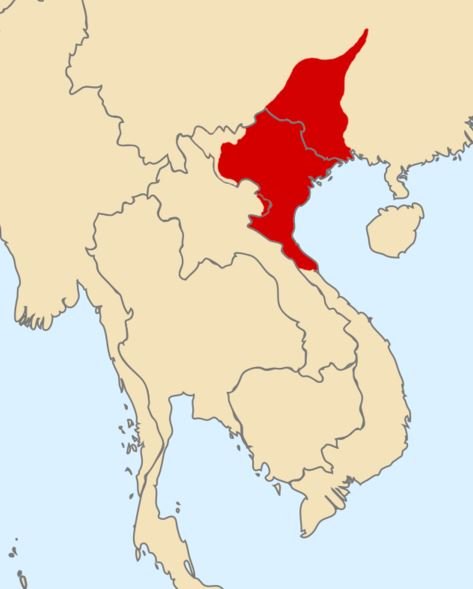
The administrative structure Chinese rulers in Vietnam facilitated economic integration and infrastructure development, enhancing trade and connectivity while spreading Chinese cultural norms throughout the region.. Image: A map showing the extent of the Ngô Dynasty (in red).
Cultural and Linguistic Influence
Chinese rule brought about extensive cultural assimilation, evident in various aspects of Vietnamese life. Confucianism became the dominant philosophical and ethical framework, shaping educational systems and bureaucratic governance. Chinese literary and artistic styles influenced local traditions, leading to a syncretic cultural landscape.
Linguistically, Chinese influence was profound. The Vietnamese language absorbed numerous Chinese loanwords, particularly in areas related to governance, technology, and culture. The use of chữ Hán (classical Chinese characters) and later chữ Nôm (a vernacular script based on Chinese characters) facilitated literary and administrative functions. This linguistic integration played a crucial role in the development of Vietnamese literature and scholarly traditions.
Frequently Asked Questions
What were commanderies in Bắc Thuộc?
Commanderies were administrative divisions established by Chinese mandarins to govern northern Vietnam, implementing Han bureaucratic systems for tax collection, law enforcement, and public works.
How did Chinese mandarins influence local governance?
Chinese mandarins oversaw the commanderies, introducing Han administrative practices while allowing local Vietnamese elites to retain some authority, creating a blend of indigenous and Chinese governance.
Why did Chinese rule foster resentment among the Vietnamese population?
The imposition of foreign administrative systems and cultural practices led to feelings of oppression, sparking periodic uprisings and rebellions as locals sought to reclaim autonomy and preserve their traditions.
How did Vietnamese culture adapt under Chinese influence?
Vietnamese society engaged in a dynamic cultural exchange, integrating Chinese elements into their own traditions while maintaining distinct local practices in language, religion, and the arts.
What is chữ Nôm and its significance?
Chữ Nôm is a script developed by Vietnamese scholars by adapting Chinese characters to represent the Vietnamese language, enabling the growth of native literature and intellectual expression.
In what ways did cultural resilience manifest during Chinese rule?
Despite extensive Chinese influence, Vietnamese society preserved significant aspects of its pre-existing cultural identity, including indigenous languages, religious practices, and artistic traditions alongside Chinese elements.
How did the administrative and cultural policies of the Han Dynasty shape Vietnam’s history?
Han policies of economic integration and cultural dissemination deeply embedded Chinese influences in Vietnamese society, while also igniting enduring resistance and fostering a strong sense of national identity.
Timeline of Vietnam under Chinese Rule (Bắc Thuộc)
- 111 BC: The Han dynasty defeats Nanyue (Nam Việt), initiating the first Bắc Thuộc period and incorporating northern Vietnam into the Han Empire.
- 40 AD: The Trung sisters lead a major rebellion against Han rule, temporarily ending the first era of Chinese domination.
- 43 AD: Eastern Han dynasty reasserts control, beginning the second Bắc Thuộc period.
- 544 AD: The second period ends with Lý Bôn’s revolt, who establishes the Early Lý dynasty, breaking Chinese dominance.
- 602 AD: The Sui dynasty reincorporates Vietnam, starting the third Bắc Thuộc era, which continues under the Tang and other subsequent dynasties.
- 939 AD: The Battle of Bạch Đằng results in the defeat of Tang forces, leading to the foundation of the Ngô dynasty and ending the third period of Chinese rule.
- 1407 AD: The Ming dynasty invades and conquers Vietnam, beginning the fourth Bắc Thuộc period after overthrowing the Hồ dynasty.
- 1428 AD: The Lam Sơn uprising, led by Lê Lợi, successfully expels the Ming forces, restoring Vietnamese independence and establishing the Lê dynasty.





