Basilica of Sant’Ambrogio
The Basilica of Sant’Ambrogio, officially known as Basilica romana minore collegiata abbaziale prepositurale di Sant’Ambrogio, is a prominent Roman Catholic church in Milan, Lombardy, Italy. Renowned for its Romanesque architecture and deep historical significance, this basilica stands as one of the most important religious and cultural landmarks in the city. Originally commissioned by Saint Ambrose in the late 4th century, the church has undergone multiple renovations, particularly during the 12th century when it took its present Romanesque form.
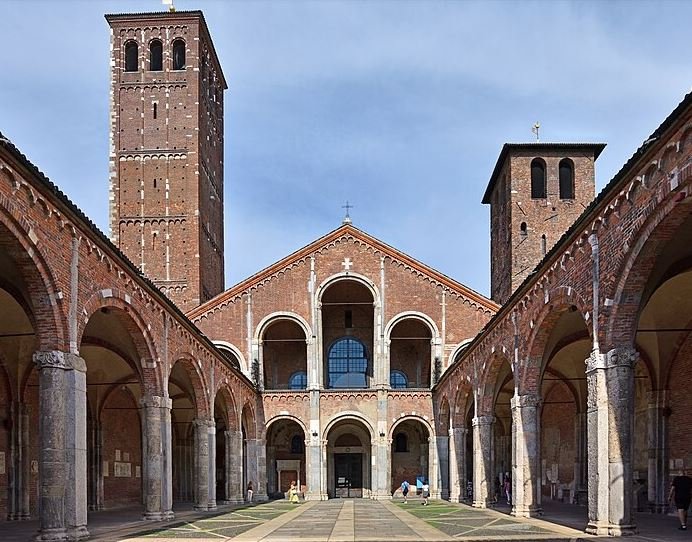
The apex façade of the Basilica of Sant’Ambrogio.
Historical Background
The Basilica of Sant’Ambrogio was founded between 379 and 386 AD by Saint Ambrose, then the Bishop of Milan. He built it in an area where many Christian martyrs had been buried during the Roman persecutions, initially naming it the Basilica Martyrum in their honor. Ambrose, a staunch defender of the Nicene Creed against Arianism, commissioned several churches around Milan to assert the influence of Nicene Christianity.
After Saint Ambrose’s death, the basilica was dedicated to him and renamed in his honor. Throughout the early medieval period, the church remained a center of religious life and monastic activity. By the 8th century, a Benedictine monastery was established within its grounds, coexisting with a community of canons. These two religious groups functioned independently within the basilica, a rare arrangement that persisted for centuries.
The most significant transformation of the basilica occurred in the 12th century, when it was rebuilt in the Romanesque style. During this period, many of its architectural elements, including the grand arcades, ribbed vaults, and the characteristic brick façade, were introduced. The basilica’s two bell towers, each associated with one of the religious communities, also symbolize the historical division between the canons and the monks.
Architectural Features
Exterior Design
The façade of the Basilica of Sant’Ambrogio is a classic example of Lombard Romanesque architecture. It features an atrium, originally used for religious gatherings, and a portico with elegant arches supported by semi-columns and pilasters. The two bell towers are distinctive:
- The Monks’ Tower (Torre dei Monaci), dating back to the 9th century, has a fortress-like appearance.
- The Canons’ Tower, completed in 1144, is taller and adorned with decorative Romanesque elements.
Interior Layout
The basilica follows a basilica-plan with a central nave flanked by two side aisles, all terminating in semi-circular apses. The groin vaults of the nave, added in the 12th century, rest on alternating pillars and columns, a hallmark of Romanesque construction. The matronei, or upper galleries, support the vaults but obscure clerestory windows, creating a dim and solemn interior.
The apse mosaic, dating to the early 13th century, depicts Christ Pantokrator surrounded by saints, including Gervasius and Protasius, whose relics rest in the crypt. This mosaic suffered significant damage during World War II, but was later restored.
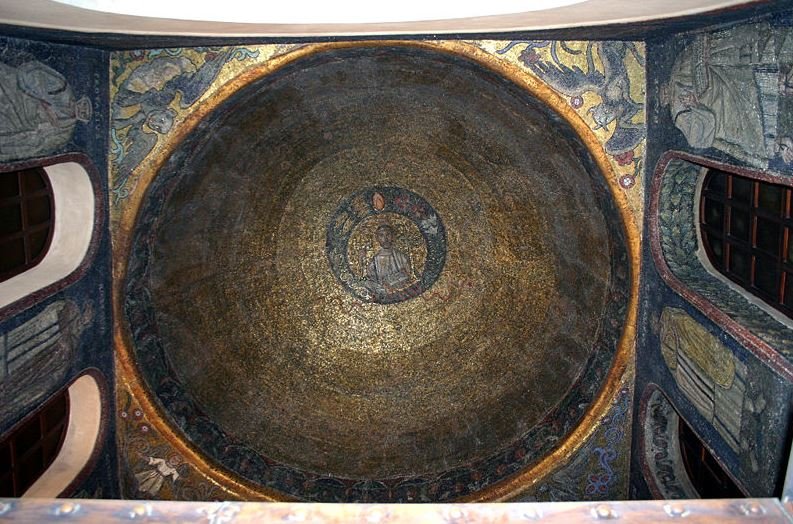
The ceiling of the Oratory of San Vittore of at the Basilica of Sant’Ambrogio.
Religious and Cultural Significance
One of the most revered elements of the basilica is the high altar, commissioned by Archbishop Angilbert II in the 9th century. Crafted by the goldsmith Volvinius, the altar is covered in gilded reliefs depicting biblical scenes and adorned with precious stones. Above it stands a ciborium, supported by four porphyry columns, with reliefs illustrating scenes from the life of Saint Ambrose.
Beneath the high altar lies the crypt, which houses the relics of Saint Ambrose, along with Saints Gervasius and Protasius. Originally buried separately, their remains were relocated to a single porphyry sarcophagus in the 9th century and later placed in a silver urn during the 18th-century renovations.
The Oratory of San Vittore in Ciel d’Oro, an ancient chapel within the basilica, dates back to the 4th century. It is best known for its 5th-century mosaics, including a striking portrait of Saint Ambrose, one of the earliest depictions of the saint. The oratory was originally built to enshrine the relics of Saint Victor, a revered Christian martyr.
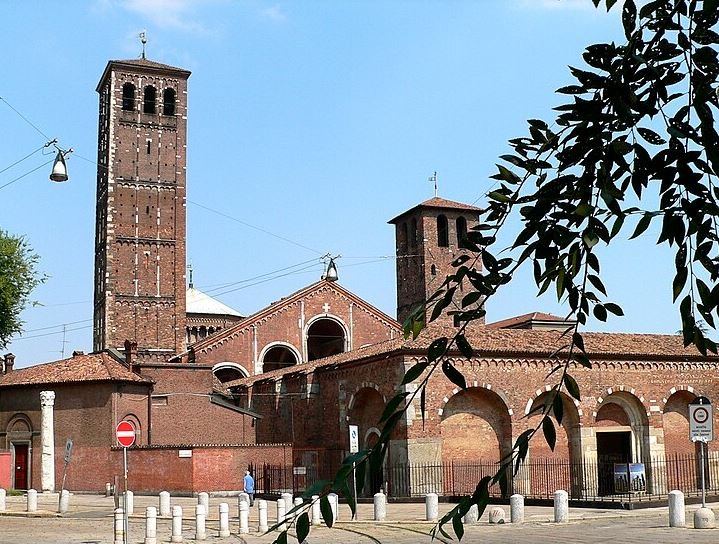
Front view of the Basilica of Sant’Ambrogio.
The Basilica in Modern Times
War Damage and Restoration
During World War II, the basilica suffered extensive damage from Allied bombings in August 1943, particularly affecting the apse and nearby structures. Following the war, significant restoration efforts were undertaken, including the reconstruction of parts of the church and the creation of a new abbey office building in a distinct pink hue.
Symbolism and Influence
Beyond its religious function, Sant’Ambrogio has played a role in Milan’s political and social history. In 1528, the Peace of Saint Ambrose was signed here, bringing temporary reconciliation between Milan’s noble and popular factions. The basilica has also influenced modern architecture; for example, parts of UCLA’s Royce Hall and Powell Library were modeled after Sant’Ambrogio’s Romanesque design.
In 1943, Allied bombings severely damaged the apse and surrounding structures of the Basilica of Sant’Ambrogio, leading to post-war restoration.
The Devil’s Column: A Popular Legend
Adjacent to the basilica stands a white marble column with two mysterious holes. According to local legend, the holes were made by the Devil’s horns when he attempted to tempt Saint Ambrose and, in frustration, struck the column. This site, known as the Devil’s Column, remains a point of curiosity and superstition.
9 Greatest Catholic Saints of All Time and Their Accomplishments
Frequently Asked Questions
Why was the Basilica of Sant’Ambrogio originally called Basilica Martyrum?
It was named Basilica Martyrum because it was built in an area where many early Christian martyrs had been buried.
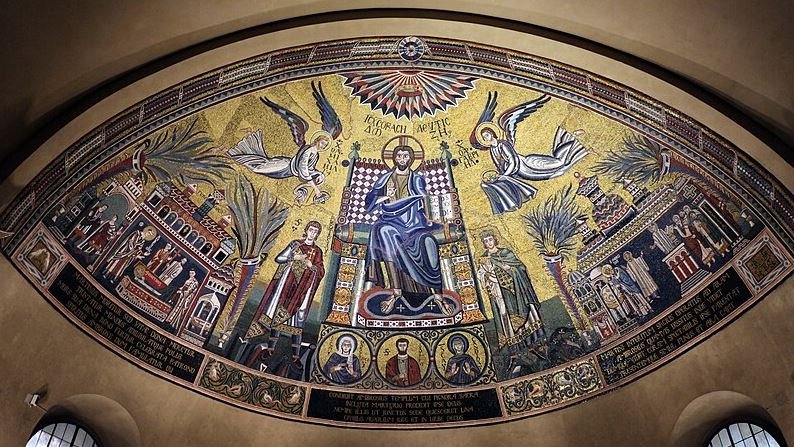
Christ Pantocrator mosaic at the Church.
How did St. Ambrose influence the basilica’s construction?
St. Ambrose built the basilica as part of his efforts to strengthen Nicene Christianity in Milan, constructing several churches to counter Arian influence.
When did the basilica take its current Romanesque form?
The basilica was rebuilt in the 12th century in the Romanesque style, with its present layout and architectural features dating from this period.
What do the two bell towers symbolize?
The two towers represent the division between the monks and the canons, who lived as separate religious communities within the basilica.
What significant event took place at the basilica in 1528?
The “Peace of St. Ambrose” was signed there, resolving conflicts between Milan’s noble and popular factions.
What is the legend of the Devil’s Column?
A nearby marble column has two holes, which legend claims were made by the Devil’s horns when he tried and failed to tempt St. Ambrose.





