Ambrose of Milan
Ambrose of Milan (c. 339–397), venerated as Saint Ambrose, was a pivotal figure in the early Christian Church. As Bishop of Milan, he played a significant role in defending Nicene Christianity against Arianism and paganism. His theological and literary contributions left a lasting impact on Christian thought and liturgical practices.
Below, World History Edu explores Ambrose of Milan’s life, career, and legacy in detail.
Ambrose was a skilled diplomat, preacher, and writer, influencing figures such as Augustine of Hippo.
Early Life and Education
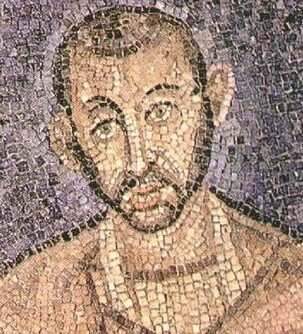
Mosaic of Ambrose.
Ambrose was born in 339 in Augusta Treverorum (modern Trier, Germany) into a Christian Roman aristocratic family. His father, traditionally believed to be Aurelius Ambrosius, was a high-ranking official in the Roman government.
According to legend, a swarm of bees settled on Ambrose’s face as an infant, which was seen as an omen of his future eloquence. His education in Rome included studies in law, rhetoric, and literature, preparing him for a public career.
Political Career and Unexpected Election as Bishop
Before his ecclesiastical career, Ambrose served as the governor of Aemilia-Liguria, based in Milan. In 374, the sudden death of Milan’s Arian bishop, Auxentius, led to a heated dispute over his successor. While attempting to mediate, Ambrose was unexpectedly chosen as bishop by popular acclamation. Despite his initial reluctance—he was still a catechumen at the time—Ambrose accepted the position and was rapidly baptized and consecrated.
Bishop of Milan and Opposition to Arianism
As bishop, Ambrose became a formidable opponent of Arianism, a doctrine that denied the full divinity of Christ. He actively opposed Arian influence at court, particularly under the rule of Emperor Valentinian II and his mother, Justina, who were sympathetic to Arian beliefs. Ambrose’s resistance was exemplified in his refusal to surrender churches to Arian groups, culminating in a standoff where he and his congregation occupied a basilica in defiance of imperial orders.
Theological Contributions and Writings
Ambrose was a prolific writer, contributing significantly to Christian ethics, exegesis, and doctrine. Some of his most influential works include:
- De Officiis Ministrorum (377–391): A treatise on Christian ethics, modeled on Cicero’s De Officiis, instructing clergy on moral conduct.
- Exameron (386–390): A commentary on the six days of creation, integrating Christian doctrine with Greek philosophical insights.
- De Fide (378–380): A defense of Nicene orthodoxy against Arianism, written at the request of Emperor Gratian.
- De Spiritu Sancto (381): A treatise affirming the divinity of the Holy Spirit.
- De Mysteriis and De Sacramentis: Explanations of Christian rites and sacraments, foundational to later theological developments.

Relationship with Roman Emperors
Ambrose navigated complex relationships with Roman emperors, balancing political diplomacy with ecclesiastical authority:
- Gratian (r. 367–383): Ambrose’s writings and guidance influenced Gratian’s pro-Nicene policies and actions against paganism.
- Valentinian II (r. 375–392): Clashed with Ambrose over Arianism, leading to conflicts over church property and doctrine.
- Theodosius I (r. 379–395): Ambrose exercised significant influence over Theodosius, famously compelling him to perform public penance after the Massacre of Thessalonica in 390.
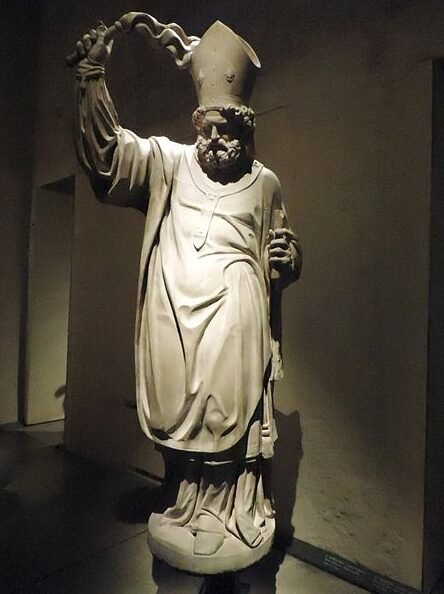
A statue depicting Saint Ambrose.
READ MORE: Roman Emperors Who Changed the Course of History
Opposition to Paganism and Judaism
Ambrose was a staunch opponent of state-sponsored pagan practices. He successfully lobbied against the restoration of the Altar of Victory in the Roman Senate and opposed financial support for Vestal Virgins. His stance against Judaism was more complex; while he condemned Jewish-Christian conflict, he also opposed imperial orders to rebuild synagogues destroyed by Christian mobs.
Musical Innovations and Influence on Church Liturgy
Ambrose contributed to early Christian hymnography and liturgical practices. He is credited with composing hymns such as “Veni Redemptor Gentium” and promoting antiphonal chanting, which influenced Ambrosian chant traditions. Though he is often attributed with composing the “Te Deum” hymn, modern scholars dispute this claim.

Impact on Augustine of Hippo
Ambrose played a crucial role in the conversion of Augustine of Hippo, one of Christianity’s greatest theologians. Augustine admired Ambrose’s rhetorical skills and theological depth, leading to his baptism by Ambrose in 387. Augustine’s later writings, including Confessions, reflect Ambrose’s influence.
Later Years and Death
In his later years, Ambrose continued his episcopal duties, writing and mediating political conflicts. He passed away on April 4, 397. His relics are enshrined in the Basilica of Sant’Ambrogio in Milan, alongside the remains of saints Gervase and Protase.
Legacy and Canonization
Ambrose was canonized shortly after his death and recognized as one of the four Great Latin Church Fathers, alongside Augustine, Jerome, and Gregory the Great. His feast day is celebrated on December 7 in the Catholic, Anglican, and Lutheran traditions. He remains the patron saint of Milan and beekeepers.
His ability to navigate the complexities of faith and imperial politics cemented his status as a foundational figure in Western Christianity.
Saint Augustine of Hippo: The event that marked his conversion to Christianity
Frequently Asked Questions
How did Ambrose become Bishop of Milan?
Ambrose was the Roman governor of Aemilia-Liguria when, during a heated succession dispute in 374, he was unexpectedly chosen as bishop by popular acclamation. He was quickly baptized, ordained, and consecrated within a week, despite initially resisting the appointment.

An engraving depicting Ambrose’s statue.
What was Ambrose’s stance on Arianism?
Ambrose was a staunch opponent of Arianism, which denied the full divinity of Christ. He actively resisted Arian influences at court, defended Nicene Christianity, and played a key role in the condemnation of Arian bishops at the Council of Aquileia (381).
What was Ambrose’s relationship with the Roman emperors?
Ambrose had significant influence over emperors like Gratian, Valentinian II, and Theodosius I. He clashed with Valentinian II’s Arian court but persuaded Theodosius I to perform public penance after the Massacre of Thessalonica in 390.
What were Ambrose’s contributions to Christian hymnody?
Ambrose is credited with developing Ambrosian hymnody, writing several hymns, including Veni Redemptor Gentium. Though traditionally linked to Ambrosian chant and the Te Deum hymn, modern scholars debate these attributions.
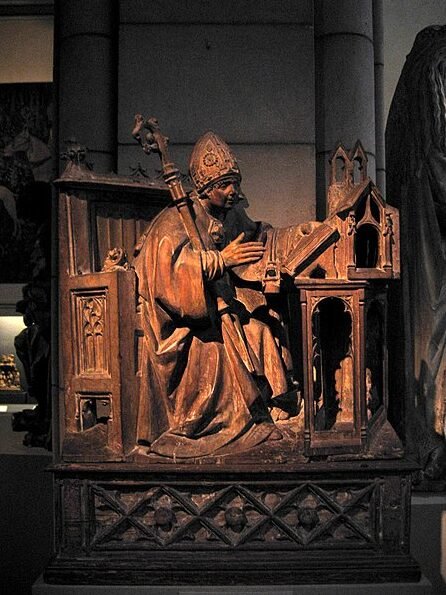
Artwork depicting Saint Ambrose in His Study. Its located at the Metropolitan Museum of Art, New York City.
How did Ambrose influence Augustine of Hippo?
Ambrose’s eloquent preaching and theological writings played a crucial role in the conversion of Augustine, who later became a major Church Father. Ambrose also baptized Augustine in 387.
Ambrose of Milan successfully opposed the restoration of the Altar of Victory in the Roman Senate and worked to suppress state support for pagan cults, reinforcing Christianity’s dominance in the empire.
What is Ambrose’s most famous written work?
His De Officiis Ministrorum (377–391) is one of his most important works, outlining Christian ethics for clergy, drawing from both Stoic philosophy and Scripture.
What is Ambrose’s legacy in the Church?
Ambrose is recognized as one of the four Great Latin Church Fathers and was declared a Doctor of the Church in 1298. He remains a saint in Catholic, Orthodox, Anglican, and Lutheran traditions.
What symbols are associated with Ambrose?
Bees and honey are commonly linked to Ambrose, originating from a legend in which a swarm of bees landed on his face as an infant, foreshadowing his eloquence and wisdom. He is also the patron saint of Milan and beekeepers.
9 Greatest Catholic Saints of All Time and Their Accomplishments





