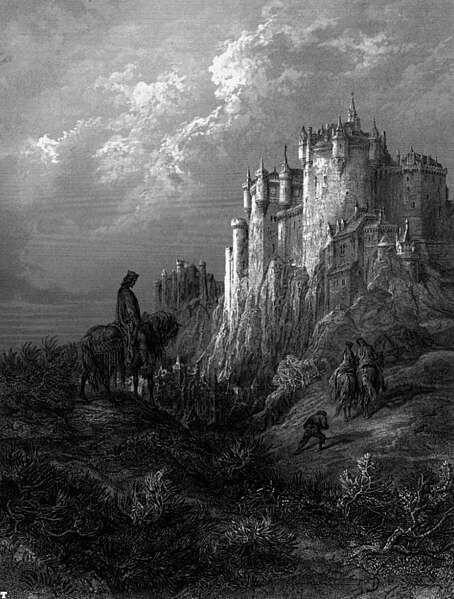
An illustration of Camelot by French printmaker Gustave Doré, featured in Lord Tennyson’s “Idylls of the King” (1867).
What is Camelot?
Camelot is the legendary castle and court of King Arthur that became the iconic center of Arthurian romance, first appearing in 12th-century French literary works.
Summary
Camelot is a storied and legendary castle, long associated with King Arthur and his court. Absent in early Arthurian material, it emerged in 12th-century French romances. Over time, Camelot became known as the mythical capital of Arthur’s realm, symbolizing the grandeur of the Arthurian world. Although medieval texts often placed it in Great Britain and sometimes linked it to real locations, its precise geography remained ambiguous, enhancing its mystique. Scholars largely regard Camelot as fictional, created to fit the needs of chivalric romance. Nonetheless, debates about its “real” location persist to this day, fueled by historical conjecture and tourism interests.
Etymology
The name Camelot has uncertain origins, appearing with varied spellings in medieval French texts: Camaalot, Camalot, Chamalot, and more. Some scholars have suggested it derived from the Battle of Camlann in Welsh tradition, while others believed it came from Cavalon, a name linked to Avalon and possibly confused with Caerleon, a traditional court of Arthur.
Other scholars have connected Camelot to Camulodunum, the Roman British city and early capital of Roman Britain. Historian John Morris posited that Romanized Britons nostalgically referenced the golden era of Roman peace, inspiring Camelot’s legend.
However, doubts remain about how Chrétien de Troyes, the earliest known writer to mention Camelot, could have encountered such references. American scholar Urban T. Holmes speculated that Chrétien might have been influenced by Pliny’s Natural History, where the name Camaloduno appears, but this remains uncertain.
Camelot in Medieval Literature
Camelot’s first literary mention appears in Chrétien de Troyes’ Lancelot, the Knight of the Cart (1170s). In the text, Camelot is referenced briefly as a location where Arthur held a magnificent court. Different manuscripts spell the name variously, and in some, the name is absent entirely. In Chrétien’s account, Arthur’s chief court is at Caerleon, which had earlier prominence in Geoffrey of Monmouth’s Historia Regum Britanniae. Arthur’s court is portrayed as mobile, consistent with medieval monarchical practices.
Camelot’s descriptive grandeur, with its cathedral and Round Table, mirrored Geoffrey’s depiction of Caerleon and broader Welsh oral traditions.
By the 13th century, Camelot’s significance grew in French prose romances, such as the Vulgate and Post-Vulgate cycles. These works established Camelot as Arthur’s primary court, eclipsing Caerleon. English and Welsh traditions, however, retained Caerleon or Carlisle as Arthur’s court. Camelot’s descriptive grandeur, with its cathedral and Round Table, mirrored Geoffrey’s depiction of Caerleon and broader Welsh oral traditions.
Symbolism and Location
Camelot transcends its physicality, becoming a potent symbol of Arthur’s realm. Its magnificence, courtesy, and chivalric ideals embody the utopian world of Arthurian romance. The Lancelot-Grail cycle situates Camelot along a river near Astolat, surrounded by plains and forests. It features St. Stephen’s Cathedral, which holds the tombs of kings and knights and serves as the spiritual hub for the Round Table. Camelot’s mythological stature deepened through depictions of jousts, quests, and the Holy Grail vision.
Despite ongoing debates about its “real” location, Camelot’s true essence lies in its role as a beacon of chivalric ideals and timeless human aspirations.
In some versions, Camelot’s demise follows Arthur’s death. For instance, the Tavola Ritonda portrays the city’s abandonment and ruin. Other works like Palamedes describe King Mark of Cornwall’s invasion and destruction of Camelot after the Battle of Camlann. These narratives underscore Camelot’s symbolic linkage to Arthur’s fate and the fall of his chivalric order.
Historical and Geographic Speculations
In the 15th century, Thomas Malory’s Le Morte d’Arthur solidified Camelot’s image. Malory identified it with Winchester, England, partly due to the city’s history as a Wessex capital and its association with the Winchester Round Table. Malory’s editor, William Caxton, preferred a Welsh location, possibly referencing Caerwent’s Roman ruins.
Cadbury Castle in Somerset has been a strong candidate for Camelot since John Leland’s 1542 account, where locals linked it to Arthur. Archaeological digs in the 20th century, led by Leslie Alcock, revealed significant fortifications from around 470 to 580 CE, with evidence of trade and possible Saxon conquest. Though Alcock distanced himself from the Camelot connection, Cadbury Castle remains a popular contender.
Other Theories
- Camulodunum (Colchester): Once the capital of Roman Britain, its name derived from the Celtic god Camulus. However, its early Saxon conquest makes its Arthurian connection unlikely.
- Camelford (Cornwall): Linked to the River Camel and Camlann, but its ties are speculative.
- Viroconium (Shrewsbury): Archaeological evidence of a grand palace supports its candidacy.
- Other Locations: Camelon in Scotland and Roxburgh have also been proposed, though with limited evidence.
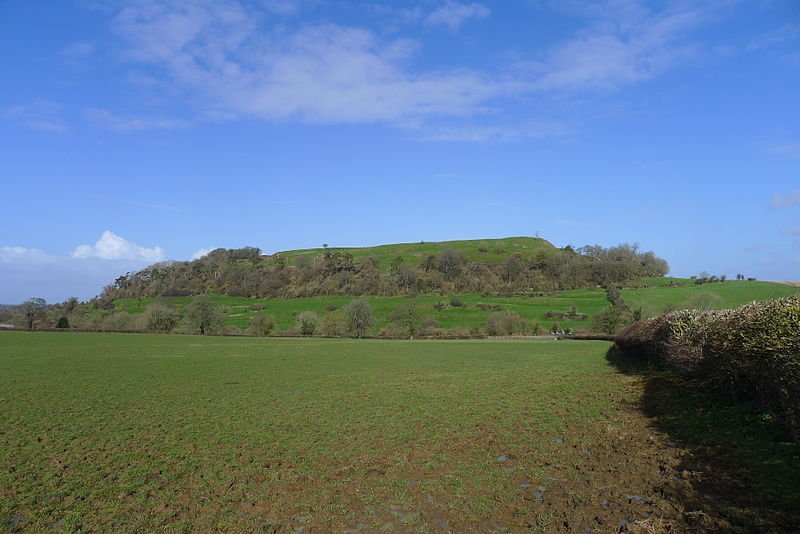
Cadbury Castle, an archaeological site, situated near South Cadbury and Yeovil in Somerset, England.
Camelot in Modern Culture
Camelot’s cultural resonance endures, symbolizing ideals of justice, chivalry, and utopia. Alfred, Lord Tennyson, immortalized it in his Idylls of the King. Modern portrayals of Camelot often depict it as a lavish medieval palace, emphasizing its romantic allure.
Media and Literature
- Film and Theatre: The musical Camelot and its film adaptation popularized the castle’s imagery. Locations like Coca Castle in Spain served as cinematic Camelots.
- Television and Comics: The series Camelot and the comic Camelot 3000 reimagine the legend in new contexts.
Did you know…?
Camelot has inspired theme parks, hotels, and even the UK National Lottery’s first operator, the Camelot Group. The Kennedy administration was famously dubbed the “Camelot era” after Jacqueline Kennedy referenced the musical in a Life magazine interview.
Frequently Asked Questions
Is Camelot considered real or fictional?
Most scholars view it as entirely fictional. Its indefinite location suited medieval romance writers and has fueled centuries of debate and tourism.
Where did Camelot first appear in literature?
It was first mentioned in Chrétien de Troyes’s 12th-century poem Lancelot, the Knight of the Cart, though the text barely describes it.
Why are there so many theories about Camelot’s location?
Its precise site was never firmly established in medieval sources, leading later readers to link it with places like Caerleon, Winchester, Cadbury Castle (sometimes called “Camalet”), and even Colchester—though none has been definitively proven.
What is known about the name’s origin?
There is no clear consensus on Camelot’s derivation. Some scholars suggest it is linked to Camlann (Arthur’s final battle) or “Cavalon,” while others connect it to the Roman town Camulodunum.
How did Camelot evolve in medieval romances?
Later French prose works elevated Camelot into a grand capital with a cathedral, the Round Table, and epic jousts, serving more as a symbolic ideal of Arthur’s court than as a tangible location.
FACT CHECK: At World History Edu, we strive for utmost accuracy and objectivity. But if you come across something that doesn’t look right, don’t hesitate to leave a comment below.





