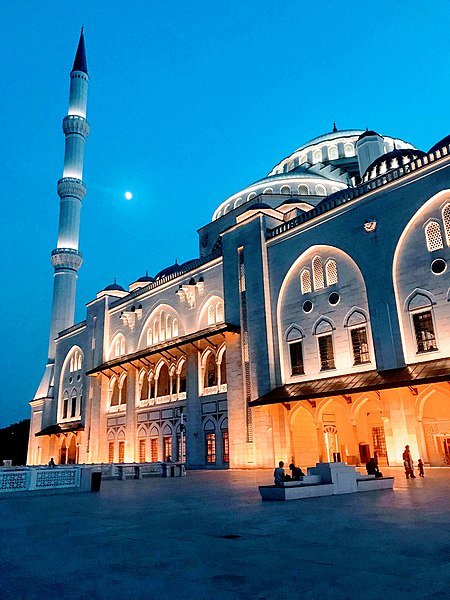
Çamlıca Mosque illuminated at night.
The Grand Çamlıca Mosque, completed in March 2019, is the largest mosque in Turkey and a monumental addition to Istanbul’s skyline.
Situated atop Çamlıca Hill in the Üsküdar district, it is visible from much of the city and serves as both a religious and cultural hub. The mosque can accommodate over 62,000 worshippers, with provisions to shelter 100,000 people in emergencies, such as earthquakes. More than just a place of worship, the complex includes an art gallery, library, museum, conference hall, and childcare facilities, making it a center for both Islamic and civic life.
Designed by female architects Bahar Mızrak and Hayriye Gül Totu, the mosque cost approximately $109 million (550 million Turkish liras at the time). After years of planning, it was officially inaugurated on May 3, 2019, by President Recep Tayyip Erdoğan, with several international dignitaries in attendance. As one of Turkey’s most ambitious megaprojects, the mosque has sparked both admiration and controversy.
Most Transformative Events in the History of Turkey in the 20th Century
Architectural Inspiration and Design
The architectural style of the Grand Çamlıca Mosque is rooted in Classical Ottoman traditions, drawing inspiration from the works of Mimar Sinan, the renowned 16th-century Ottoman architect. The mosque’s colonnaded courtyard, domes, and half-domes resemble Sinan’s famous mosques, such as Süleymaniye Mosque and Selimiye Mosque. However, unlike Sinan’s structurally innovative designs, the Çamlıca Mosque’s use of concrete has relegated some of these elements to decorative features rather than functional engineering solutions.
At the heart of the mosque is its main dome, which stands at 72 meters—a symbolic reference to the 72 nationalities residing in Istanbul. The dome’s diameter of 34 meters represents Istanbul’s license plate number (34). The largest finial in the world, used atop the mosque, was colored with nanotechnology to ensure longevity and brilliance.
The mosque’s main gate, measuring 5 meters in length and 6.5 meters in height, is one of the largest in any place of worship. The interior design follows a minimalist approach, focusing on light, color, calligraphy, and ornamentation to create a spiritually uplifting atmosphere.
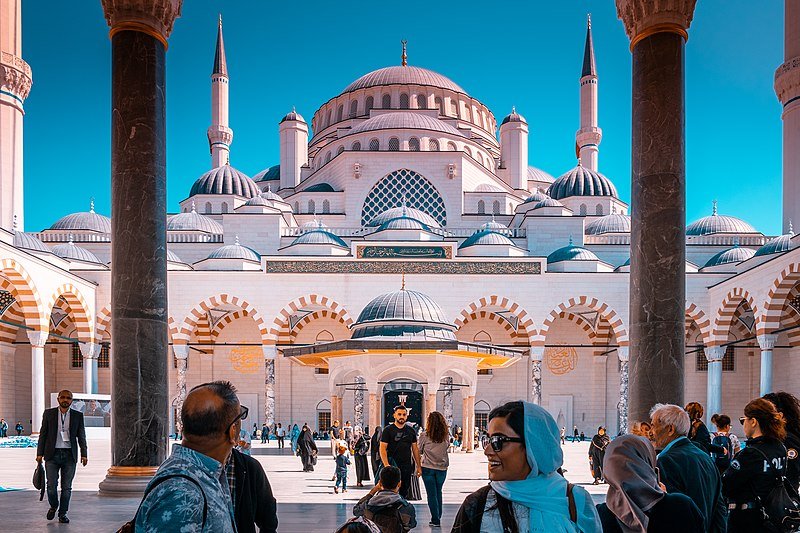
Çamlıca Mosque
The Grand Çamlıca Mosque is the largest mosque in Turkey, located on Çamlıca Hill in Istanbul’s Üsküdar district, completed and opened in 2019.
Minarets and Symbolism
One of the most striking features of the Grand Çamlıca Mosque is its six towering minarets, a feature shared only with the Sultan Ahmed Mosque (Blue Mosque) in Istanbul and the Sabancı Merkez Mosque in Adana. These minarets symbolize the six pillars of Islamic faith (Iman).
Four of the minarets, positioned around the central dome, each stand 107.1 meters tall, referencing the 1071 Battle of Manzikert, which marked the Seljuk Turks’ entry into Anatolia. The remaining two minarets, located at the outer ends of the mosque, reach a height of 90 meters. The height and placement of the minarets make the mosque a dominant feature of the Istanbul skyline, visible from both the Asian and European sides of the city.
Interior and Religious Features
The interior of the mosque is designed to enhance spirituality through its use of light and space. The main dome, which is 3.12 meters wide and 7.77 meters high, weighs 4.5 tons, emphasizing grandeur and scale.
The mihrab, the semicircular niche indicating the direction of Mecca, is intricately decorated, as is the minbar (pulpit). Unlike traditional Ottoman mosques, where women often have separate, smaller prayer areas, the Grand Çamlıca Mosque has a centrally located women’s prayer section that can accommodate 600 worshippers.
The mosque also features massive stained-glass windows, an artistic combination of traditional Islamic geometric patterns and modern glasswork. The walls are adorned with calligraphy, written in an elegant, flowing script that adds to the mosque’s aesthetic and spiritual ambiance.
Complex and Additional Facilities
Beyond its primary function as a place of worship, the Grand Çamlıca Mosque serves as a cultural and educational center. The mosque complex includes:
- An Art Gallery (covering 3,500 square meters)
- A Library (3,000 square meters)
- A Conference Hall (seating up over 1,050 people)
- A Museum of Islamic Civilizations (opened in 2022)
- Childcare Facilities with a playground and parking area
- Underground Parking for over 3,400 vehicles
These features make the mosque not just a religious institution, but a community hub that promotes learning, cultural exchange, and social services.
Female Architects and Women-Friendly Design
A notable aspect of the Grand Çamlıca Mosque is that it was designed by two female architects, Bahar Mızrak and Hayriye Gül Totu. Their involvement was significant, as mosque architecture has historically been a male-dominated field.
The architects aimed to create a female-friendly space by incorporating:
- A dedicated women’s prayer area in the main hall, rather than isolating it in a separate section.
- A separate space for women to perform ablutions before prayer.
- A private elevator leading to the women’s prayer area.
- Childcare facilities, ensuring that mothers could attend prayers while their children were cared for.
Their design reflects a modern approach to inclusivity, making the mosque more accessible to women while preserving Islamic architectural traditions.
Designed by female architects, the Grand Çamlıca Mosque challenges traditional norms by being one of the most female-friendly mosques in Turkey.
Did you know…?
To accommodate the large number of visitors and worshippers, plans were made to improve transportation access to the mosque. In 2022, construction began on a new metro spur to connect the M5 Üsküdar Metro Line directly to the Çamlıca Mosque, making it easier for people to visit without relying on private vehicles.
The mosque’s location on Çamlıca Hill, while offering spectacular views, also posed challenges for accessibility. However, the underground parking facility and planned metro extension aim to reduce congestion and make travel to the mosque more convenient.
Controversy and Criticism
As one of Turkey’s most ambitious megaprojects, the Grand Çamlıca Mosque has received both praise and criticism. Critics argue that its construction was:
- Politically motivated, symbolizing the ruling party’s push to emphasize Islamic heritage in Turkey’s secular framework.
- An unnecessary expense, with $110 million spent on a project some saw as excessive, given Turkey’s economic challenges.
- An attempt to rival Istanbul’s historical mosques, such as Süleymaniye and Sultan Ahmed, in a way that some architects and historians found architecturally forced.
Despite these critiques, supporters view the mosque as a symbol of national pride and a modern interpretation of Ottoman heritage that will serve future generations.
Frequently Asked Questions
What is the mosque’s capacity and significance?
It can hold over 62,000 worshippers, with space for 100,000 in emergencies, making it the largest place of worship in Turkey.
Who designed the mosque and how much did it cost?
Designed by female architects Bahar Mızrak and Hayriye Gül Totu, it cost $109 million (550 million Turkish liras at the time).
What are the architectural influences of Çamlıca Mosque?
It is inspired by Classical Ottoman architecture and Mimar Sinan’s works, but features modern construction techniques.
What do the mosque’s dome and minarets symbolize?
The 72-meter-high main dome represents Istanbul’s diverse ethnic groups, while the six minarets symbolize the six articles of Islamic faith.
What additional facilities are part of the mosque complex?
It includes a museum, art gallery, library, conference hall, childcare facilities, and underground parking for 3,500 vehicles.
How does the mosque accommodate female worshippers?
It was designed with dedicated spaces for women, including a separate prayer area, ablution facilities, an elevator, and a childcare center.
What controversies surround the mosque’s construction?
Critics argue that it was a political megaproject conflicting with Turkey’s secular traditions, while others see it as a cultural and religious landmark.
While its construction has sparked debate, the Grand Çamlıca Mosque’s impact on Istanbul’s skyline, culture, and religious life is undeniable.





