Carthaginian General Hasdrubal the Boetharch
Hasdrubal the Boetharch was a notable Carthaginian general active during the Third Punic War (149–146 BC). Despite limited historical information about him, his role and actions during this pivotal period offer insights into Carthage’s final struggle against Rome. In this overview, World History Edu explores his background, military campaigns, and legacy.
The Title of Boetharch
The title “Boetharch,” attributed to Hasdrubal, originates from Carthaginian administrative terminology. Its exact role remains unclear, though scholars speculate that it may have signified a position of military or civil authority. The term potentially derives from the Greek word boēthós (“auxiliary”), suggesting leadership over Carthage’s mercenary forces. Importantly, this title should not be confused with the Greek “boeotarch,” a distinct title held by leaders of the Boeotian Confederacy.
Post-Second Punic War Constraints
Following its defeat in the Second Punic War (218–201 BC), Carthage was subjected to harsh conditions by Rome. Under the peace treaty, Carthage was forbidden to engage in warfare without Roman consent. This stipulation placed the city at a severe disadvantage, particularly against aggressive neighbors like Masinissa, the Numidian king and a Roman ally.
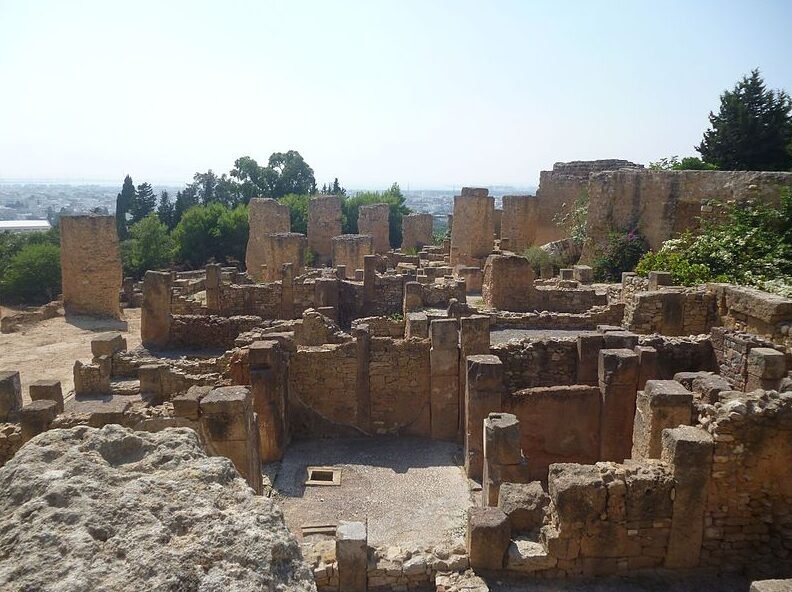
Archaeological site in Carthage.
Masinissa’s Encroachments
Masinissa exploited Carthage’s vulnerability, continuously raiding its territories. His actions tested Carthage’s patience, forcing it to choose between submission and defiance. By 149 BC, tensions escalated to open conflict when Carthage, in violation of its treaty with Rome, sent an army led by Hasdrubal to confront Masinissa.

Battle of Oroscopa
Hasdrubal commanded Carthage’s forces during the campaign against Masinissa in 149 BC. However, the campaign ended disastrously for Carthage at the Battle of Oroscopa. Hasdrubal’s army suffered a crushing defeat, and he surrendered his forces to Masinissa. This failure not only underscored Carthage’s declining military capabilities but also provided Rome with a pretext to intervene, marking the start of the Third Punic War.
Siege of Carthage (149–146 BC)
Despite his earlier defeat, Hasdrubal resurfaced as the primary Carthaginian commander during the Siege of Carthage, the culminating event of the Third Punic War. Under his leadership, the city mounted a formidable resistance against Roman forces led by Scipio Aemilianus.
Hasdrubal demonstrated considerable organizational skills, overseeing the training and equipping of Carthaginian defenders. His efforts turned Carthage into a well-fortified bastion that resisted Roman assaults for three years. While his tactical abilities were commendable, they ultimately fell short against Scipio’s superior strategy and resources.
The Fall of Carthage and Hasdrubal’s Fate
In 146 BC, Carthage fell after a prolonged and devastating siege. Hasdrubal surrendered to Scipio Aemilianus, marking the definitive end of Carthaginian resistance. Despite his earlier efforts to delay Roman victory, Hasdrubal’s capitulation underscored the inevitability of Carthage’s defeat.
According to the historian Polybius, Hasdrubal’s surrender was accompanied by a harrowing personal tragedy. His wife, distraught and outraged by his perceived cowardice, cursed him publicly before killing their two sons and throwing their bodies into a burning temple. She then leaped into the flames herself, a dramatic act symbolizing Carthage’s ultimate downfall.
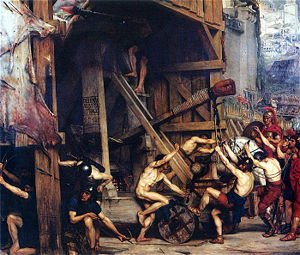
A Roman siege engine in action during the siege of Carthage in the Third Punic War.
Carthaginian general Hasdrubal’s defeats, while significant, were not solely due to personal shortcomings but rather the overwhelming geopolitical forces arrayed against Carthage.
Unlike many other Carthaginian leaders, Hasdrubal’s life was spared. He was paraded as a captive in Scipio’s triumphal procession in Rome but later allowed to live out his days in peace in Italy. This unusual clemency suggests Roman recognition of his role as a capable, albeit defeated, leader.\
Assessment of Hasdrubal’s Legacy
Hasdrubal’s career highlights the challenges faced by Carthage during its final years. While he showed skill in organizing and leading defenses, his defeats at Oroscopa and Carthage underscore the overwhelming advantages held by Rome and its allies.
His legacy is also colored by the tragic end of his family, a potent symbol of the destruction wrought by the Third Punic War. Despite his failures, Hasdrubal remains a significant figure in Carthaginian history as one of its last military leaders.
Frequently Asked Questions about General Hasdrubal
What does the title “Boetharch” mean?
The exact function of “Boetharch” is unclear, but it may derive from the Greek “boēthós” meaning “auxiliary,” implying a leadership role in Carthage’s mercenary armies.
What caused the conflict between Carthage and Masinissa of Numidia?
Masinissa, a Roman ally, raided Carthaginian lands, exploiting Carthage’s inability to wage war without Roman permission under the post-Second Punic War treaty.
What happened at the Battle of Oroscopa (149 BC)?
Hasdrubal led a Carthaginian army against Masinissa in defiance of Rome but was defeated and surrendered, marking a significant failure for Carthage.
What role did Hasdrubal play during the Siege of Carthage (146 BC)?
Hasdrubal commanded Carthaginian forces, demonstrating military skill in organizing a strong defense, though ultimately losing to Roman proconsul Scipio Aemilianus.
How did Hasdrubal’s wife react to his surrender?
According to Polybius, she cursed him, killed their sons, and set herself on fire in a burning temple, refusing to accept Roman captivity.
What was Hasdrubal’s fate after the Third Punic War?
Captured by the Romans, Hasdrubal was displayed in Scipio’s triumph but later allowed to live peacefully in Italy.
Is Hasdrubal connected to other defeats during the war?
He may be the same general defeated near Tunes (modern Tunis) by Masinissa in the early stages of the Third Punic War.





