Trade in Ancient Carthage
Trade in ancient Carthage was undoubtedly a cornerstone of the ancient Mediterranean economy. It was both extensive and complex, reaching far beyond the boundaries of the city-state of Carthage itself....
Ancient Carthage was a powerful and influential Phoenician city-state located on the coast of modern-day Tunisia in North Africa.
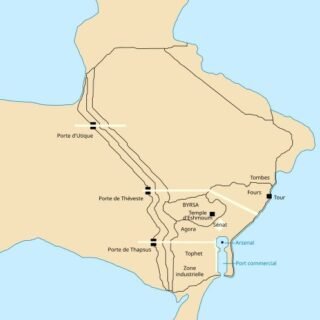
Carthage was founded by Phoenician settlers from the city of Tyre (in modern-day Lebanon) around the 9th century BC. According to legend, Queen Dido was its founder. The city’s location was strategic for trade, given its position in the central Mediterranean, allowing it to serve as a hub for maritime commerce.
Carthage prospered primarily due to its robust trade networks, which stretched across the Mediterranean. The Carthaginians became particularly known for their naval prowess. Additionally, they established colonies and trading outposts throughout the Mediterranean in regions like Sicily, Sardinia, and the Iberian Peninsula.
The North African city is perhaps best known for its series of conflicts with Rome, known as the Punic Wars (264-146 BC). These wars ended with the complete destruction of Carthage by Rome in 146 BC during the Third Punic War.
One of the most notable figures from Carthage was the military commander Hannibal, who during the Second Punic War, famously led an army, complete with war elephants, over the Alps to attack Rome.
The Carthaginians practiced a polytheistic religion with influences from their Phoenician roots. Their pantheon included deities such as Baal and Tanit. Some ancient sources suggest that they practiced child sacrifice, but this claim is a matter of debate among historians.
Despite initial successes in the Punic Wars, Carthage could not withstand the rising power of Rome. After their defeat in the Third Punic War, the city was razed, its inhabitants sold into slavery, and Roman legends say the ground was salted to ensure nothing would grow there again.
Though Carthage was destroyed, its legacy lived on. Eventually, the Romans founded a new city on the site, also called Carthage, which became a major city in the Roman Empire. The ruins of both Punic and Roman Carthage can still be seen today in Tunisia.
There is no doubt whatsoever that Carthage was one of the ancient Mediterranean’s most powerful states, remembered for its rich maritime trade, its conflicts with Rome, and its indelible impact on the history of the region.
Trade in ancient Carthage was undoubtedly a cornerstone of the ancient Mediterranean economy. It was both extensive and complex, reaching far beyond the boundaries of the city-state of Carthage itself....

The Punic Wars were a series of fierce ancient conflicts between Rome and Carthage, spanning nearly a century. These monumental battles shaped the Mediterranean world, leading to Carthage’s downfall and...

On a summer’s day in 202 BC, Roman forces and their Carthaginian counterparts met on the open fields of Zama (located in modern-day Tunisia) to wrestle each other for supreme...

Legend has it that Dido, who was a princess of Tyre, fled her home to establish her own city named Carthage (in modern-day Tunisia) around 814/3 BC. Apart from being...





