Why did Lord Shiva carry the Ganges River on his head?
In Hindu mythology and religion, it’s believed that the Ganges descended from the heavens, and its force was so immense that it could destroy the Earth. Lord Shiva agreed to...
Lord Shiva, one of the principal deities of Hinduism, occupies a unique and revered position in the pantheon.
He is part of the Holy Trinity or Trimurti, alongside Lord Brahma, the creator, and Lord Vishnu, the preserver.
Shiva is often characterized as the destroyer, but his role is far more multifaceted, encompassing concepts of regeneration, meditation, and even asceticism.
Shiva’s roots can be traced back to the ancient Vedic texts, though his characterization in them differs from the Shiva worshipped today.
In modern depictions, Shiva is shown with a blue throat, a consequence of consuming the poison Halahala during the churning of the ocean. He typically has three eyes, with the third eye on his forehead symbolizing inner vision and spiritual insight.
Often, he is depicted with a crescent moon on his head, signifying the passing of time. The flowing Ganges river, believed to originate from his hair, is a testament to his divine power to control and channel destructive forces.
One of Shiva’s most celebrated forms is Nataraja, the cosmic dancer. In this form, he performs the Tandava, a dance that both creates and destroys the universe. The dance signifies the cyclic nature of creation and destruction, representing the dynamic forces of the cosmos.
Shiva embodies paradoxes. He is an ascetic, often depicted meditating on Mount Kailash, yet he is also a householder, married to Goddess Parvati with two children, Lord Ganesha and Lord Kartikeya. His duality showcases the balance of asceticism and worldly duties, a harmony of detachment and attachment.
Shiva is often worshipped in the form of a Lingam, a symbolic representation of divine generative energy. The Lingam, usually a cylindrical stone, is set on the Yoni, symbolizing the union of masculine and feminine divine energies. Together, they represent the totality of creation. Temples dedicated to Shiva can be found throughout India, with the Jyotirlingas being the most prominent.
While Shiva is termed the ‘destroyer,’ this shouldn’t be taken in a solely negative context. His destruction is essential for recreation. Without ending the old, the new cannot emerge. It’s a cycle of death and rebirth, decay, and renewal. Just as trees shed old leaves to make way for new ones, Shiva’s destructive force is a necessary component of the eternal cycle of existence.
Shiva’s tales often revolve around his interactions with other gods, goddesses, and demons. His marriage to Parvati, after the self-immolation of his first wife Sati, is a central narrative. The stories of his children, especially the beloved elephant-headed Ganesha, are also widely celebrated. Furthermore, tales of his confrontation with demons like Tripurasura showcase his power and might.
Several symbols are associated with Shiva. The trishul or trident represents the trinity of life – birth, life, and death. His drum, the damaru, symbolizes the rhythm of the cosmos. Serpents draped around him signify his mastery over desires and the material world. Finally, the tiger skin he sits on denotes victory over every force.
The story of Lord Shiva carrying the Ganges River on his head is deeply rooted in Hindu mythology and conveys profound spiritual and philosophical meanings.
Here’s a brief rendition of the tale:
Symbolism:
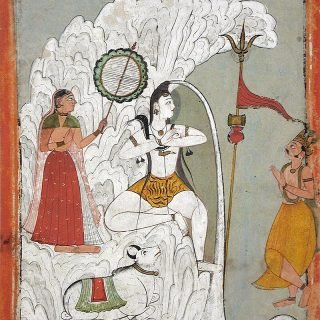
In Hindu mythology and religion, it’s believed that the Ganges descended from the heavens, and its force was so immense that it could destroy the Earth. Lord Shiva agreed to...





