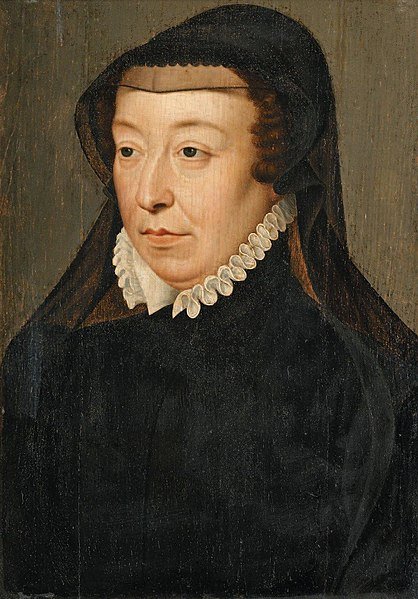
Catherine de’ Medici
Catherine played a pivotal role as Queen of France and later as regent for her sons. She was a key political figure during a time of intense civil and religious conflict, striving to maintain Valois rule amidst the Wars of Religion.
Early Life and Marriage
Catherine de’ Medici was born on April 13, 1519, in Florence, Italy, into the powerful Medici family. Her parents, Lorenzo de’ Medici, Duke of Urbino, and Madeleine de La Tour d’Auvergne, both died within weeks of her birth, leaving her an orphan. Pope Leo X, a Medici himself, ensured that she was raised in Florence. However, her life took a dramatic turn when Pope Clement VII, another Medici relative, arranged her marriage to Henry, Duke of Orléans, the second son of King Francis I of France, in 1533. This marriage was a strategic alliance designed to strengthen ties between France and the Papacy.
Despite her noble heritage, Catherine’s status at the French court was uncertain, especially as she struggled to produce an heir. Her husband, Henry, largely ignored her in favor of his mistress, Diane de Poitiers. For ten years, Catherine remained childless, fueling rumors of a possible annulment. However, she eventually gave birth to ten children, securing her position as queen consort.
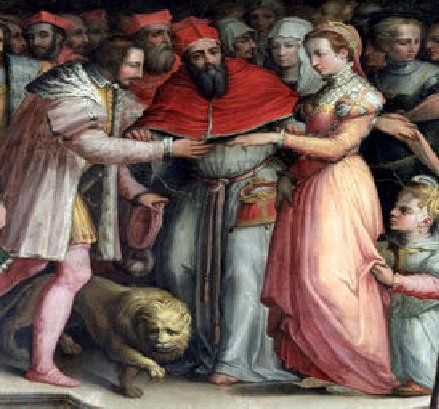
A painting of Catherine and Henry’s marriage, created seventeen years after the event.
Queen of France
Catherine became Queen of France in 1547 when Henry ascended the throne as Henry II. However, her role remained largely ceremonial as Henry continued to favor Diane de Poitiers in political matters. Catherine’s influence at court grew only after Henry’s death in 1559, following a jousting accident. The death of her husband left their eldest son, Francis II, as king, but his frail health made Catherine the de facto ruler.
Regency and Political Influence
After the untimely death of Francis II in 1560, Catherine was named regent for her ten-year-old son, Charles IX. Her political acumen and determination ensured the survival of the Valois dynasty during one of France’s most turbulent periods. Catherine’s ability to navigate the dangerous waters of religious conflict and civil war earned her a reputation as one of the most influential figures in European history.
As queen consort, regent, and queen mother, Catherine de’ Medici wielded significant influence over France during one of its most chaotic periods.
Despite her attempts at reconciliation, she was often criticized for her handling of the French Wars of Religion. Initially, she sought to mediate between the Catholic majority and the Protestant Huguenots, but as tensions escalated, she resorted to harsher measures. This culminated in her alleged involvement in the St. Bartholomew’s Day Massacre of 1572, where thousands of Huguenots were killed. Although her exact role remains debated, her reputation suffered greatly from the event.
Catherine’s Role Under Henry III
When Charles IX died in 1574, his brother Henry III ascended the throne. By this time, Catherine’s political influence had begun to wane, though she continued to advise her son. Henry III struggled to maintain control over the increasingly fractious nobility, and Catherine often acted as a mediator between rival factions.
Despite her efforts, the Catholic League, led by the Duke of Guise, posed a significant threat to Henry III’s reign. The assassination of the Duke of Guise in 1588 further destabilized the kingdom, and Catherine, who had always sought balance, found herself powerless to prevent the ensuing chaos. She died on January 5, 1589, just months before Henry III was also assassinated, marking the end of Valois rule in France.
The Patron of Arts and Architecture
Catherine de’ Medici was a great patron of the arts, heavily influencing French culture. Inspired by her Medici heritage, she brought Italian artistic traditions to France and commissioned numerous works, including the construction of the Tuileries Palace in Paris. She also played a crucial role in the development of ballet, sponsoring elaborate court performances that laid the groundwork for the future of French dance.
Her interest in astrology and architecture extended to the design of chateaus and gardens, many of which showcased intricate Renaissance influences. The patronage of artists, musicians, and architects under Catherine’s reign significantly shaped French artistic identity.
Legacy and Controversy
Catherine de’ Medici remains a controversial figure in history. Some historians view her as a pragmatic ruler who navigated France through an era of extreme turbulence, while others see her as a ruthless schemer who prioritized political power above all else. The St. Bartholomew’s Day Massacre remains one of the darkest marks on her legacy, often overshadowing her efforts to maintain the Valois dynasty and stabilize France.
Though often vilified, Catherine de’ Medici’s ability to maintain power in an era of civil strife speaks to her formidable political skills.
Despite the controversies, Catherine’s influence on France’s political and cultural landscape was undeniable. Her children, particularly Henry III, depended on her counsel, and without her, the Valois dynasty may not have lasted as long as it did. Her patronage of the arts left a lasting impact, helping to shape the grandeur and sophistication of French culture during the Renaissance.
Frequently Asked Questions
How did Catherine de’ Medici influence the French Wars of Religion?
Initially, she pursued a policy of religious compromise but later resorted to repression, including suspected involvement in the St. Bartholomew’s Day Massacre (1572), which led to mass killings of Huguenots.
What was her relationship with her husband, Henry II?
Henry II largely sidelined Catherine in favor of his mistress, Diane de Poitiers, who held significant influence over him. Catherine only gained political power after Henry’s death in 1559.
How did Catherine secure her family’s hold on the French throne?
She orchestrated political marriages, navigated shifting alliances, and used her influence to maintain her sons on the throne despite the Valois dynasty’s instability.
Was Catherine de’ Medici responsible for the St. Bartholomew’s Day Massacre?
Historians debate her exact role. While she likely supported action against Huguenot leaders, the scale of violence was beyond her control. Her reputation as a ruthless politician stems in part from this event.
What impact did Catherine have on the arts?
She was a major patron of Renaissance culture in France, commissioning grand architectural projects, promoting ballet, and supporting artists like François Clouet and Antoine Caron.
What was her relationship with the Catholic League?
Initially wary of the ultra-Catholic League, she later supported it under pressure, but ultimately failed to control its leader, the Duke of Guise, who became a powerful rival to the crown.
How did Catherine de’ Medici die, and what was her legacy?
She died in 1589, likely of pleurisy. Her death marked the decline of the Valois dynasty, with her last surviving son, Henry III, assassinated shortly afterward, leading to the rise of the Bourbon monarchy.





