Charon: The Boatman of the Underworld in Greek mythology
Charon, the ferryman of the dead in Greek mythology, is one of the most enduring figures associated with the Greek concept of the afterlife. His role as a psychopomp—a guide for souls—places him at the heart of the mythological process that transports the deceased from the world of the living to the world of the dead.
Charon’s character, both in terms of mythological function and literary representation, embodies the Greek view of death as a passage into the unknown, filled with rites and customs meant to ensure the safe journey of the soul to its final resting place.

Charon is the ferryman of the Underworld, responsible for transporting the souls of the deceased across the rivers Acheron and Styx, which separate the living from the dead. Image: Charon carries souls across the river Styx by Russian painter Alexander Dmitrievich Litovchenko.
READ MORE: Most Famous Psychopomps from around the World
Origins and Etymology
Charon’s name is derived from the Greek word charon, a poetic form of charopós, meaning ‘keen gaze’ or ‘fierce eyes.’ This association with sharp or intense vision suggests that Charon may have been imagined as a figure who could see through the veil of death, guiding the souls of the departed with a gaze that penetrated the darkness of the Underworld.
However, the exact etymology of Charon’s name remains uncertain. Some sources believe his name might be a euphemism for death itself, reflecting the mysterious nature of his role.
The ancient historian Diodorus Siculus speculated that Charon’s name and role were imported from Egyptian mythology, though this theory has been largely dismissed by modern scholars.
In Greek mythology, Charon first appears in the epic poem Minyas, which dates to the 6th century BC. This poem includes a description of a descent to the Underworld, introducing Charon as a key figure in guiding souls across the river that separates the living from the dead. Despite his early appearance in literature, ancient sources provide little in the way of a detailed genealogy for Charon.
Some accounts suggest that he was the son of Akmon, though this claim is considered dubious. Renaissance writers like Giovanni Boccaccio later tried to link Charon to Chronos, the god of time, due to their similar names and associations with old age, but this connection lacks substantial historical basis.

Ferryman Charon departs with the soul of the deceased. Fresco from an ancient Lucanian tomb.
Role in Greek Mythology
In Greek mythology, Charon’s primary function is to ferry souls across the rivers Acheron or Styx, which divide the world of the living from the realm of the dead.
His role is that of a psychopomp, a figure who escorts souls to the afterlife. Charon’s service is reserved for those who have been properly buried or cremated and provided with the necessary payment—typically a coin, often referred to as Charon’s obol. This coin was traditionally placed in or on the mouth of the deceased during burial, a practice confirmed by archaeological evidence.
The obol was a form of fare, meant to ensure that the dead could afford the journey to the afterlife. Without this payment, the souls of the dead were said to be stranded on the banks of the river for 100 years, unable to cross into the realm of Hades.
In Virgil’s Aeneid, those who lacked payment or proper burial were condemned to wander the shores of the Styx for a hundred years before being allowed to cross.
The two rivers most commonly associated with Charon are Acheron and Styx. The Acheron, often referred to as the “River of Woe,” was the more common river mentioned in Greek sources, including those by poets like Pindar, Aeschylus, and Plato.
The Styx, known as the “River of Hate,” is also associated with the Underworld, especially in Roman adaptations of the Greek myths. Virgil, in his epic Aeneid, associates Charon with both the Acheron and Styx, emphasizing his role as the ferryman of the dead. This blending of rivers in later Roman literature suggests that Charon’s role transcended specific geographic or mythological boundaries, solidifying his position as the universal guide for the dead.
READ MORE: The Five Rivers of the Greek Underworld
Charon’s Appearance in Art and Literature
Charon’s depiction in Greek art reflects his somber and sometimes menacing nature. In early depictions, such as those found on 5th and 4th-century BC Attic funerary vases, Charon is portrayed as a rough, unkempt figure, resembling a common Athenian boatman.
Dressed in reddish-brown garments, he holds a ferryman’s pole in his right hand while extending his left to receive the souls of the dead. Hermes, in his role as a psychopomp, is often depicted standing nearby, assisting Charon in escorting the deceased to the Underworld.
As Greek art evolved, Charon’s appearance became less crude. On later vases, he is portrayed with a more refined and kind demeanor, reflecting a shift in how the Greeks conceptualized death. Rather than a fearsome figure, Charon became a necessary, if somber, part of the natural order—a figure whose role was to facilitate the passage of souls in a dignified manner.
In literature, Charon’s presence is most notably recorded in Roman works, particularly Virgil’s Aeneid. In Book 6, Virgil describes Charon as an old and grim figure, with a lengthy, unkempt beard and fiery, hollow eyes. Virgil’s Charon is both terrifying and pitiable, manning his rust-colored skiff across the Underworld’s rivers. This portrayal emphasizes Charon’s otherworldly nature and the inevitability of his role in guiding the souls of the dead.
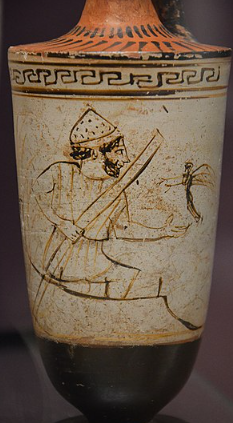
Charon also plays a significant role in stories where he ferried living mortals, such as Heracles and Aeneas, into and out of the Underworld, underscoring his vital role as a psychopomp guiding souls in their transition from life to death. Image: Attic red-figure lekythos by the Tymbos painter depicting Charon welcoming a soul into his boat, c. 500–450 BC.
Seneca, in his tragedy Hercules Furens, adds to Charon’s literary character by depicting him as an aged and fierce boatman with haggard cheeks and a long pole to guide his boat. When Heracles demands passage across the river, Charon resists, but the hero overpowers him, using the boatman’s own pole to force his way into the Underworld.
The 2nd-century satirist Lucian also included Charon in his Dialogues of the Dead, further developing Charon as a literary figure. Lucian’s portrayal is somewhat more light-hearted, depicting Charon in humorous dialogues that highlight the absurdity and inevitability of death.
During the Middle Ages, Dante Alighieri’s Divine Comedy brought Charon into Christian literary tradition, particularly in the Inferno, where he is the first mythological character Dante encounters in the underworld. Dante’s depiction of Charon echoes Virgil’s, describing him as a stern, old man with eyes of fire. Charon’s task in Dante’s Inferno is to ferry the damned souls across the river Acheron into Hell, reinforcing his association with death and the afterlife. Charon’s fiery eyes in Dante’s work became a lasting image of the ferryman, influencing later artistic depictions, including those by the French artist Gustave Doré and the Flemish painter Joachim Patinir.
Charon in Etruscan Mythology
A figure similar to Charon appears in Etruscan mythology under the name Charun. Although their names are alike, Charun differs from the Greek Charon in both origin and function. The Etruscan Charun was a violent and fearsome psychopomp who escorted the souls of the dead to the afterlife, often by horseback or chariot. Depicted with wings, a vulture’s beak, and a large hammer, Charun’s role was to “mercilessly pummel” the dead, reflecting a more brutal version of death’s transition.
Unlike the Greek Charon, who is largely neutral in his role as the ferryman, the Etruscan Charun represents a more active and aggressive force of death. Charun’s hammer, in particular, symbolizes his authority over the dead, and he is often shown wielding it in art to terrorize or punish the souls under his care. This distinction between Charon and Charun highlights the differences in how the Greeks and Etruscans conceptualized death and the journey to the afterlife.
Rivers of the Underworld
Charon’s role as the ferryman is deeply connected to the geography of the Greek and Roman Underworld. In most Greek sources, Charon is associated with the Acheron, the “River of Woe,” which Pindar, Aeschylus, and Plato mention as the river over which the dead must be ferried. The Acheron is portrayed as a dismal and mournful river, reflecting the sorrow and loss that accompanies death.
Roman poets, particularly Ovid, Propertius, and Statius, often associate Charon with the river Styx, the “River of Hate.” This shift in river associations may have been influenced by Virgil’s depiction of the Underworld in the Aeneid, where both the Acheron and Styx play significant roles. The Styx is famous not only as a river of the dead but also as the river by which the gods swear their most solemn oaths. Swearing by the Styx was considered binding and unbreakable, and the gods feared violating such oaths due to the severe consequences.
Despite these differing river associations, Charon’s function remains consistent—he ferries souls across the boundary between life and death, guiding them into the realm of Hades. His boat represents the passage from one state of being to another, marking the finality of death in Greek and Roman mythology.
Modern Depictions and Legacy
Charon’s influence extends far beyond the classical world, permeating modern culture in various forms. His image, often merged with the Grim Reaper, has become symbolic of death and the inevitable passage to the afterlife. In modern depictions, Charon is frequently shown as a skeletal figure in a hooded cloak, a visual association that draws from both his ancient role and the imagery of the Reaper.
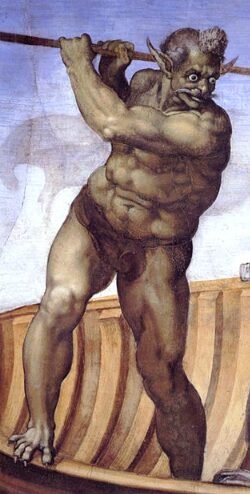
Image: Charon as depicted by Michelangelo in his fresco The Last Judgment in the Sistine Chapel
In addition to his role in art and literature, Charon’s name has also been commemorated in modern astronomy and paleontology. The largest moon of the dwarf planet Pluto, discovered in 1978, was named Charon, fitting with Pluto’s connection to the Greek god of the Underworld. Similarly, the dinosaur Charonosaurus was named after Charon when it was discovered along the banks of the Amur River, a nod to the ferryman’s mythological association with waterways.
Frequently Asked Questions
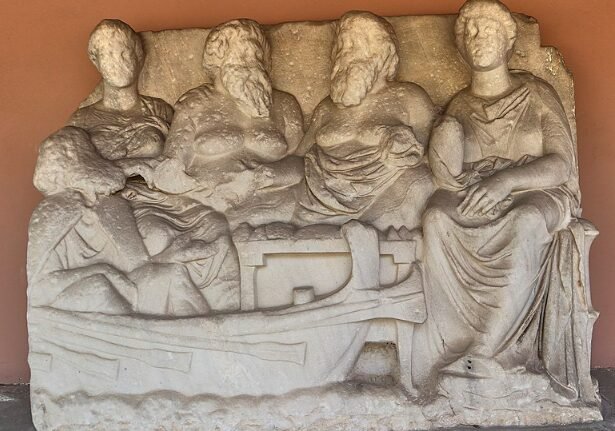
Charon’s name is derived from the Greek word charon, a poetic form of charopós, meaning ‘keen gaze’ or ‘fierce eyes.’ This may symbolize the anger or intense demeanor often associated with him in mythology, though the exact etymology is uncertain. Image: Image: Charon and his boat on a funerary relief, ca 320s BC, Kerameikos Archaeological Museum, Athens, Greece.
When does Charon first appear in Greek mythology?
Charon first appears in Greek mythology in the epic poem Minyas from the 6th century BC, which describes a journey to the underworld.
Is there any genealogy provided for Charon?
Charon’s genealogy is largely ambiguous. One reference claims him to be the son of Akmon, though this is considered dubious by scholars. During the Renaissance, Giovanni Boccaccio linked Charon to the god of time, Chronos, due to similarities in their names and associations with age.
How was Charon depicted in ancient Greek art?
In ancient Greek art, Charon was typically depicted on funerary vases, guiding the dead across the river in his boat. He appeared as a rugged, unkempt seaman in earlier depictions but later was portrayed with a more refined demeanor.
How does Charon appear in Roman literature, particularly in Virgil’s Aeneid?
In Virgil’s Aeneid, Charon is described as a grim figure with fiery eyes and a filthy appearance, steering his boat across the underworld’s river. He plays a significant role in Aeneas’s descent to the underworld.
How did the 1st-century playwright Seneca depict Charon?
Seneca, in his play Hercules Furens, described Charon as a fierce, shabby boatman, who is overpowered by Heracles when the hero forces his way into the underworld.
In which other literary works does Charon appear?
Charon is featured in Lucian’s Dialogues of the Dead in the 2nd century AD, and Dante’s Divine Comedy, where he transports souls across the Acheron in the Inferno. Artists like Michelangelo and Gustave Doré have visualized Charon, often drawing on Dante’s depiction.
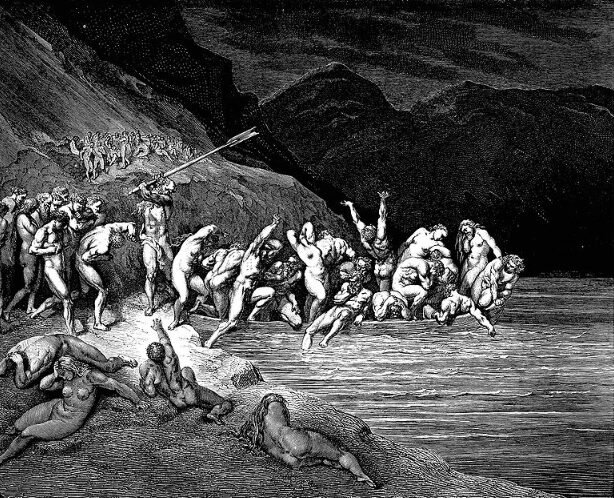
In the Divine Comedy, Charon drives reluctant sinners onto his boat by striking them with his oar. (French artist Gustave Doré, 1857).
Who is Charun in Etruscan mythology, and how does he differ from Charon?
Charun is an Etruscan death-demon who, despite the similar name, differs from Charon. Charun is a violent psychopomp who delivers the dead to the afterlife, often depicted with wings, a hammer, and a fearsome appearance, in contrast to Charon’s more passive role as a ferryman.
What rivers is Charon associated with in Greek and Roman mythology?
In Greek mythology, Charon is traditionally associated with the river Acheron, as mentioned by sources like Pindar and Plato. However, Roman poets such as Ovid and Virgil associate him with the river Styx, possibly influenced by Virgil’s depiction of the underworld.

Image: Charon, with punt pole, stands in his boat as Hermes Psychopompos leads a deceased woman. Thanatos Painter, circa 430 BC.





