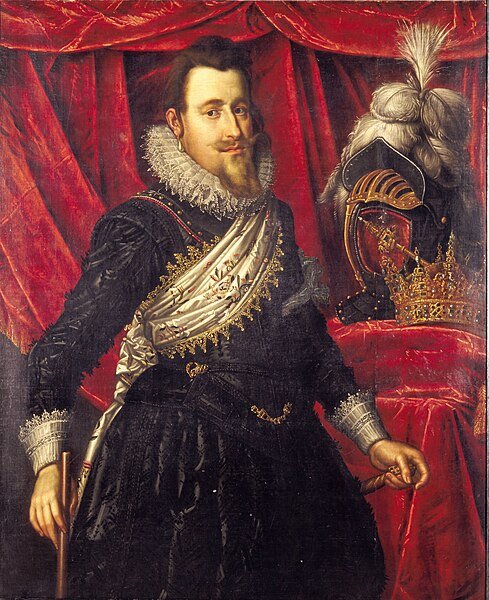
A portrait of Christian IV, painted by Danish artist Pieter Isaacsz.
Christian IV, who ruled Denmark-Norway from 1588 to 1648, remains one of Scandinavia’s most well-known and longest-reigning monarchs. His reign spanned nearly six decades, a period marked by military engagements, economic advancements, and cultural developments. A member of the House of Oldenburg, Christian IV embarked on numerous projects to modernize his kingdom, expand trade, and fortify its defenses. Despite his ambitious vision, his military campaigns, particularly in the Thirty Years’ War, ultimately weakened Denmark’s power in Europe.
Early Life and Ascension to the Throne
Christian IV was born on April 12, 1577, at Frederiksborg Castle in Denmark. He was the eldest son of King Frederick II and Queen Sophie of Mecklenburg-Schwerin. Although Denmark was an elective monarchy, he was designated as the heir in 1580, ensuring the continuation of the union between Denmark and Norway.
When his father died in 1588, Christian was just ten years old, too young to assume direct rule. A regency council, led by Chancellor Niels Kaas, governed the kingdom in his stead. His mother, Queen Sophie, attempted to exert influence over state affairs but was sidelined by the council. Christian was given a robust education at Sorø Academy, where he displayed intelligence and leadership potential.
In 1596, at the age of 19, Christian IV was officially crowned King of Denmark and Norway. His coronation was marked by an elaborate ceremony in Copenhagen’s Church of Our Lady. As was tradition, he signed a haandfæstning, a document restricting the monarchy’s power, similar to the Magna Carta. This agreement ensured that the Danish nobility retained influence over governance.

The coronation of King Christian IV on August 29, 1596, depicted in a history painting by Danish realist Otto Bache, 1887.
Christian IV’s Ambitious Reforms
One of Christian IV’s foremost goals was strengthening Denmark’s military. He expanded the Royal Dano-Norwegian Navy from 22 to 60 ships and constructed modern fortifications with the help of Dutch engineers. However, his efforts to establish a standing army proved difficult, forcing him to rely on mercenaries.
Christian IV pursued a mercantilist economic policy, establishing trading cities and encouraging commerce. He founded several towns, including Glückstadt and Kristiansand, to enhance trade and secure Danish dominance in key regions. Additionally, he sought to increase revenues by raising tolls on the Øresund, a decision that later provoked tensions with other European powers.
A patron of the arts and architecture, Christian IV was responsible for numerous construction projects. He built Rosenborg Castle, Christian IV’s Chapel at Roskilde Cathedral, and the Rundetårn observatory. His architectural legacy extended to Norway, where he reconstructed Oslo after a devastating fire in 1624, renaming it Christiania (now Oslo).
Foreign Policy and Military Conflicts
Christian IV’s ambition to dominate the Baltic Sea led to conflicts with Sweden. The Kalmar War, fought between Denmark and Sweden from 1611 to 1613, ended with the Treaty of Knäred. Though Denmark retained control over key trade routes, the war’s gains were limited.
Denmark’s involvement in the Thirty Years’ War was a turning point in Christian IV’s reign. Hoping to expand his influence in northern Germany and contain the Holy Roman Emperor’s power, he led an army into the conflict in 1625. However, his forces suffered a devastating defeat at the Battle of Lutter in 1626. Denmark was forced to withdraw from the war in 1629 after signing the Treaty of Lübeck, which prevented further Danish involvement in German affairs.
In 1643, Sweden launched a surprise attack on Denmark, known as the Torstenson War. Christian IV, despite his age and injuries from battle, personally led the Danish fleet in a heroic but ultimately unsuccessful defense. The Treaty of Brömsebro in 1645 resulted in Denmark ceding territories to Sweden, marking a significant loss in the kingdom’s power.
Colonial and Exploration Efforts
Christian IV sponsored multiple expeditions to Greenland between 1605 and 1607 to assert Danish sovereignty and locate lost Norse settlements. These efforts, however, were largely unsuccessful due to poor navigation and harsh Arctic conditions.
In 1618, Christian IV established the Danish East India Company to compete with European colonial powers. He sent Admiral Ove Gjedde to India, resulting in the acquisition of Tranquebar, Denmark’s first overseas colony. Despite high hopes, Danish trade ventures in Asia struggled against competition from the Dutch and English.
The Norwegian Legacy
Christian IV played a significant role in Norway’s development. He visited the country multiple times, founded cities like Kongsberg and Kristiansand, and invested in mining operations. He also strengthened Akershus Fortress and promoted trade in Norwegian territories. However, Norway suffered territorial losses in the Treaty of Brömsebro, as Denmark ceded Jämtland and Härjedalen to Sweden.
Personal Life and Court Intrigues
Christian IV married Anne Catherine of Brandenburg in 1597, with whom he had several children, including his successor, Frederick III. After her death in 1612, he entered into a controversial morganatic marriage with Kirsten Munk, producing numerous offspring. His turbulent relationships and eventual estrangement from Kirsten Munk fueled court scandals.
Beyond his two marriages, Christian IV had multiple mistresses, most notably Vibeke Kruse. His personal life was marked by indulgence, with contemporaries remarking on his excessive drinking and amorous escapades.
Christian IV was heavily involved in Denmark’s witch trials, overseeing the execution of several accused witches, including Maren Spliid in 1641. His belief in witchcraft reflected broader European superstitions of the time.
Decline and Death
Following Denmark’s losses in the Torstenson War, Christian IV’s influence waned. The nobility, led by figures like Corfitz Ulfeldt, took on greater political authority. His health deteriorated, and he became increasingly isolated.
On February 21, 1648, Christian IV was transported to Copenhagen, where he died a week later on February 28. He was buried in Roskilde Cathedral, in the chapel he had commissioned years earlier. His son, Frederick III, succeeded him as King of Denmark-Norway.

Frequently Asked Questions
What were Christian IV’s most significant achievements?
Christian IV modernized Denmark-Norway’s military, expanded trade, founded several cities, including Christiania (Oslo), and initiated major construction projects like Rosenborg Castle and the Rundetårn observatory.
How did Christian IV impact Denmark’s military strength?
He expanded the Royal Dano-Norwegian Navy, built new fortifications, and attempted to establish a standing army. However, his reliance on mercenaries proved costly during his military campaigns.
What role did Christian IV play in the Thirty Years’ War?
He entered the war in 1625 to curb Holy Roman Empire influence but suffered a major defeat at the Battle of Lutter in 1626. The Treaty of Lübeck in 1629 forced Denmark to withdraw from the conflict.
How did the Torstenson War affect Denmark?
Sweden’s surprise attack in 1643 led to Denmark losing Gotland, Jämtland, and other territories under the Treaty of Brömsebro in 1645, weakening Danish control in the Baltic.
What were his contributions to exploration and colonization?
He sponsored Arctic expeditions to Greenland, backed Jens Munk’s voyage to North America, and established Denmark’s first overseas colony in India, Tranquebar, through the Danish East India Company.
What was Christian IV’s influence on Norway?
He founded several Norwegian cities, expanded mining industries, strengthened fortifications, and played a key role in rebuilding Oslo after a fire in 1624, renaming it Christiania.
How was Christian IV’s personal life controversial?
He had two wives, numerous mistresses, and many children, leading to court scandals. His turbulent relationship with Kirsten Munk and his mistress Vibeke Kruse fueled political intrigue.
What is his lasting legacy?
Despite military failures, he is remembered for his cultural patronage, city foundations, and economic reforms, making him one of Denmark-Norway’s most influential and well-known monarchs.





