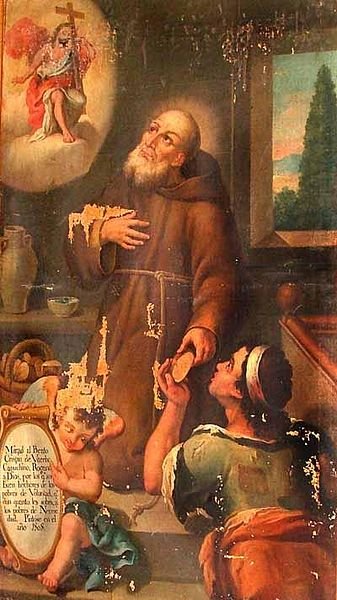
Painting circa 1808
Crispino da Viterbo was an Italian Roman Catholic friar from the Capuchin Order, known for his devotion to the Virgin Mary, piety, miracles, and simple lifestyle.
Early Life and Family
Crispino da Viterbo, born Pietro Fioretti, entered the world on November 13, 1668, in Bottarone, Viterbo, Italy. His parents were Ubaldo Fioretti, a craftsman, and Marzia Antoni, who had a daughter from a previous marriage. Pietro’s father passed away before he turned five, leaving his mother as the primary influence in his early years. She instilled in him a deep devotion to the Virgin Mary, consecrating him to her protection at a Marian shrine in 1674. From then on, Pietro referred to Mary as his “other mother,” a sentiment that shaped his lifelong piety.
Known for his pious demeanor and knowledge of saints, locals nicknamed him “il santarello” or “the little saint.” Pietro’s formal education came under Jesuit guidance, where he developed proficiency in Latin. Following this, he apprenticed with his shoemaker uncle, who also supported his education. Despite his humble origins, Pietro showed signs of spiritual depth and dedication from an early age.
Calling to Religious Life
In 1693, Pietro decided to pursue a religious vocation after witnessing a Franciscan procession that deeply moved him. He sought admission to the Order of Friars Minor Capuchin at their house in Viterbo. Upon being accepted, he adopted the religious name Crispino da Viterbo, marking the beginning of his novitiate on July 22, 1693.
Initially, Crispino served in various practical roles within the order, including as a cook and gardener. His first assignment was at the Capuchin house in Viterbo, followed by a transfer to Tolfa, where he worked as an infirmarian during a local epidemic. During this period, several miraculous healings were attributed to his prayers. From 1694 to 1697, he served in Tolfa, later moving to Rome, Albano, and Bracciano, performing humble duties while inspiring those around him with his dedication.
Devotion to the Virgin Mary
Crispino’s devotion to the Virgin Mary remained a defining feature of his life. While serving in the kitchens at Orvieto in 1710, he created a small altar dedicated to her, reflecting his deep spiritual connection. This Marian devotion extended into his daily life, influencing his prayers, actions, and interactions with others. His room in Orvieto was modest, and his routine reflected an austere commitment to his faith. He meditated early in the morning, attended Masses, and lived simply, often subsisting on vegetable soup or bread dipped in water.
Crispino’s profound humility and unwavering dedication to the Virgin Mary earned him the respect of both the laity and the clergy. His example inspired many to deepen their own faith.
Roles Within the Order
Crispino served in various roles within the Capuchin order, often being transferred between towns to meet the needs of his superiors. In 1703, he was sent to Monterotondo, where he stayed until 1709. His next major assignment was in Orvieto, which became a central chapter in his life. There, he acted as a questor, soliciting alms for the poor. His warm personality and humor endeared him to the townspeople, to the extent that they would only accept him in this role. His approach to his work was marked by humility; he often referred to himself as the “beast of burden” for his order.
Despite his modest station, Crispino became well-known among both commoners and nobles. He was visited by prominent figures, including Pope Clement XI, who sought his counsel and admired his piety. Crispino’s humility extended even to moments of ridicule, as evidenced by his comment when treated poorly by a nun: “Praise God that there is one woman in Orvieto who knows me and treats me as I deserve.”
Miracles and Reputation
Crispino gained a reputation as a wonderworker, with numerous miracles attributed to his intercession during his lifetime. These included healings during the epidemic in Tolfa and other instances where his prayers brought about remarkable outcomes. His life embodied the virtues of simplicity, humility, and service, making him a figure of admiration and inspiration.
Despite his rising fame, Crispino remained deeply humble. He often minimized his actions, seeing himself as a servant of God and his fellow man. His sense of humor and grounded approach to life added to his appeal, making him approachable to people from all walks of life.
Final Years and Death
In his later years, Crispino’s health began to decline. During the winter of 1747, he became seriously ill, but after a brief recovery, he resumed his duties. By May 1750, his condition worsened, prompting his superiors to send him to Rome, where he predicted he would die. On May 19, 1750, Crispino passed away from pneumonia at the Immaculate Conception convent on the Via Veneto in Rome. His final wish was to die after the feast of Saint Felix of Cantalice, a fellow Capuchin and his spiritual role model.
Calls for Crispino da Viterbo’s sainthood began immediately. His body, found incorrupt in 1959, is venerated in the Santa Maria della Concezione dei Cappuccini church in Rome.
Crispino’s remains were interred at the Santa Maria della Concezione dei Cappuccini church in Rome. Remarkably, his body was found to be incorrupt when exhumed in 1959, a testament to his sanctity in the eyes of the faithful.
Path to Sainthood
The process to canonize Crispino began shortly after his death. On September 16, 1761, under Pope Clement XIII, a formal investigation into his life and virtues was opened. His heroic virtue was confirmed in 1796, leading to his declaration as Venerable by Pope Pius VI. On August 26, 1806, he was beatified by Pope Pius VII.
The canonization process gained momentum in the 20th century, culminating in the recognition of a miraculous healing attributed to Crispino’s intercession. This miracle involved the recovery of Rinaldo Crescia in 1950, which was investigated and validated between 1958 and 1960. Medical experts, theologians, and the Congregation for the Causes of Saints all confirmed the event as miraculous. On June 20, 1982, Pope John Paul II canonized Crispino, making him the first saint canonized during his pontificate.
Legacy and Influence
Crispino da Viterbo’s life continues to inspire people worldwide. His unwavering devotion to the Virgin Mary, humility, and dedication to serving others exemplify the virtues of the Franciscan tradition. His incorrupt body remains a site of pilgrimage, drawing the faithful to the church of Santa Maria della Concezione dei Cappuccini in Rome.
Crispino da Viterbo’s journey from a humble craftsman’s son to a canonized saint reflects a life of profound faith and service.
Crispino’s legacy is one of simplicity and joy. He demonstrated that holiness is accessible to all, regardless of one’s social standing or worldly achievements. His example encourages believers to embrace humility, service, and a deep love for God and the Virgin Mary.
Frequently Asked Questions
What was his relationship with the Virgin Mary?
In 1674, his mother consecrated him to the Virgin Mary, whom he called his “other mother.” He later built a small altar dedicated to her while serving in the kitchen at Orvieto.
What roles did Crispino hold in his religious order?
He served as a gardener, cook, infirmarian, and questor in various locations, including Orvieto, Tolfa, Rome, and Albano, becoming a beloved figure in his community.
How was Crispino regarded during his lifetime?
Known for his warm humor, humility, and miracles, Crispino was sought after by nobles, clergy, and even Pope Clement XI for advice and support.
What were his notable habits and lifestyle?
He led an austere life, eating frugally, visiting prisoners and the sick, and often sleeping on rooftops in summer. He referred to himself humbly as a “beast of burden.”
What steps led to Crispino da Voterbo’s canonization?
He was declared Venerable in 1796, beatified in 1806, and canonized by Pope John Paul II on 20 June 1982 after a recognized miracle involving Rinaldo Crescia.
Why is Crispino’s canonization significant?
It marked the first canonization of Pope John Paul II’s pontificate, highlighting Crispino’s enduring legacy of holiness and service.





