Ctesias of Cnidus was a fifth-century BC Greek physician and historian from the city of Cnidus in Caria, an area under the control of the Achaemenid Empire during his lifetime.
Known for his medical service at the Achaemenid court and his historical writings, Ctesias remains a controversial yet fascinating figure. His dual roles as a physician to Persian royalty and a chronicler of history gave him unique insights into the events and cultures of his era. His works, Persica and Indica, offer an intriguing but often debated perspective on the ancient world.
Early Life and Career
Born in Cnidus, a prominent center of medical practice in the ancient Greek world, Ctesias likely received his medical training there. The town was renowned for its association with the Hippocratic school of medicine, and this background may have shaped Ctesias’s expertise. His career took a significant turn when he entered the service of the Achaemenid court, likely attracted by the opportunities presented by Persia’s wealth and influence. This association with the Persian elite gave him access to the inner workings of one of the world’s most powerful empires.
Role in the Achaemenid Court
Ctesias served as the personal physician to Artaxerxes II, one of the key rulers of the Achaemenid Empire. His most famous moment came during the Battle of Cunaxa in 401 BC, where Artaxerxes faced his rebellious brother, Cyrus the Younger. During the battle, Ctesias treated a wound suffered by the king, a task that underscored his close proximity to the center of power.
As a Greek physician serving at the Persian court, Ctesias of Cnidus provided rare insights into Achaemenid politics, culture, and perceptions of foreign lands.
Beyond his medical duties, Ctesias played a role in diplomatic activities. He reportedly negotiated with Greek mercenaries following the battle, reflecting his involvement in the political sphere. His interactions with Clearchus, the Spartan general, further illustrate his engagement with prominent figures of the era. These experiences allowed Ctesias to witness events of immense historical importance firsthand, shaping the narratives he later recorded.
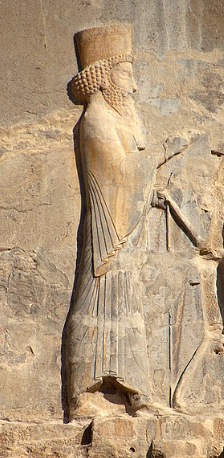
Relief of Artaxerxes II on his tomb at Persepolis, Iran
Ctesias’s Historical Works
Ctesias’s historical writings are his most enduring legacy, though they survive only in fragments and references by later authors. His two major works, Persica and Indica, were ambitious attempts to document the history and culture of the ancient world as observed from the Achaemenid court. These works reflect both his insider perspective and his Greek audience’s expectations, resulting in accounts that are as imaginative as they are informative.
The Persica
The Persica, a 23-book history, is Ctesias’s most significant work. It sought to chronicle the history of Assyria, Babylon, and Persia, offering a narrative that spanned from the rise of the Assyrian Empire to the reign of Artaxerxes II. The first six books dealt with the early history of Assyria and Babylon, culminating in the foundation of the Persian Empire by Cyrus the Great in 550 BC. The remaining 17 books documented events up to 398 BC, including the reigns of notable Persian kings and key political and military events.
The Persica was intended as a counterpoint to Herodotus’s Histories. Ctesias claimed to base his accounts on official Persian records and his experiences at court, presenting an alternative perspective to the widely accepted narratives of Herodotus. However, the reliability of the Persica has been widely debated. Critics point to its discrepancies with archaeological evidence, such as cuneiform inscriptions, and its inclusion of fantastical elements. Despite this, the Persica has been valued for preserving insights into Persian culture and the dynamics of the Achaemenid court.

The Indica
Ctesias’s Indica provided a description of India as perceived through Persian eyes. Unlike the Persica, which focused on historical events, the Indica was more a compilation of geographic, cultural, and ethnographic observations. It included accounts of India’s immense wealth, particularly its gold resources, as well as its people and customs. The Indica also described fantastical elements, such as one-legged individuals and people with feet so large they could be used as umbrellas.
Though often criticized for its implausible claims, the Indica remains a valuable source for understanding how India was mythologized in the ancient world. It reflects the fascination and exaggeration with which distant lands were often portrayed in Greek and Persian literature.
Ctesias’s Legacy and Reception
Ctesias’s works sparked considerable debate among ancient and modern scholars. Ancient commentators like Plutarch, Diodorus Siculus, and Athenaeus used his writings as sources, ensuring their preservation in fragmentary form. However, his contemporaries often criticized his accuracy. The satirist Lucian mocked him in True Story, placing him among those punished in the afterlife for writing “mendacious histories.”
While Ctesias’ works are marred by inaccuracies and fantastical elements, they remain valuable for understanding the complexities of historical writing in antiquity.
Modern historians remain divided over the value of Ctesias’s accounts. While some view his works as an unreliable mix of fact and fiction, others appreciate their unique perspective and narrative richness. His attempt to document Persian history from within the empire offers insights unavailable in Greek-centric accounts, despite their inconsistencies.
Influence on Historiography
Ctesias’s influence extended beyond his lifetime, shaping the works of later historians and writers. His narratives, though contested, provided material for authors like Nicolaus of Damascus and Diodorus Siculus, who incorporated them into their own histories. These subsequent accounts helped preserve fragments of the Persica and Indica, ensuring that Ctesias’s voice continued to inform discussions about ancient history.
Challenges in Interpreting Ctesias
Interpreting Ctesias’s works poses significant challenges due to their fragmentary nature and the biases inherent in his narratives. His position at the Persian court likely influenced his portrayal of events, leading to embellishments and distortions intended to serve his audience or align with Persian perspectives. Moreover, his rivalry with Herodotus may have motivated him to exaggerate or fabricate details to undermine his predecessor’s authority.
Modern scholars must balance these considerations with the recognition that Ctesias’s works provide valuable glimpses into the Achaemenid world and its interactions with Greece. His accounts highlight the complexities of cross-cultural exchange and the challenges of documenting history in an era where myth and fact often intertwined.
Ctesias as a Physician-Historian
Ctesias’s dual identity as a physician and historian is central to his legacy. His medical expertise secured his position at the Persian court, granting him access to the inner workings of one of history’s most powerful empires. This unique vantage point informed his historical writings, blending firsthand observation with narrative creativity. His background as a physician may also explain his interest in ethnographic details, as seen in the Indica’s descriptions of India’s people and customs.
Rulers of the Achaemenid Empire: From Cyrus the Great to Artaxerxes V
Frequently Asked Questions

Ctesias of Cnidus is best known for serving as the personal physician to Artaxerxes II of Persia and for his historical works, particularly Persica and Indica, which have been both valued and criticized by scholars. Image: Ctesias was on the Achaemenid side, attending to Artaxerxes II, at the Battle of Cunaxa (401 BC), Jean Adrien Guignet
What role did Ctesias play in the Achaemenid court?
Ctesias served as the personal physician to King Artaxerxes II and attended to him during significant events such as the Battle of Cunaxa in 401 BC, where he treated the king’s injuries. Beyond his medical duties, he also participated in diplomatic negotiations, including discussions with Greek mercenaries and interactions with Spartan general Clearchus.
What is the Persica, and what does it cover?
The Persica is a 23-book historical account by Ctesias. The first six books focus on the history of Assyria and Babylon up to the establishment of the Persian Empire by Cyrus the Great in 550 BC. The remaining volumes detail Persian history up to 398 BC, offering insights into Achaemenid court life and politics. The work survives in fragments through later authors like Diodorus Siculus and Photius.
Why is the Persica considered controversial?
The Persica is controversial due to discrepancies between its accounts and other historical records, such as cuneiform evidence. Critics, including the satirist Lucian, accused Ctesias of fabricating stories. While some valued it for its unique perspective, modern historians often question its reliability compared to Herodotus’s work.
What is the Indica, and what does it describe?
The Indica is a work by Ctesias that documents Persian perceptions of India. It includes descriptions of India’s geography, wealth, and culture, as well as fantastical elements like one-legged people and individuals with umbrella-like feet. Though its accuracy is doubtful, it reflects ancient views of India and highlights its mythical allure.
How did Ctesias’s works differ from those of Herodotus?
Ctesias wrote his histories as a counter to Herodotus, often aiming to provide an alternative narrative of Persian and Indian history. However, his works are criticized for exaggerations and inconsistencies, which sometimes make Herodotus’s accounts appear more reliable by comparison.
What criticisms did ancient commentators have about Ctesias’s writings?
Ancient critics like Lucian ridiculed Ctesias for his alleged fabrications, claiming he wrote “mendacious histories.” Lucian even placed him in a satirical afterlife where liars were punished. This reflects skepticism among contemporaries about the authenticity of his accounts.
What is the historical significance of Ctesias’s works despite their inaccuracies?
Ctesias’s works are significant for preserving details about Persian and Indian culture, as well as providing insight into Greek-Persian relations. Authors like Plutarch and Diodorus Siculus used his writings as sources, ensuring their fragments endured. His narratives also illustrate how history can be shaped by personal context and cultural biases.





