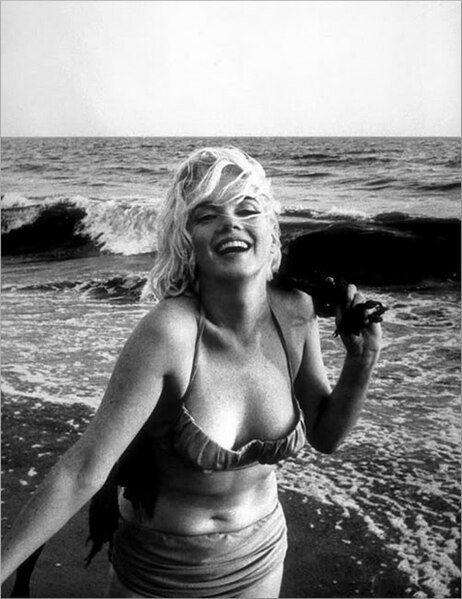
Marilyn Monroe, captured by George Barris in a July 1962 photoshoot for “Cosmopolitan”.
Marilyn Monroe, an American actress and one of the most iconic figures in Hollywood history, died on the evening of August 4, 1962, at the age of 36. Her lifeless body was found in her home at 12305 Fifth Helena Drive in Brentwood, Los Angeles, California, before dawn on August 5.
The official cause of death was determined to be an overdose of barbiturates, and the Los Angeles County coroner ruled it a probable suicide. However, numerous conspiracy theories have emerged over the years, questioning whether her death was an accident, a suicide, or even a murder orchestrated by powerful figures.
Below, WHE examines the events leading to her death, the official investigation, and the various speculations surrounding her demise.
Background
Monroe’s life in the years leading up to her death was marked by professional struggles and personal turmoil. Although she had been one of the most sought-after actresses in Hollywood, her film career had been on a decline. Her last completed film, The Misfits (1961), was a commercial failure, and she faced challenges with her mental health and substance abuse. Monroe’s dependency on prescription drugs, including barbiturates and amphetamines, as well as her struggles with depression and anxiety, contributed to her unstable condition.
By 1962, Monroe was engaged in a troubled production of Something’s Got to Give, a film by 20th Century Fox. Her frequent absences from the set led to her being fired in June, though she was later in negotiations to be rehired. She attempted to repair her public image by giving interviews and making media appearances, including her famous rendition of “Happy Birthday” to President John F. Kennedy in May 1962. Her personal life was equally chaotic, with rumors of affairs involving both John F. Kennedy and his brother Robert F. Kennedy.
Events on August 4, 1962
On the day of her death, Monroe spent time at her Brentwood home with several visitors, including her publicist Patricia Newcomb, housekeeper Eunice Murray, photographer Lawrence Schiller, and psychiatrist Dr. Ralph Greenson. Monroe reportedly had a therapy session with Greenson that evening, after which he instructed Murray to stay overnight to keep her company.
At approximately 3:00 AM on August 5, Murray noticed that Monroe had locked herself in her bedroom and was unresponsive. Looking through a window, she saw Monroe lying motionless. She alerted Greenson, who broke a window to enter the room and found Monroe dead. Dr. Hyman Engelberg, her personal physician, was called to the scene, and the Los Angeles Police Department was notified at 4:25 AM.
Official Investigation and Autopsy
The autopsy was conducted later that day by Deputy Coroner Dr. Thomas Noguchi. The toxicology report revealed high levels of Nembutal (pentobarbital) and chloral hydrate in her system, with amounts far exceeding the lethal dose. No signs of external injury were found, and the lack of residue in her stomach suggested that the drugs had been absorbed into her bloodstream rapidly, leading to speculation that they were administered in a different manner, such as via an enema.
Psychiatrists who reviewed Monroe’s case concluded that her history of depression, coupled with previous suicide attempts and her known struggles with addiction, indicated that her death was likely a suicide. However, no suicide note was found, leaving room for speculation.
Conspiracy Theories and Speculations
Involvement of the Kennedys
One of the most prevalent conspiracy theories suggests that Monroe was murdered due to her alleged affairs with John F. Kennedy and Robert F. Kennedy. Some theorists believe that she had access to sensitive political information and posed a threat to the Kennedy administration. Speculations arose that Monroe had kept a diary containing confidential government secrets, which led to suggestions that she was silenced to prevent a scandal.
Mafia and Political Intrigues
Other theories implicate organized crime figures, including mob boss Sam Giancana and labor leader Jimmy Hoffa, who allegedly had interests in undermining the Kennedy family. The idea that Monroe was a pawn in a larger political power struggle has been widely discussed but remains unproven.
Accidental Overdose
Some researchers believe that Monroe’s death was an accidental overdose, possibly due to a miscalculated or unauthorized administration of medication. Dr. Greenson and Engelberg had reportedly been attempting to regulate Monroe’s drug intake, and there were claims that she had been given an enema containing a lethal dose of barbiturates.
Cover-Up Allegations
In the 1980s, the Los Angeles District Attorney’s office reviewed Monroe’s case due to the growing number of conspiracy claims. The investigation found no credible evidence to support foul play but acknowledged “factual discrepancies” and “unanswered questions.” Some believe that evidence was tampered with or suppressed, further fueling speculation.
Public Reaction and Funeral
Monroe’s death was a global shock, with reports of increased suicide rates in Los Angeles following the news. She was buried on August 8, 1962, at Westwood Village Memorial Park Cemetery in a private ceremony arranged by her ex-husband, Joe DiMaggio. DiMaggio maintained a deep devotion to Monroe, sending roses to her grave three times a week for the next twenty years.
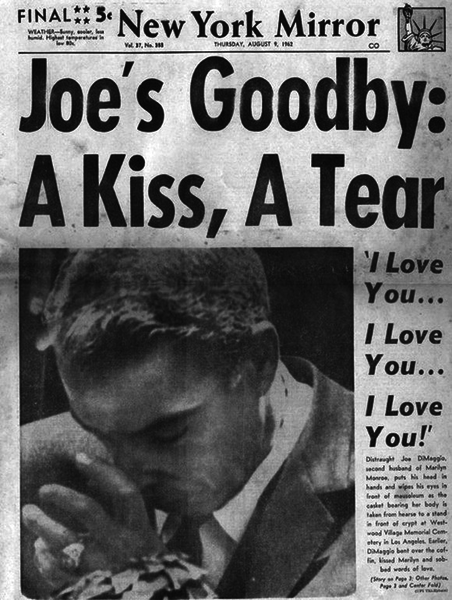
Joe DiMaggio mourning at Marilyn Monroe’s funeral—front page, “New York Daily Mirror”, August 9, 1962.
Legacy and Estate
Monroe left behind a vast cultural legacy. In her will, she allocated portions of her estate to her half-sister, close friends, and her acting coach, Lee Strasberg. Upon Strasberg’s death, his widow took control of Monroe’s estate and capitalized on her image rights, leading to ongoing disputes over ownership and licensing.
Whether an unfortunate accident, an act of self-destruction, or something more sinister, Monroe’s death continues to captivate the public, reinforcing her status as one of the most enigmatic figures of the 20th century.