Deciphering the Ancient Inscriptions in Numidia and Mauretania
Libyan inscriptions in Numidia and Mauretania provide significant insight into the ancient cultures of North Africa.
These inscriptions, found in what is now modern-day Algeria, Tunisia, and Morocco, are some of the earliest written records from the region and offer a glimpse into the linguistic, cultural, and social aspects of the Berber-speaking peoples who inhabited these areas.
Understanding these inscriptions sheds light on the development of written language in North Africa, the interaction of indigenous cultures with foreign influences, and the broader history of the region.
Background and Historical Context
Numidia and Mauretania were two major regions in North Africa during antiquity, corresponding to parts of present-day Algeria, Tunisia, and Morocco. The people inhabiting these areas were predominantly Berbers, an indigenous group with a long history in the region. The term “Libyan” in this context refers to the ancient name for the Berbers or indigenous North Africans as known by the Greeks and Romans.
Libyan inscriptions are written in what is known as the Libyco-Berber script, an ancient writing system that is believed to have developed in the first millennium BCE. It was used primarily by the Berbers of Numidia and Mauretania, though the script’s exact origins remain a matter of debate. The inscriptions are found on stone monuments, tombs, and sometimes pottery, and they vary from brief funerary texts to more extensive commemorations or dedications.
The spread of Libyan inscriptions reflects the cultural and political landscape of Numidia and Mauretania, where indigenous traditions blended with external influences from Phoenician, Roman, and later Arab cultures. These regions experienced various degrees of colonization, which brought with them foreign languages and writing systems, yet the Berbers maintained their own language and script for centuries.
The Libyco-Berber Script
The Libyco-Berber script is a consonantal alphabet, similar to the Phoenician script, and consists of a set of symbols that represent sounds. The exact number of characters in the script varies slightly depending on the region, but it generally consists of about 22 to 25 characters. One of the most interesting aspects of the Libyco-Berber script is its bi-directional writing style. In some inscriptions, the text is written from right to left, while in others it is written from left to right. There are even examples of boustrophedon inscriptions, where the lines alternate direction.
The use of the Libyco-Berber script continued well into the Roman period, long after the Romans had established control over North Africa. This indicates a strong cultural continuity among the Berber-speaking populations, despite the political changes in the region. In fact, the script evolved into what is now known as the Tifinagh script, still in use today among the Tuareg people of the Sahara.
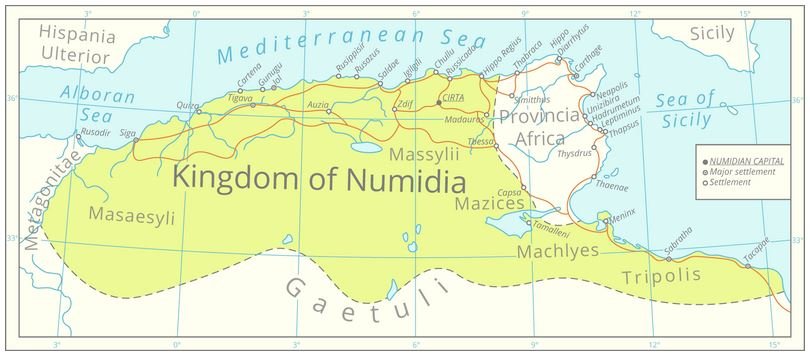
Image: Map of Numidia
Numidia and Mauretania: Political and Cultural Landscape
In the late centuries BCE, Numidia emerged as a powerful Berber kingdom under the leadership of rulers such as Masinissa, who allied with Rome during the Punic Wars against Carthage. After Carthage’s fall, Numidia grew stronger, consolidating power across large portions of North Africa. Libyan inscriptions from this period often commemorate the deeds of kings, noble families, and warriors, reflecting the importance of political and military achievements in Numidian society.
Mauretania, located to the west of Numidia, also had a significant Berber population and shared many cultural similarities with Numidia. The Mauretanian rulers, like their Numidian counterparts, engaged in alliances and conflicts with the Romans, and the region was eventually annexed into the Roman Empire. In both regions, Libyan inscriptions serve as a testament to the resilience of Berber culture in the face of Romanization.
READ MORE: Rise and Fall of Carthage, the Ancient North African Kingdom
Types of Inscriptions
Libyan inscriptions can be classified into several types based on their content and purpose. The most common types include funerary, commemorative, and votive inscriptions. Each type provides valuable insights into different aspects of life in ancient Numidia and Mauretania.
Funerary Inscriptions: These are the most common type of Libyan inscriptions and are often found on tombstones or funerary stelae. They typically include the name of the deceased, their family lineage, and sometimes their achievements or status. Funerary inscriptions are valuable for understanding the social structure of Berber society, as they often indicate the importance of family ties and tribal affiliations. Many inscriptions also include references to the afterlife, suggesting the spiritual beliefs of the people at the time.
Commemorative Inscriptions: These inscriptions celebrate significant events, such as military victories, the construction of public works, or the accomplishments of a ruler. They often highlight the deeds of kings, chieftains, or other important figures in society. Commemorative inscriptions provide insight into the political history of Numidia and Mauretania, as well as the role of leadership in Berber culture.
Votive Inscriptions: Votive inscriptions are offerings made to deities in fulfillment of a vow. These inscriptions are typically found at religious or sacred sites and give us a glimpse into the religious practices of the Berber people. The gods and goddesses mentioned in these inscriptions are often local or regional deities, though some show the influence of Phoenician or Roman religion.
Language and Interpretation
The language of the Libyan inscriptions is an early form of Berber, though the exact linguistic relationship between ancient Berber and modern Berber dialects is still a topic of scholarly research. Deciphering the Libyco-Berber script has been a challenging task for linguists and historians, largely due to the scarcity of bilingual inscriptions that could serve as a Rosetta Stone-like key for translation. However, comparisons with modern Berber languages, along with a handful of inscriptions that include translations into Latin or Punic, have allowed researchers to make progress in understanding the script.
One of the most famous bilingual inscriptions is the “Dougga inscription” from Tunisia, which includes both a Libyan and a Punic text. This inscription has been crucial in helping scholars to decode the Libyan script, as Punic was already a well-known language due to its close relationship with Phoenician. The Dougga inscription, along with other bilingual texts, has provided a foundation for the ongoing study of the Libyan language.
Religious and Cultural Significance
Libyan inscriptions often reflect the religious beliefs and practices of the Berber people. Many inscriptions are associated with sacred sites, such as temples or tombs, and include references to gods, goddesses, and the afterlife. The Berbers had a polytheistic religion, and their pantheon included both local deities and gods borrowed from neighboring cultures, such as the Phoenician god Baal or the Roman goddess Juno.
In addition to religious content, the inscriptions reveal a great deal about the social structure of Berber society. Many of the inscriptions emphasize family lineage and tribal affiliations, indicating the importance of kinship ties in Berber culture. This is particularly evident in funerary inscriptions, where the deceased is often identified by their familial connections, rather than by individual accomplishments.
Influence of Foreign Cultures
Although the Libyan inscriptions are primarily written in the indigenous Libyco-Berber script, they also show the influence of foreign cultures, particularly Phoenician, Roman, and Greek. This is most evident in the bilingual inscriptions, which often include translations into Latin or Punic. These bilingual texts demonstrate the interaction between Berber society and the broader Mediterranean world, as well as the ways in which the Berbers adapted foreign cultural elements to suit their own needs.
The influence of Roman culture is particularly strong in the later inscriptions from Numidia and Mauretania, especially after these regions were incorporated into the Roman Empire. Romanization brought Latin as the dominant administrative language, but many Berbers continued to use the Libyan script for local purposes. This suggests a degree of bilingualism among the Berber elite, who were able to navigate both the Roman and Berber cultural spheres.
Preservation and Archaeological Discoveries
The majority of Libyan inscriptions have been discovered through archaeological excavations in North Africa. Sites such as Dougga in Tunisia, Tipasa in Algeria, and Volubilis in Morocco have yielded numerous examples of Libyan script, often in conjunction with Roman or Phoenician ruins. These inscriptions are typically found on stone monuments, though some examples have been discovered on pottery or other everyday objects.
Preserving these inscriptions has been a challenge, particularly given the harsh climate of the North African desert and the fact that many inscriptions are found in remote or poorly studied areas. However, modern archaeological techniques, including digital imaging and 3D scanning, have helped to preserve and study the inscriptions in greater detail. Ongoing excavations and research continue to uncover new examples of Libyan script, further expanding our understanding of the ancient Berber world.
Questions and Answers

Who was Massinissa, and how was he honored after his death?
Massinissa was the king of Numidia (c. 241–148 BCE). After his death, the people of Dougga (Thugga) built a monument in his honor. The monument features a bilingual inscription, one part in Punic and the other in a script known as the “Libyan” alphabet.

What does the bilingual inscription on the Massinissa monument reveal?
The inscription reveals that the monument was built during the tenth year of the reign of Massinissa’s successor, Micipsa, in 139/8 BCE. It is written in both Punic and the Libyan script, which is composed of geometric shapes such as strokes, circles, and dots.
What is the “Libyan” alphabet, and where has it been found?
The “Libyan” alphabet is an ancient writing system consisting of geometric symbols. It was mentioned by writers like Fulgentius the Mythographer and Corippus. Archaeologists have uncovered more than a thousand Libyan inscriptions throughout North Africa.
Is the Massinissa inscription typical of other Libyan inscriptions?
No, the Massinissa inscription is not typical. Most Libyan inscriptions are much shorter, often limited to phrases like “Here lies X.” Bilingual inscriptions in Libyan-Punic or Libyan-Latin are rare, and the alphabet varies across different regions, making interpretation difficult.

Image: Numidian coins during Massinissa’s time
What challenges do scholars face in deciphering the Libyan inscriptions?
Scholars face several challenges: the Libyan alphabet has regional variations, making it unclear if the same symbol has the same sound everywhere. Dating many inscriptions is problematic, and only the ‘oriental’ group of inscriptions can be deciphered with reasonable certainty.
What language might the Libyan inscriptions be written in?
It is plausible that the Libyan inscriptions were written in an early form of Berber, the indigenous language of North Africa. Berber, also known as Tamazight, consists of various dialects and likely originated in the region.
Why do scholars believe there might be a connection between the Libyan script and the Berber language?
The Tuareg, a nomadic Berber group, use an alphabet similar to the Libyan script, called Tifinagh, to exchange messages. Tifinagh is thought to have evolved from the Punic alphabet, suggesting a possible link between the ancient Libyan script and the Berber language.
The Berber language wasn’t recorded in writing until the Middle Ages, so scholars must rely on reconstructed words rather than authentic ancient Berber. It is uncertain whether these reconstructions accurately reflect the language spoken in Roman-era Numidia or Mauretania.





