
A signage being removed from a street once called “Adolf Hitler-Straße.”
Denazification (German: Entnazifizierung) was an Allied initiative to eradicate Nazi ideology and influence from German and Austrian society following World War II. This process was aimed at purging Nazi members from political, economic, judicial, and cultural life while also ensuring that those responsible for war crimes were brought to justice. The initiative was officially solidified by the Potsdam Agreement of August 1945 and was implemented with varying degrees of strictness across the occupied zones of Germany.
Origins and Objectives
Denazification was first introduced as a legal concept in 1943 by the Pentagon. Initially, it was meant to be a narrow judicial process within post-war Germany. However, the program soon expanded into a broad effort to dismantle all Nazi-associated institutions and ideologies. The key goals of denazification were:
- Political Purge: Removing Nazi officials from government positions.
- Judicial Proceedings: Conducting trials for war criminals, most notably at the Nuremberg Trials (1945–1946).
- Economic Reforms: Breaking up industrial and financial networks that supported the Nazi regime.
- Cultural and Educational Reforms: Removing Nazi ideology from education, literature, and media.
- Rehabilitation of German Society: Re-educating Germans to adopt democratic values.
Implementation Across Different Zones
After Germany’s surrender, the country was divided into four occupation zones: American, British, French, and Soviet. Each zone implemented denazification with distinct approaches and varying levels of rigor.
American Zone
The United States enforced one of the most bureaucratic and stringent denazification programs. The U.S. initially planned for a long-term occupation, believing that German attitudes would take decades to change. A detailed system of classification was introduced, dividing individuals into five categories:
- Major Offenders – Subject to immediate imprisonment or execution.
- Offenders – Those heavily involved with the Nazi regime, sentenced to prison terms.
- Lesser Offenders – Given probation and restrictions on employment.
- Followers – Limited sanctions, often small fines.
- Exonerated Persons – Cleared of Nazi affiliations.
A questionnaire system (Fragebögen) was implemented to assess individuals’ involvement in Nazi activities. However, due to the sheer number of people involved, this process soon became impractical, leading to its relaxation. By 1947, denazification efforts in the American zone were significantly scaled back, shifting responsibility to the Germans themselves.
British Zone
The British initially pursued a strict denazification policy but soon prioritized economic recovery over punishment. Unlike the Americans, who required extensive documentation from all Germans over eighteen, the British only required forms from those seeking employment or official positions. By 1946, denazification was handed over to the Germans, effectively reducing its stringency.
French Zone
The French applied the mildest denazification measures. With a focus on stability rather than retribution, their efforts were inconsistent and lenient. Although some Nazi officials were removed from office, many were quietly reintegrated into society. The French also sought to strengthen ties with Germany for future cooperation, leading to an early termination of denazification policies.
Soviet Zone
Denazification in the Soviet-occupied zone was the most severe and politically driven. The Soviets used denazification as a means to eliminate opposition and implement communist rule. Thousands of suspected Nazis and anti-communists were arrested, and former Nazi lands and businesses were confiscated. Many were sent to internment camps, where conditions were harsh, and high mortality rates were reported. The Soviet government portrayed East Germany as a “true anti-fascist state,” in contrast to West Germany, which they accused of harboring former Nazis.

The Nuremberg Trials and War Crimes Tribunals
One of the most significant aspects of denazification was the Nuremberg Trials, held between 1945 and 1946. High-ranking Nazi officials, including Hermann Göring, Rudolf Hess, and Albert Speer, were tried for war crimes, crimes against humanity, and crimes against peace. These trials aimed to:
- Establish accountability for the Holocaust and other atrocities.
- Publicly expose Nazi crimes to the German and global populations.
- Set a legal precedent for prosecuting future war crimes.
While some Nazis received death sentences or life imprisonment, others were acquitted or received relatively short sentences, leading to criticism of the trials as “victors’ justice.”
Challenges and Controversies
Denazification faced several challenges and criticisms, including:
Resistance from the German Population
Many Germans viewed denazification as unfair collective punishment. As post-war hardships increased, resentment grew toward the occupying powers, particularly in West Germany.
Economic and Political Pragmatism
The onset of the Cold War led the U.S. and Britain to shift priorities. As tensions with the Soviet Union escalated, former Nazis were often reintegrated into society if they were deemed useful for countering communist influence. This was particularly evident in cases like Operation Paperclip, in which German scientists, including Wernher von Braun, were recruited for American military and space programs.
Denazification was a complex and controversial process that sought to cleanse Germany of its Nazi past while also facing political, economic, and social constraints.
Flawed Implementation
The sheer scale of Nazi Party membership (approximately 8 million people) made comprehensive denazification impractical. Many lower-ranking Nazis managed to evade serious consequences, and corruption plagued the process, with some individuals bribing officials to secure favorable classifications.
Disparities Between Occupation Zones
Denazification varied significantly between the Western and Eastern zones, leading to inconsistencies in enforcement. In West Germany, many former Nazi officials returned to power by the 1950s, whereas in East Germany, the process was harsher but politically manipulated.
The End of Denazification
By the early 1950s, denazification had largely ended. In West Germany, Chancellor Konrad Adenauer officially terminated the program in 1951, advocating for reintegration rather than punishment. Amnesties were granted, allowing many former Nazi officials to return to positions of influence in government, business, and academia.
In East Germany, denazification was replaced with socialist re-education efforts. Former Nazis who aligned with the communist regime were often spared punishment, while political dissidents were targeted under the guise of denazification.
Unification of East and West Germany in 1990: History & Major Facts
Long-Term Impact
Despite its shortcomings, denazification played a key role in shaping post-war Germany. Its legacy includes:
- Increased awareness of Nazi crimes: The Nuremberg Trials set a precedent for future war crimes tribunals.
- Formation of democratic institutions: In West Germany, the process laid the groundwork for democratic governance.
- Historical reckoning: Germany later took extensive measures to acknowledge and atone for its Nazi past, including memorials and Holocaust education.
- Cold War realignments: Former Nazis were rehabilitated in both East and West Germany to serve broader geopolitical interests.

Frequently Asked Questions
How was denazification implemented?
It involved removing Nazi Party members from government, media, and business; prosecuting high-ranking Nazis at the Nuremberg Trials; and requiring Germans to fill out questionnaires to assess their involvement with Nazism.
Why did denazification lose momentum?
The onset of the Cold War and the need to rebuild Germany’s economy led to a more lenient approach, especially in the West. By 1951, the program was largely abandoned.
How did denazification differ in East and West Germany?
West Germany, under Konrad Adenauer, opposed extensive denazification, focusing on reintegration, while East Germany pursued stricter measures, using it to establish a socialist state and frame West Germany as a Nazi successor.
What was the role of the Nuremberg Trials?
They prosecuted top Nazi officials, showcasing their crimes to the world, though many Germans viewed them as “victors’ justice.”
Did all Nazis face consequences?
No, many avoided prosecution by working for the Allied occupation forces, especially scientists recruited in programs like Operation Paperclip.
What were the effects of denazification on German society?
It was unpopular in West Germany, where many former Nazis retained positions of power. In East Germany, it reinforced state ideology and propaganda.
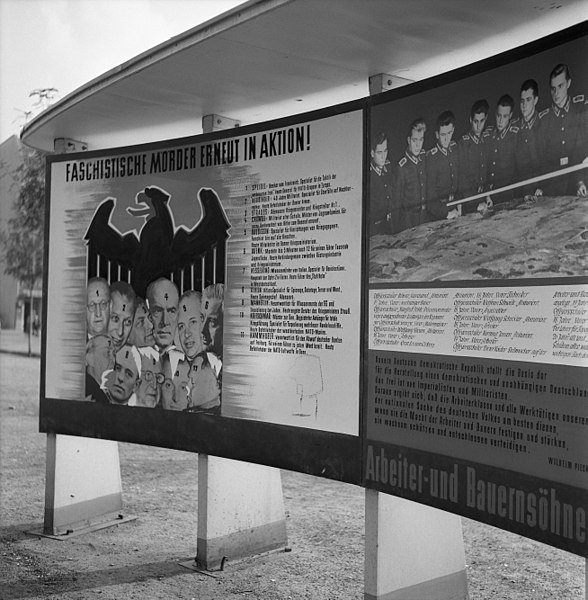
A 1957 East German propaganda poster.

How did the Allies control German media?
The U.S. and other occupying forces censored Nazi-related content, controlled press and publishing, and destroyed books promoting militarism or Nazism.
What were the results of denazification?
By 1950, it had largely faded, with many former Nazis reintegrated into society. Amnesty laws allowed them to reclaim jobs, and public opinion remained divided on the Nazi past.
How did post-war surveys reflect German attitudes?
Many Germans saw Nazism as a good idea poorly executed, opposed Jewish rights, and viewed denazification efforts as unfair. Some even expressed admiration for Hitler years after the war.
What was the impact of denazification outside Germany?
Similar processes occurred in Nazi-occupied countries, but many former collaborators avoided punishment due to Cold War politics.





