Ehecatl: Pre-Columbian Deity of the Wind
Ehecatl was the Mesoamerican god of wind, often identified as an aspect of Quetzalcoatl, the Feathered Serpent deity.
Origins and Mythological Significance
Ehecatl, a deity in Aztec and broader Mesoamerican mythology, is the god of wind and is often regarded as an aspect of the Feathered Serpent deity, Quetzalcoatl. Known as Ehecatl-Quetzalcoatl, he plays a vital role in creation myths and the sustenance of life.
The wind, being an invisible yet powerful force, was seen as a divine breath that brought movement and vitality to the world. Ehecatl’s presence in multiple cultures of central Mexico, including the Mexica (Aztecs), reflects his importance in their spiritual and cosmological beliefs.
Role in Creation Myths
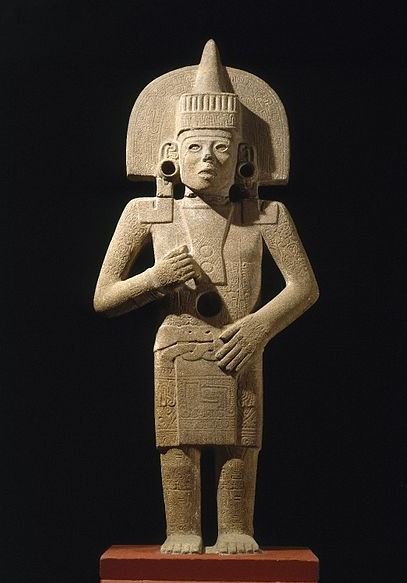
Ehecatl’s statue at the Brooklyn Museum in New York City, USA.
Ehecatl is closely linked to the Aztec creation story, particularly in the cycle of the suns, which narrates the creation and destruction of different worlds. In one version of the myth, he was responsible for setting the sun and moon in motion.
According to Aztec legend, after the gods sacrificed themselves to create the fifth sun at Teotihuacan, the celestial bodies remained still in the sky. Ehecatl, as the god of wind, breathed life into them, pushing the sun across the heavens and allowing time to continue. Without his intervention, the world would have remained in darkness, and life would not have thrived.
Ehecatl, the Aztec god of wind, was a crucial figure in Mesoamerican mythology, symbolizing movement, breath, and life itself.
Another prominent myth involving Ehecatl describes his role in bringing humans back to life. When Quetzalcoatl retrieved the bones of previous generations from the underworld (Mictlan) to create new humans, Ehecatl’s wind animated them, symbolizing the life-giving power of breath. This act reinforced his connection to renewal and the cycle of life and death.
READ ALSO: Ceremonial Knives used by the Aztecs
Attributes and Depictions
Ehecatl is typically depicted with distinctive features that set him apart from other Aztec deities. He is often shown wearing a red mask covering the lower half of his face, symbolizing his connection to the wind.
His appearance is streamlined, sometimes portrayed with bird-like features, emphasizing his role as a deity of movement and air.
The mask he wears is said to represent a duck’s beak, an allusion to the wind’s ability to pass through obstacles and bring messages from the gods.
Additionally, Ehecatl’s association with Quetzalcoatl means he is sometimes shown with feathered elements, reinforcing his link to the sky and the divine. In some representations, he has two protruding masks through which the wind is believed to blow, demonstrating his ability to shape and direct the forces of nature.
Temples and Worship
Unlike the towering pyramidal structures dedicated to gods such as Huitzilopochtli and Tlaloc, Ehecatl’s temples were typically cylindrical. This unique architectural style was designed to reduce wind resistance, allowing air to flow smoothly around the structure. The rounded shape of his temples symbolized the omnipresence of the wind and its ability to move in all directions.
Ehecatl’s temples were often placed at the entrances of larger sacred precincts, highlighting his role as a deity of movement and transition. Worship of Ehecatl involved offerings, prayers, and rituals that sought his favor for good weather, successful harvests, and safe journeys. Wind, being an essential force for agriculture, was crucial for dispersing pollen and ensuring bountiful crops, making Ehecatl an important figure in agrarian societies.
Connection to the Cardinal Directions
As a god of wind, Ehecatl was associated with all the cardinal directions, reinforcing his role as an ever-present and dynamic force. The wind does not belong to a single place; instead, it moves freely across the world, influencing weather patterns and the natural balance. Ehecatl’s ability to govern the winds meant that he played a role in maintaining harmony in the cosmos.
This connection to movement also extended to his role in guiding souls and influencing fate. Wind was believed to carry messages from the gods, and Ehecatl was often invoked to ensure that divine communication remained uninterrupted. In some myths, he is depicted as a messenger between the heavens and the earth, further emphasizing his role in the cosmic order.
Cultural Influence Beyond the Aztecs
Ehecatl’s worship was not limited to the Aztecs; many other Mesoamerican civilizations recognized the significance of the wind god. The Toltecs, predecessors to the Aztecs, also associated wind with Quetzalcoatl, and this belief persisted into later cultures. Ehecatl’s attributes can also be seen in the Maya god Kukulkan, another feathered serpent deity linked to wind and creation.
Beyond the Aztecs, Ehecatl’s influence extended across Mesoamerican cultures, demonstrating the universal reverence for wind as a sustaining force.
The universality of Ehecatl’s symbolism in Mesoamerica highlights the importance of wind in sustaining life, agriculture, and movement. Civilizations that depended on seasonal rains and winds for farming naturally revered deities that controlled these elements. Ehecatl’s presence in various cultural traditions indicates his widespread influence and the shared cosmological views of Mesoamerican peoples.
Ehecatl in Modern Understanding
Today, Ehecatl remains an important figure in the study of Mesoamerican mythology. Archaeological findings, such as statues and temple ruins, provide insight into his worship and role in pre-Columbian societies. Ehecatl’s legacy endures in modern Mexican culture, where elements of Aztec mythology continue to influence art, literature, and historical narratives.
Ehecatl-Quetzalcoatl’s dual identity as both wind god and cultural hero highlights the interconnectedness of natural forces and divine beings in Aztec thought. His role as the breath of life, the force that sets the sun and moon in motion, and the guide of spirits exemplifies the deep spiritual significance the Aztecs placed on wind and movement.
Religious Practices and Major Deities of Pre-Columbian Civilizations
Frequently Asked Questions
What was Ehecatl’s role in Aztec mythology?
He was a creator god and culture hero, playing a key role in mythical accounts of creation and the movement of celestial bodies.
Why was Ehecatl associated with all cardinal directions?
Since the wind moves in all directions, Ehecatl was believed to have influence over all four cardinal points.
How were temples dedicated to Ehecatl designed?
His temples were built as cylindrical structures to reduce air resistance and facilitate the passage of wind.
What was a unique feature of Ehecatl’s depictions?
He was often portrayed with two protruding masks through which the wind was believed to blow.
How was Ehecatl linked to Quetzalcoatl?
He was considered an aspect of Quetzalcoatl in his role as the wind god, hence the name Ehecatl-Quetzalcoatl.
What was Ehecatl’s significance in creation myths?
He was said to have helped set the sun and moon in motion, ensuring the continuation of time and life.





