Who was Quetzalcoatl in the Aztec Pantheon?
Quetzalcoatl, meaning “Feathered Serpent” in Nahuatl, is one of the most significant deities in Mesoamerican cultures, particularly among the Aztecs. Revered as a god of wind, Venus, the Sun, knowledge, merchants, and arts, Quetzalcoatl symbolized balance between creation and destruction.
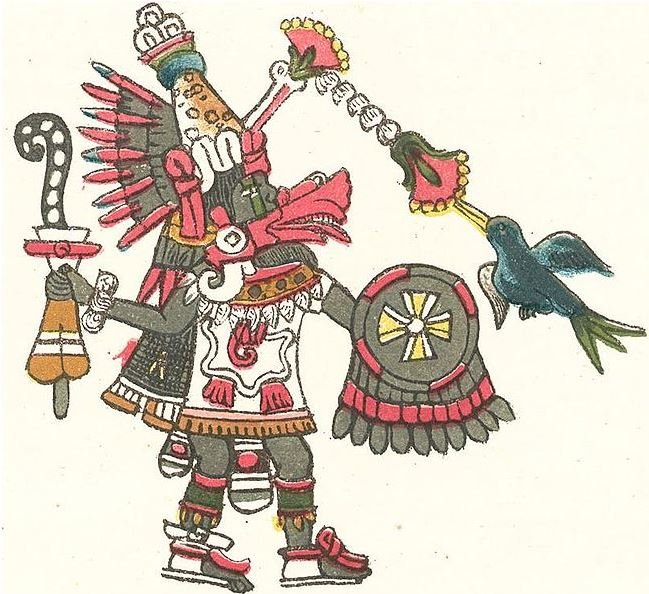
The Codex Magliabechiano’s depiction of Quetzalcoatl.
As the patron deity of the priesthood, his influence extended into various aspects of Aztec religious and social life. Closely related to other Mesoamerican deities like Kukulkan among the Maya, Quetzalcoatl’s worship transcended cultural and linguistic boundaries.
Religious Practices and Major Deities of Pre-Columbian Civilizations
Mythological Attributes and Symbols
Quetzalcoatl is depicted with various symbolic elements that illustrate his attributes:
- The Wind Jewel: The “ehēcacōzcatl,” a spiral-shaped conch shell necklace, symbolizes the wind’s force and cyclical patterns. It is frequently depicted in Mesoamerican art and suggests connections to natural phenomena like whirlpools and hurricanes.
- Animal Representations: He is associated with resplendent quetzals, rattlesnakes, and harpy eagles, reflecting his dual identity as both a feathered serpent and Venus, the morning star.
- Dual Roles: Quetzalcoatl embodies creation and destruction, representing life’s cyclical nature. As Ehecatl, he governs the wind, sweeping paths for rain and symbolizing renewal.
Origins and Historical Worship
The earliest evidence of Quetzalcoatl’s worship dates back to Teotihuacan (100 BCE–100 CE), where he was associated with fertility and internal governance. By the Classic Period (600–900 CE), his veneration spread throughout Mesoamerica, blending with local traditions. In the Postclassic Period (900–1519 CE), Cholula emerged as a key center for his worship, marked by grand temples and rituals.
Quetzalcoatl’s influence also reached the Maya region, where he became equated with Kukulkan and Gukumatz. The cultural exchange during this era highlights his role as a unifying deity across diverse Mesoamerican civilizations.
Iconography and Architectural Significance
The visual representation of Quetzalcoatl evolved over time.
Initially depicted as a fully zoomorphic serpent, the deity’s imagery reflected his divine status as a powerful yet benevolent entity.
The Temple of Quetzalcoatl in Teotihuacan features intricate carvings of feathered serpents alongside depictions of other deities. Cholula’s great pyramid, the largest in the world by volume, was dedicated to his worship.
Feathered serpent motifs appear at Chichen Itza, Xochicalco, and El Tajín, signifying his widespread influence.
Religious and Cultural Impact
Quetzalcoatl held diverse roles within Mesoamerican belief systems.
According to Aztec myths, Quetzalcoatl created humanity by using his own blood to revitalize the bones of previous generations, emphasizing his role as a life-giver.
His connection with Venus symbolized his dual identity as the morning and evening star, representing cycles of death and rebirth.
Some myths portray Quetzalcoatl as opposing human sacrifice, contrasting with other Aztec deities that demanded it.
Quetzalcoatl as a Historical Figure
Quetzalcoatl’s identity is often conflated with Ce Acatl Topiltzin, a Toltec ruler of the city of Tollan (Tula). Topiltzin, a priest-king devoted to Quetzalcoatl’s worship, sought to reform Toltec religious practices. Over time, legends blurred the line between the deity and the historical figure, complicating interpretations of his role in Mesoamerican history.
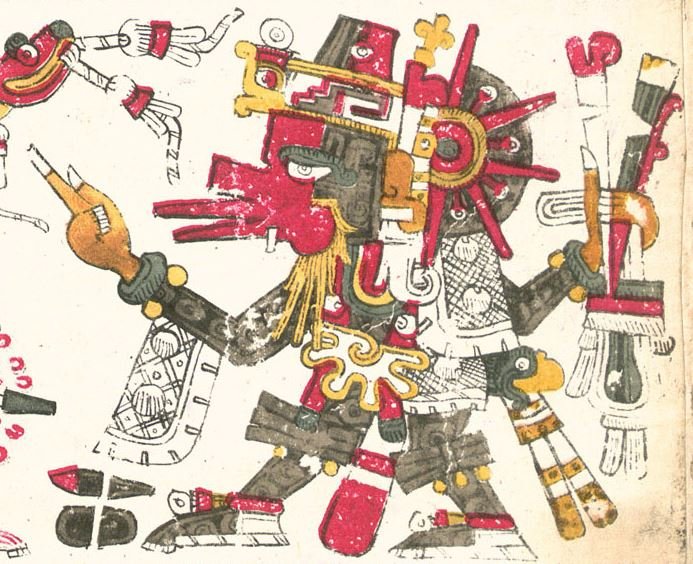
A drawing of Quetzalcoatl,.
Colonial Interpretations and Misconceptions
Following the Spanish conquest, European chroniclers like Bernardino de Sahagún conflated Quetzalcoatl with Christian figures such as St. Thomas and even Hernán Cortés. This misunderstanding arose partly from indigenous myths of the deity’s eventual return, which Spaniards exploited to frame their arrival as divinely ordained. Modern scholars, however, question the accuracy of these claims, emphasizing the post-conquest origins of such narratives.
Influence on Aztec Society and beyond
In Aztec culture, Quetzalcoatl represented the ideal of a priest-king, blending religious devotion with rulership. The Templo Mayor in Tenochtitlan featured rituals dedicated to him, and his association with the calendar system and agriculture underscored his role in sustaining societal harmony. He was also tied to intellectual pursuits, credited with introducing writing and the use of calendars.
As a deity of creation, wisdom, and duality, Quetzalcoatl bridges myth and history, uniting diverse cultures under a shared symbol of resilience and creativity.
Quetzalcoatl’s worship facilitated peaceful interactions and trade between diverse Mesoamerican groups. His image as a unifier made him an ideal deity for promoting alliances and cultural exchange. The spread of his cult through merchants and pilgrims ensured that his influence extended beyond political boundaries.
Modern Interpretations and Legacy
Quetzalcoatl remains a symbol of cultural identity and pride in modern Mexico.
Stories of the Feathered Serpent persist in indigenous folklore, often blending pre-Columbian beliefs with Christian elements.
His imagery continues to inspire contemporary art, from Mexican painter Diego Rivera murals to public sculptures.
The pterosaur Quetzalcoatlus was named after the deity, reflecting his enduring association with flight and majesty.
Questions and Answers
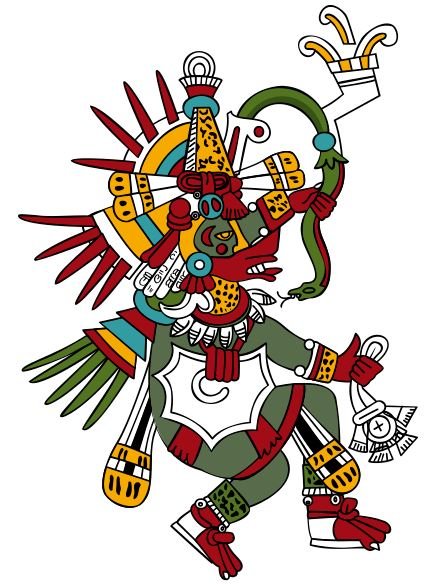
Vector illustration of Quetzalcoatl portrayed in the style of the Codex Borbonicus.
What are Quetzalcoatl’s attributes and symbols?
Quetzalcoatl is often depicted wearing the wind jewel (ehēcacōzcatl), associated with hurricanes and whirlpools, and represented by animals such as quetzals, rattlesnakes, and harpy eagles.
Where and when did the worship of Quetzalcoatl originate?
The earliest evidence of Feathered Serpent worship comes from Teotihuacan in the Late Preclassic to Early Classic period (400 BCE–600 CE) and later spread across Mesoamerica.
What is the connection between Quetzalcoatl and Venus?
Quetzalcoatl is associated with Venus as the morning star, symbolizing renewal and often connected to fertility, warfare, and the agricultural cycle.
How is Quetzalcoatl linked to other Mesoamerican deities?
Quetzalcoatl has parallels with Kukulkan (Maya) and Gukumatz (K’iche’) and is one of the sons of the primordial god Ometecuhtli, representing light, wind, and mercy.
What role did Quetzalcoatl play in Aztec myths about creation?
Quetzalcoatl is credited with creating humanity in the Fifth Sun by retrieving bones from the underworld and giving them life through his own blood.
What is the debated connection between Quetzalcoatl and Hernán Cortés?
Some post-Conquest accounts suggest Aztecs believed Cortés was Quetzalcoatl returning, but modern scholars argue this idea likely arose from Spanish reinterpretations of indigenous narratives.





