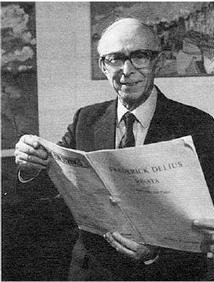
Eric William Fenby OBE (22 April 1906 – 18 February 1997)
English composer and conductor Eric Fenby is best known as Frederick Delius’s amanuensis from 1928 to 1934, helping the paralyzed and blind composer complete several major works.
Early Life and Musical Beginnings
Eric Fenby was born on April 22, 1906, in Scarborough, North Yorkshire, into a Methodist family. A musically inclined child, he began learning piano, organ, and cello at an early age. By the age of 12, his talent was evident as he was appointed organist at Holy Trinity Church in Scarborough. Although largely self-taught as a composer, Fenby demonstrated promise early on, conducting his own string orchestra compositions at Scarborough’s Spa Grand Hall by 1925. These formative years set the stage for his future contributions to the world of music.
Collaboration with Frederick Delius
In 1928, Fenby learned of Frederick Delius’s plight—blind, paralyzed, and unable to write music due to the advanced effects of syphilis. Offering his services as an amanuensis, Fenby moved to Grez-sur-Loing, near Paris, where Delius and his wife Jelka lived. The task was both physically and emotionally demanding. Fenby devised a system to transcribe Delius’s music by interpreting the composer’s verbal cues and fragmented dictations.
Despite Delius’s challenging temperament and atheism—contrasting with Fenby’s devout Catholic beliefs—the partnership bore remarkable fruit. Fenby helped Delius complete significant works, including:
- A Song of Summer
- Fantastic Dance
- Irmelin Prelude
- Caprice and Elegy (for cello and chamber orchestra)
- Violin Sonata No. 3
- Songs of Farewell (for double choir and orchestra)
- Idyll (for soprano, baritone, and orchestra).
The collaboration continued until Delius’s death in 1934. The process left Fenby emotionally exhausted, as he also served as a nurse to the ailing composer and later managed arrangements for Delius’s reburial in England. Fenby chronicled this challenging yet transformative period in his 1936 book, Delius As I Knew Him.
Popular Culture and Legacy of the Delius Collaboration
Fenby and Delius’s unique partnership inspired works in various media. Ken Russell’s 1968 BBC film Song of Summer, based on Fenby’s memoir, vividly portrayed their collaboration, with Christopher Gable playing Fenby. In music, Kate Bush referenced the relationship in her song “Delius” (1980). Even David Mitchell’s novel Cloud Atlas fictionalized elements of the Fenby-Delius dynamic.
Later Career and World War II
Following Delius’s death, Fenby joined the renowned music publisher Boosey & Hawkes. In 1939, he was commissioned to compose the score for Alfred Hitchcock’s Jamaica Inn. However, World War II interrupted his film career. Fenby enlisted in the Royal Artillery but was soon transferred to the Royal Army Education Corps, where he conducted the Southern Command Orchestra and oversaw educational music programs.
Eric Fenby’s contributions to music and his selfless devotion to preserving Delius’s works ensure his place in musical history.
In 1944, Fenby married Rowena C.T. Marshall, the daughter of a Scarborough vicar. The couple had two children, Roger and Ruth. This period marked a shift in Fenby’s religious journey as he left the Catholic Church, though he would later return to it in his final years.
Contributions to Music Education and Delius’s Legacy
After the war, Fenby continued to nurture future generations of musicians. He founded the music department at North Riding Training College, later serving as Professor of Harmony at the Royal Academy of Music in London from 1964 to 1977. Fenby played a pivotal role in promoting Delius’s work, notably serving as Artistic Director for the 1962 Bradford Delius Centenary Festival, an effort that earned him an OBE the same year.
Recordings and Performances
Fenby’s contributions as a performer and conductor were significant. He recorded definitive versions of Delius’s works, including the Violin Sonatas with Ralph Holmes and Yehudi Menuhin, and the Cello Sonata with Julian Lloyd Webber. His recordings, such as those featured in the Fenby Legacy collection for Unicorn Records, remain essential references for Delius enthusiasts.
Fenby also worked as an advisor for Ken Russell’s Song of Summer and was featured in the documentary Song of Farewell by Yorkshire Television, which further cemented his association with Delius.
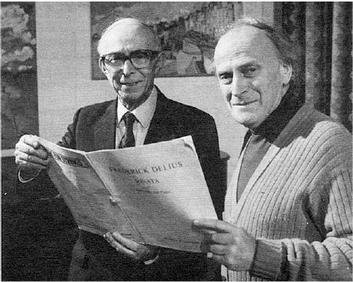
Fenby (left) and Yehudi Menuhin
Original Compositions
While Fenby is best known for his work with Delius, he was also a composer in his own right. Despite being a harsh critic of his early works, he left behind several notable pieces:
Orchestral Works
- Rossini on Ilkla Moor (1938), a humorous overture.
- Lion Limb (1952), a slow march.
- Two Aquarelles (originally choral works later arranged for orchestra).
Choral Works
- Magnificat and Nunc Dimittis (1932).
- For Music on the Eve of Palm Sunday (1933), set to text by Robert Nichols.
Honors and Recognitions
Fenby’s lifelong dedication to music earned him numerous accolades:
- OBE (1962) for his contributions to the Delius Centenary Festival.
- Honorary doctorates from the Universities of Bradford, Warwick, and Jacksonville.
- Presidency of the Delius Society, a role he held until his death.
Final Years and Death
In his later years, Fenby returned to his Catholic faith and settled back in Scarborough. He passed away on February 18, 1997, just shy of his 91st birthday. He is buried alongside his wife Rowena at St. Laurence’s Churchyard in Scalby, near Scarborough.

Frequently Asked Questions
How did Fenby begin his musical career?
Fenby, largely self-taught, became the organist at Holy Trinity Church in Scarborough at age 12 and conducted his first orchestral work by 1925.
What were the main challenges Fenby faced while working for Delius?
He dealt with Delius’s blindness, paralysis, atheism, and difficult temperament, as well as the physical and emotional toll of caregiving.
What significant works did Fenby help Delius compose?
He assisted with A Song of Summer, Songs of Farewell, Irmelin Prelude, Fantastic Dance, Violin Sonata No. 3, and others.
How was Fenby’s experience with Delius commemorated in media?
Ken Russell’s 1968 BBC film Song of Summer dramatized their collaboration, and Kate Bush referenced it in her song “Delius.”
What were Fenby’s post-Delius contributions to music?
He worked for Boosey & Hawkes, served in the Royal Artillery during WWII, and later founded the music department at North Riding Training College.
What honors did Fenby receive during his lifetime?
He was appointed OBE in 1962, received honorary doctorates, and became the Delius Society’s president.
Where did Fenby spend his final years?
He returned to Scarborough, North Yorkshire, where he died in 1997 and was buried in St Laurence’s Churchyard in Scalby.





