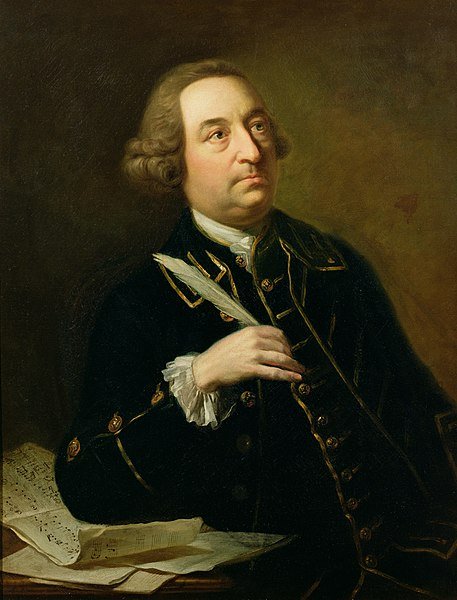
A portrait of John Christopher Smith painted by Johan Zoffany.
John Christopher Smith, originally Johann Christoph Schmidt, was an 18th-century English composer born in Ansbach, Germany, in 1712. His contributions to music spanned multiple genres, including opera, oratorio, and instrumental compositions. Known for his close association with George Frideric Handel, Smith played a significant role in preserving and continuing Handel’s legacy, particularly during the latter’s final years of blindness.
Early Life and Family Background
John Christopher Smith was born into a musically inclined family. His father, Johann Christoph Schmidt Sr., was a notable musician and Handel’s first copyist in London. Their acquaintance dated back to their time in Halle, Germany. In 1716, Handel summoned Schmidt Sr. to London to assist him with musical transcriptions. Around 1720, the Schmidt family relocated to London, where Smith Jr. would develop his musical talents.
Smith’s early musical education included lessons with George Frideric Handel himself, Johann Christoph Pepusch, and, primarily, Thomas Roseingrave. This comprehensive training laid the foundation for Smith’s future career as a composer and Handel’s trusted assistant.
Collaboration with Handel
Smith’s collaboration with Handel began in earnest during the 1740s. Initially serving as Handel’s secretary and amanuensis, Smith’s role grew increasingly important as Handel’s eyesight deteriorated. By 1752, Handel was no longer able to conduct or write music independently, leaving Smith to take on the responsibilities of conducting performances of Handel’s oratorios.
Despite a falling-out between Handel and Smith’s father in the 1750s, the bond between Handel and Smith Jr. remained intact. From 1753 until Handel’s death in 1759, Smith conducted the composer’s oratorios and helped preserve his works. In recognition of Smith’s contributions, Handel bequeathed him his manuscripts and keyboard instruments upon his passing.
Smith also worked with John Langshaw on innovative projects to transcribe Handel’s compositions for mechanical reproduction using barrel organs. This effort ensured that Handel’s music could reach broader audiences.
Personal Life
In 1760, Smith married Martha Coxe, becoming stepfather to William Coxe, a historian. His marriage coincided with the peak of his career, following the success of his oratorio Paradise Lost. Unfortunately, his health began to decline, leading him to retire from his position as artistic director of the Covent Garden Royal Theatre in 1772.
Health issues forced John Christopher Smith to retire as artistic director of Covent Garden Royal Theatre in 1772. He moved to Bath in 1774 and later to London, where he died in 1795.
In 1774, King George III granted Smith an annual pension, allowing him to retire comfortably in Bath. After the death of his wife in 1785, Smith moved to London’s Soho district, where he lived until his death on October 3, 1795. A blue plaque now marks the site of his residence as a tribute to his legacy.

Operatic Achievements
Smith’s operatic career began with the Italian-style opera Teraminta, performed on November 20, 1732, at Lincoln’s Inn Fields in London. This was followed by Ulysses in 1733, which unfortunately failed to resonate with audiences. Disheartened, Smith temporarily abandoned opera but returned to the genre later with encouragement from Handel.
Between 1740 and 1749, Smith composed a series of Italian operas, including Rosalinda, Issipile, Il Ciro riconosciuto, and several now-lost works such as Dario, Demofoonte, and Artaserse. In the 1750s, he collaborated with David Garrick on English-language operas inspired by Shakespeare, including The Fairies (based on A Midsummer Night’s Dream) and The Tempest. His final opera, Medea, written with Benjamin Stillingfleet, premiered in 1763.
John Christopher Smith’s Contributions to Oratorio
Smith’s contributions to oratorio rival his operatic endeavors. His first oratorio, David’s Lamentation over Saul and Jonathan, debuted in 1740. That same year, he composed The Seasons, based on a poem by James Thomson.
Following Handel’s death, Smith took over the annual performances of Messiah at the Foundling Hospital, where he also served as organist. His greatest oratorio success was Paradise Lost in 1760, with a libretto by Stillingfleet based on John Milton’s epic poem. Other notable oratorios included Rebecca (1761), Nabal (1764), Tobit (1764), and Gideon (1769). Many of these works were inspired by or reworked from Handel’s music, demonstrating Smith’s dedication to his mentor’s legacy.
Smith also composed lesser-known oratorios, including Judith, Jehosaphat, and Redemption. The latter, based on a text by William Coxe, was rediscovered in the Bibliothèque Nationale de Paris in 1998, providing modern audiences with a glimpse into Smith’s compositional range.
Instrumental and Vocal Works
In addition to his operas and oratorios, Smith composed extensively for the harpsichord. He published five volumes of harpsichord music between 1732 and 1765, including:
- Suites de pièces pour le clavecin, Op. 1 (1732)
- Suites de pièces pour le clavecin, Op. 2 (1735)
- Six Suits of Lessons for the Harpsichord, Op. 3 (1755)
- A Collection of Lessons for the Harpsichord, Op. 4 (1757)
- XII Sonatas for the Harpsichord, Op. 5 (1765)
Smith’s vocal works included a book of hymns (1765) and two cantatas: Winter, or Daphne (1746) and Thamesi, Isi, e Proteo, written in honor of Frederick, Prince of Wales. He also composed a funeral service for the Dowager Princess of Wales in 1772, who had been one of his harpsichord pupils.
Legacy
John Christopher Smith’s contributions to music were deeply intertwined with his relationship with Handel. His efforts to preserve Handel’s works, conduct performances, and expand the reach of Baroque music through mechanical reproduction ensured that Handel’s legacy endured.
Despite living in the shadow of his famous mentor, Smith’s own works—particularly his operas, oratorios, and harpsichord compositions—highlight his unique talent and versatility. His ability to adapt and thrive in the demanding musical environment of 18th-century London is a testament to his skill and dedication.
Frequently Asked Questions
What role did John Christopher Smith play in Handel’s later years?
Smith became Handel’s secretary and musical assistant, conducting Handel’s oratorios when blindness prevented the composer from doing so after 1752.
What was his relationship with Handel?
Though Handel fell out with Smith’s father, he maintained a close relationship with Smith Jr., bequeathing him musical instruments and manuscripts upon his death in 1759.
What is Smith’s most notable work?
His oratorio Paradise Lost (1760), based on Milton’s text, was his greatest success and marked his prominence as a composer.
What contributions did Smith make to opera?
He composed several Italian operas, including Teraminta and Ulysses, and later collaborated on Shakespeare-inspired works such as The Tempest and The Fairies.
What was his role at the Foundling Hospital?
Between 1759 and 1768, Smith directed annual performances of Handel’s Messiah at the Foundling Hospital, where he also served as organist.
What other musical works did he compose?
Smith composed five volumes of harpsichord music, several oratorios, hymns, and cantatas, with his works reflecting both his own style and Handel’s influence.





