Who was Epaminondas? – Life and Major Accomplishments
Epaminondas (c. 419/411–362 BC) was a transformative figure in 4th-century BC Greece, renowned for his military genius, statesmanship, and dedication to justice and liberation.
A native of Thebes, Epaminondas played a central role in ending Spartan hegemony, elevating Thebes to a position of prominence in Greek politics and reshaping the geopolitical and military landscape of the ancient world. While his achievements were short-lived, his innovations in strategy and leadership left a lasting legacy in history.
Early Life and Education
Epaminondas was born into a noble but modest family in Thebes. Despite his aristocratic lineage, he chose a life of simplicity and intellectual pursuit. He was deeply influenced by philosophy and the teachings of Pythagorean principles, which emphasized ethics, harmony, and self-discipline. These values shaped his character and leadership style, blending strategic brilliance with a strong moral compass.
Epaminondas excelled in martial arts, which complemented his philosophical education. His intellectual rigor and physical training made him a formidable figure, respected both on and off the battlefield. While little is known about his early years, his rise to prominence coincided with Thebes’ struggle to assert itself against Spartan domination following the Peloponnesian War.

Image: A statue of Epaminondas at Stowe House in England.
Rise to Leadership
Thebes had long been under Spartan control, with its autonomy curtailed by a pro-Spartan oligarchy imposed after the Peloponnesian War. Epaminondas emerged as a key leader in the resistance against Spartan hegemony. His reputation grew during the Boeotian War (378–371 BC), where he demonstrated tactical brilliance and a commitment to Theban independence. He became closely associated with Pelopidas, a fellow Theban general and statesman, with whom he shared a vision of a stronger, united Thebes.
The Battle of Leuctra (371 BC)
Epaminondas’ defining moment came at the Battle of Leuctra in 371 BC, a confrontation that marked the end of Spartan supremacy in Greece. Thebes faced a Spartan army led by King Cleombrotus, renowned for its discipline and dominance on the battlefield. Despite being outnumbered, Epaminondas’ innovative tactics secured a decisive victory for Thebes.
Tactical Innovations
At Leuctra, Epaminondas employed the oblique phalanx formation, a groundbreaking strategy that concentrated Theban forces on one flank. By deploying his strongest troops, including the elite Sacred Band, in a deep and powerful column, he aimed to overwhelm the Spartan right wing, traditionally their strongest position. Meanwhile, the rest of his army held back, avoiding direct engagement until the decisive moment.
This tactic shattered the Spartan phalanx, killed King Cleombrotus, and inflicted heavy casualties. The victory ended the myth of Spartan invincibility and marked a turning point in Greek military history. Leuctra not only elevated Thebes to a position of leadership but also inspired later military leaders, including Philip II of Macedon and Alexander the Great.
Liberation of Messenia
Following the victory at Leuctra, Epaminondas launched a campaign into the Peloponnese to consolidate Theban power and permanently weaken Sparta. One of his most significant achievements was the liberation of Messenia, a region whose population had been enslaved by the Spartans for over two centuries. The Messenians, known as helots, were a vital part of Sparta’s economy, providing agricultural labor and sustaining its military elite.
In 369 BC, Epaminondas re-founded the city of Messene, establishing it as an independent and fortified center of resistance against Spartan resurgence. The liberation of Messenia deprived Sparta of its economic backbone and marked the culmination of Epaminondas’ vision for justice and autonomy. This act was not only a military and political triumph but also a profound statement against oppression.
Theban Hegemony
Epaminondas’ leadership ushered in a brief period of Theban dominance, known as the Theban Hegemony. During this time, Thebes challenged the traditional power structures of Greece, fostering alliances and promoting the autonomy of smaller city-states. Epaminondas sought to create a more equitable political order, breaking apart longstanding hegemonies and reshaping the balance of power.
City-Building and Alliances
Epaminondas was instrumental in the foundation of new cities, such as Messene and Megalopolis. These cities served as strategic centers and symbols of resistance against Spartan influence. His diplomatic efforts extended to forging alliances with other Greek states and regions, strengthening Thebes’ position and countering potential threats from Athens and Sparta.
Social and Economic Reforms
Epaminondas believed that military success should be accompanied by social and economic stability. He advocated for reforms that empowered marginalized groups and strengthened Theban society. His leadership combined military prowess with a commitment to justice, earning him admiration and respect across Greece.
Later Campaigns and the Battle of Mantinea
In 362 BC, Epaminondas faced a coalition of Greek city-states, including Sparta, Athens, and their allies, at the Battle of Mantinea. This confrontation was a culmination of years of conflict and shifting alliances. Once again, Epaminondas demonstrated his tactical brilliance, leading Theban forces to victory through innovative strategies and personal courage.
Death and Legacy
During the battle, Epaminondas personally led a charge that broke through enemy lines, turning the tide in Thebes’ favor. However, he was mortally wounded in the assault, struck by a spear in the chest. His death marked the end of Theban hegemony, as no leader could match his vision and leadership. Without his guidance, Thebes struggled to maintain its dominance, and Greek politics soon returned to a fragmented state.
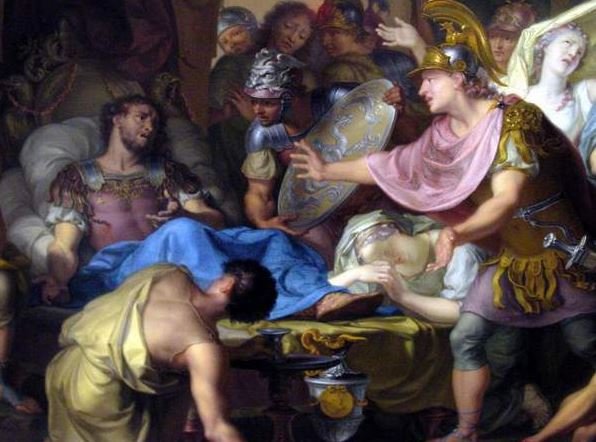
Image: “The Death of Epaminondas” by Dutch artist Isaak Walraven.
Military Innovations and Influence
Epaminondas’ contributions to military strategy had a profound and lasting impact. His use of the oblique phalanx and combined arms tactics influenced subsequent generations of commanders. Philip II of Macedon, who studied under Theban tutelage during Epaminondas’ time, adopted these strategies to build the Macedonian army, which would later be used by Alexander the Great to conquer much of the known world.
Cultural and Historical Recognition
Epaminondas was celebrated in his time as an idealist and liberator. Contemporary historians, such as Xenophon, praised his achievements, while later figures like Cicero and Michel de Montaigne regarded him as one of history’s greatest leaders. His combination of ethical principles and strategic brilliance set him apart as a transformative figure in Greek history.
The Ephemeral Nature of His Achievements
Despite his accomplishments, the changes Epaminondas wrought were short-lived. The cycle of Greek hegemonies continued, and Thebes itself was destroyed by Alexander the Great less than three decades after his death. However, his decade of leadership from 371 to 362 BC remains a testament to the potential for transformative leadership in the face of entrenched dominance.
Conclusion
Epaminondas stands as one of the most remarkable figures in ancient Greek history. His life and career were marked by a commitment to justice, innovation, and the liberation of oppressed peoples. Through his military and political achievements, he reshaped the Greek world, leaving an enduring legacy of courage, vision, and ethical leadership. While his accomplishments did not outlive him, the lessons of his life continue to inspire and inform the study of leadership and strategy.
Frequently Asked Questions
What is Epaminondas best known for?
Epaminondas is best known for his victory at the Battle of Leuctra in 371 BC, where his innovative use of the oblique phalanx shattered Sparta’s military dominance and initiated Theban hegemony in Greece.
What was the oblique phalanx, and why was it significant?
The oblique phalanx was a tactical formation that concentrated forces on one flank, allowing Epaminondas to overwhelm the Spartan elite while holding back other units. This strategy decisively defeated the Spartans at Leuctra and revolutionized battlefield tactics.
How did Epaminondas weaken Sparta after Leuctra?
Epaminondas liberated the Messenian helots, a subjugated population vital to Sparta’s economy. By founding the city of Messene, he ensured Messenian independence, depriving Sparta of crucial resources and permanently weakening its power.
What role did Epaminondas play in city-building?
Epaminondas founded cities such as Messene and Megalopolis to strengthen Theban influence and serve as bulwarks against Spartan resurgence. These cities became centers of resistance and hubs for regional autonomy.
What happened at the Battle of Mantinea in 362 BC?
At Mantinea, Epaminondas led Theban forces against a coalition of Greek city-states, including Sparta and Athens. Although his tactics once again demonstrated brilliance, he was mortally wounded in the battle, which ended inconclusively.
What was the impact of Epaminondas’s death?
Epaminondas’s death marked the end of Theban dominance. Without his leadership, Thebes struggled to maintain its power, and Greek politics returned to a fragmented state, paving the way for Macedonian hegemony under Philip II and Alexander the Great.
How did Epaminondas influence later military leaders?
Epaminondas’s innovative tactics, including the oblique phalanx and combined arms strategy, inspired leaders such as Philip II of Macedon. These ideas laid the groundwork for the military strategies that Alexander the Great would later use.
Why is Epaminondas considered an idealist and liberator?
Epaminondas championed justice, autonomy, and equality. He fought to free subjugated populations like the Messenian helots and sought to establish a more equitable political order in Greece, balancing military success with social reforms.
What is Epaminondas’s legacy in Greek history?
Epaminondas is celebrated as a visionary leader who reshaped Greece during his lifetime. Although his influence was short-lived, his military and political innovations left a lasting imprint on Greek and later Western military history.





