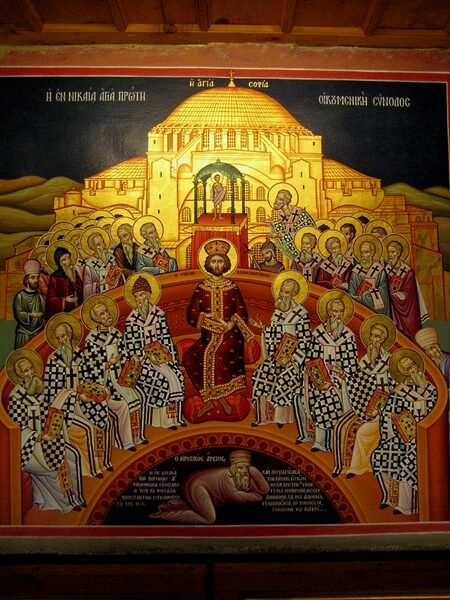
Arius is depicted as defeated by the Council of Nicaea, beneath Emperor Constantine’s feet.
The First Council of Nicaea was convened in 325 AD by Roman Emperor Constantine I (also known as Constantine the Great). The meeting was a landmark event in the history of Christianity. Held in the city of Nicaea (modern-day İznik, Turkey), it aimed to address significant theological disputes and unify the Church. This ecumenical council was the first of its kind, bringing together bishops from across the Roman Empire to deliberate on crucial matters of faith, doctrine, and church governance.
Theological and Ecclesiastical Turmoil
The primary catalyst for the council was the growing theological conflict in Alexandria, particularly between Archbishop Alexander and the presbyter Arius. This debate, known as the Arian controversy, revolved around the nature of Christ and his relationship with God the Father. Arius argued that the Son was a created being, distinct and subordinate to the Father. Alexander maintained that the Son was co-eternal and of the same essence as the Father. This doctrinal rift threatened the unity of the Church, necessitating an imperial intervention.
Simultaneously, the Church in Alexandria faced a separate but related division known as the Melitian schism. This conflict emerged during the Diocletianic Persecution when Bishop Melitius of Lycopolis challenged the authority of Peter I of Alexandria. These disputes, coupled with Constantine’s desire for religious harmony in his newly unified empire, led to the convocation of the First Council of Nicaea.
The Role of Emperor Constantine
Constantine, newly established as the sole ruler of the Roman Empire after defeating Licinius, sought to stabilize his realm. Recognizing the divisive potential of theological disputes, he took an active role in ecclesiastical matters. Constantine wrote letters urging reconciliation, dispatched Bishop Hosius of Corduba as an envoy, and ultimately convened the council at Nicaea to ensure an organized and definitive resolution. His actions underscored the emerging relationship between the Roman state and the Christian Church.
Council Logistics and Attendance
The council’s expenses, including travel and lodging for attendees, were covered by the imperial treasury. Historical records indicate an attendance of 250 to 318 bishops, primarily from the eastern provinces. Western representatives included Hosius of Corduba and delegates from Rome. The gathering featured presbyters, deacons, and other clergy, swelling the total attendance to as many as 1,800.
The council was held in a basilica within Nicaea’s imperial palace, and proceedings were conducted under strict order. Constantine, though not a voting member, presided over the opening session and participated in debates, emphasizing the importance of unity and consensus.
Key Discussions and Debates
The council’s central focus was the Arian controversy. A creed was drafted to articulate the Church’s understanding of Christ’s divinity. The term homoousios (“of one substance”) was employed to affirm that the Son was of the same essence as the Father, directly opposing Arius’s views. While the majority of bishops signed the Nicene Creed, a few, including Arius, refused and were subsequently exiled.
Another major issue was the calculation of Easter. The council resolved to adopt a unified method, breaking from reliance on the Jewish calendar. This decision aimed to standardize the observance of Easter across Christendom, aligning it with Roman and Alexandrian practices.
The First Council of Nicaea did not discuss the biblical canon. The misconception likely stems from later fictional accounts. The canon was largely established prior to the council.
To address the Melitian schism, the council decreed that Melitius could retain his title but without authority to ordain clergy. His followers were permitted to join the Church under strict conditions, requiring re-ordination by legitimate bishops.
Canons and Legislation from the First Council of Nicaea
The council promulgated twenty canons, establishing foundational rules for church discipline and administration. These included:
- Prohibition of self-castration among clergy.
- Minimum requirements for catechumens preparing for baptism.
- Regulation of clergy conduct, including prohibitions on cohabitation with women.
- Guidelines for episcopal ordination and synodal assemblies.
- Affirmation of the jurisdiction of major sees like Alexandria, Rome, and Antioch.
- Procedures for reconciling schismatics and addressing clerical misconduct.
- A ban on usury among clergy.
These canons provided a framework for Church governance, reflecting the council’s intent to establish order and unity.
The Nicene Creed
The Nicene Creed emerged as the council’s most enduring legacy. It articulated the core tenets of Christian faith, emphasizing the divinity of Christ:
We believe in one God, the Father Almighty, maker of all things visible and invisible… and in one Lord Jesus Christ, the Son of God… begotten, not made, being of one substance with the Father…
The creed explicitly condemned Arianism, anathematizing those who claimed that the Son was created or subject to change. This declaration became a cornerstone of orthodox Christianity.
Outcomes and Impacts of the First Council of Nicaea
While the council succeeded in defining orthodoxy, its decisions did not immediately quell controversy. Arianism persisted, gaining support from influential figures and even emperors in subsequent decades. Key Nicene proponents, such as Athanasius of Alexandria, faced exile and opposition.
By addressing the Arian controversy, standardizing Easter’s date, and establishing ecclesiastical canons, the First Council of Nicaea laid the foundation for the Church’s doctrinal and organizational unity.
The First Council of Nicaea set a precedent for resolving theological disputes through ecumenical councils. It marked the beginning of the Church’s formalized approach to doctrine and governance, influencing subsequent councils and shaping the development of Christian theology.
Misconceptions About the Council
Contrary to popular belief, the council did not address the biblical canon. This myth likely stems from later interpretations and fictional accounts. The canon was largely established by the time of the council, with only minor variations among regional churches.
The doctrine of the Trinity was not fully developed at Nicaea. While the council affirmed the Son’s divinity, debates about the Holy Spirit’s nature continued, culminating in the First Council of Constantinople in 381.
Constantine’s Role and Influence
Constantine’s involvement was pivotal but nuanced. Though he sought unity and supported the Nicene position, his role was primarily administrative. He convened the council, facilitated discussions, and endorsed its decisions, but he did not impose theological conclusions. Constantine’s baptism by an Arian bishop near the end of his life highlights his complex relationship with Church doctrine.

An icon shows Emperor Constantine and First Council of Nicaea bishops (325) holding the 381 Creed.
Why did Roman Emperor Constantine the Great convert to Christianity?
Frequently Asked Questions about the First Council of Nicaea

What prompted the Council’s convening?
The council was primarily convened to resolve the Arian controversy, which questioned the nature of Jesus Christ and his relationship with God the Father, alongside addressing issues like the calculation of Easter and early canon law.
Who were the major participants in the Arian controversy?
The controversy involved Arius, who argued that the Son was created and not co-eternal with the Father, and Alexander of Alexandria, who maintained that the Son was eternally begotten and of the same substance as the Father.
What were the key outcomes of the Council?
The council formulated the Nicene Creed to affirm the divinity of Jesus Christ, anathematized Arian beliefs, standardized the calculation of Easter, addressed the Melitian schism, and issued twenty church canons.
What is the significance of the Nicene Creed?
The Nicene Creed established foundational Christian doctrine, asserting that Jesus Christ is “of one substance with the Father,” countering Arianism, and uniting Christians under a uniform statement of faith.
How did Emperor Constantine influence the Council?
Constantine facilitated the council by covering expenses, attending sessions, and urging unity but did not vote. He supported the council’s decisions by exiling dissenters like Arius.
What changes were made regarding the date of Easter?
The Council separated Easter’s calculation from the Jewish calendar, aligning it with the spring equinox and Christian criteria to ensure uniform observance across Christendom.
Easter: Origin Story and Significance of the Christian Celebration





