Formation of the European Union: History and Major Facts
The European Union (EU) is a political and economic union of 27 European countries. It originated after World War II, initially as the European Coal and Steel Community (ECSC) in 1951, aiming to prevent future wars by integrating economic activities. The Treaty of Rome in 1957 expanded this integration, establishing the European Economic Community (EEC).

The EU is a political and economic union of 27 European countries that are located primarily in Europe. It aims to ensure peace, promote economic cooperation, and create a unified policy and legal framework. Image: Flag of the European Union
The Maastricht Treaty, signed in 1992, marked the formal creation of the European Union, establishing its current framework and introducing European citizenship and the Euro currency. The EU’s objectives are to promote peace, stability, and economic cooperation between its member states, and it operates through a hybrid system of intergovernmental and supranational governance structures, including the European Commission, the European Parliament, and the European Council.

Signing ceremony of the Treaty of Rome in 1957
The EU has faced various challenges, including financial crises, migration issues, and Brexit, the United Kingdom’s departure from the Union in 2020. Despite these challenges, the EU remains a unique example of regional integration, balancing national sovereignty with collective action.

Map of European Union Countries
Facts about the European Union
The European Union (EU) is a unique economic and political union between 27 European countries, as of 2023.
Here are several key facts about the EU:
- The EU was Founded with the signing of the Maastricht Treaty in 1992.
- As of 2023, it consists of 27 member countries. The United Kingdom was a member but exited the EU in 2020, a process known as Brexit.
- The Euro (€) is the official currency of 19 of the 27 member states.
- 26 European countries have abolished passport and other types of border control at their mutual borders, allowing for free movement.
- Main institutions include the European Commission, the European Parliament, the Council of the European Union, the European Council, the Court of Justice of the European Union, and the European Central Bank.
- The EU has its policies on topics like agriculture, fishery, regional development, and competition.

- It has a multiannual budget, called the Multiannual Financial Framework (MFF), which sets spending priorities and limits for several years at a time.
- Citizens of EU countries are also EU citizens, which allows them to live, work, and vote in elections in any EU country.
- The EU is committed to human rights protection, both within its borders and globally, and the Charter of Fundamental Rights of the European Union enshrines these rights.
The EU has a Common Foreign and Security Policy, allowing for coordinated EU responses to international issues.
The EU does not have its own standing army but has a range of defense and security-related structures and capabilities, known as the Common Security and Defence Policy (CSDP), which allow it to lead peacekeeping and crisis management missions.
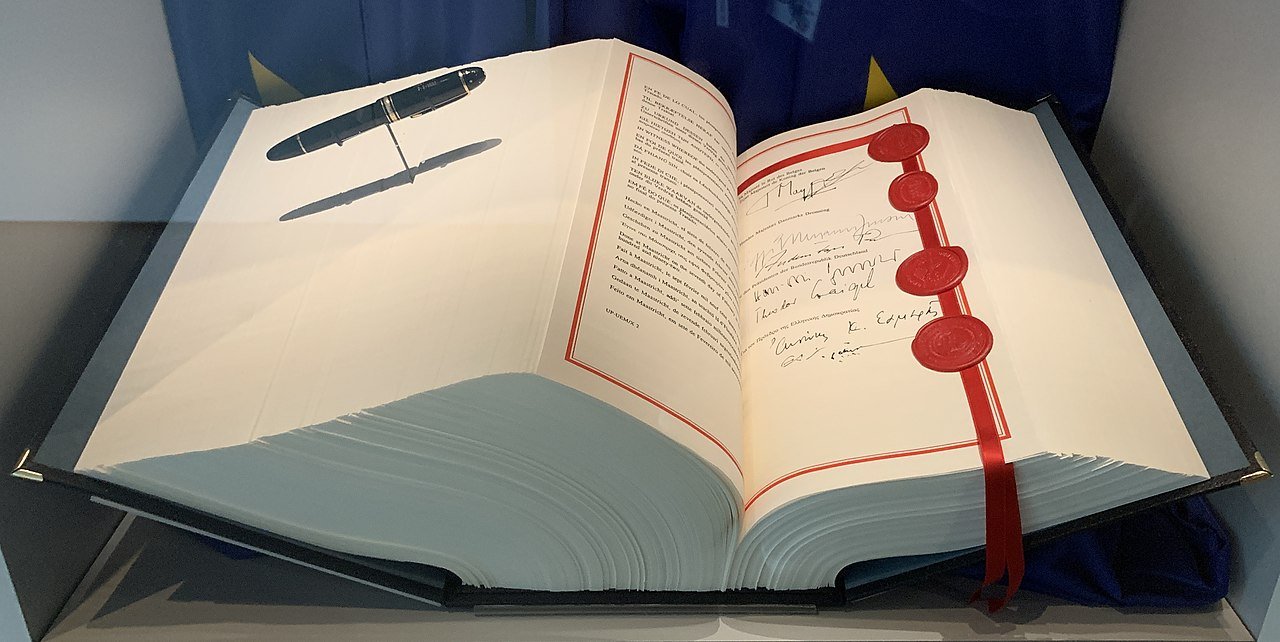
Maastricht Treaty (1992), establishing the EU
- The European Union is one of the world’s largest economic blocs, with a Gross Domestic Product (GDP) that is comparable to that of the United States.
- A country can leave the EU, as stipulated by Article 50 of the Treaty on European Union. The United Kingdom invoked this article and officially left the EU on January 31, 2020.
- Brexit, the United Kingdom’s exit from the EU, has led to significant political, economic, and social changes within the Union, including alterations in budget contributions, trade relationships, and the balance of power within the EU institutions.
- The EU operates a single market which allows free movement of goods, services, capital, and people between member states.
- The EU supports education and research through programs like Erasmus+ and Horizon Europe.
The EU is committed to sustainable development and is a leader in international efforts to combat climate change.
The EU has expanded several times, with Croatia being the latest country to join in 2013.

The EU has 24 official languages: Bulgarian, Croatian, Czech, Danish, Dutch, English, Estonian, Finnish, French, German, Greek, Hungarian, Irish, Italian, Latvian, Lithuanian, Maltese, Polish, Portuguese, Romanian, Slovak, Slovenian, Spanish and Swedish.





