What were the Freedom Rides in 1961?

The Freedom Rides of 1961 were more than just a protest against segregation; they were a profound statement of courage and determination in the face of systemic racism and violence. Image: Freedom Riders plaque in Birmingham, Alabama
The Freedom Rides of 1961 were a pivotal moment in the Civil Rights Movement in the United States, challenging racial segregation in the Southern states’ public transportation systems. These courageous actions by civil rights activists not only exposed the entrenched racism and violence in the South but also led to significant legal and societal changes.
In the article below, World History Edu presents a detailed history and overview of the major facts about the Freedom Rides.
Background and Origins of the Freedom Rides
The Freedom Rides were organized by the Congress of Racial Equality (CORE), a civil rights organization founded in 1942 that was committed to nonviolent resistance to racial segregation. The idea of the Freedom Rides was inspired by the 1947 Journey of Reconciliation, a project also organized by CORE, which tested the Supreme Court’s 1946 ruling in Morgan v. Virginia. This ruling declared that segregation on interstate buses was unconstitutional. However, the 1947 effort, which involved activists riding buses through the Upper South, did not result in widespread change, as enforcement of the ruling was largely ignored in the Southern states.
By 1960, the Civil Rights Movement had gained significant momentum through various nonviolent actions, including sit-ins and boycotts. However, despite the Supreme Court’s rulings in Morgan v. Virginia and the 1960 decision in Boynton v. Virginia (which extended the desegregation ruling to bus terminals), segregation persisted in the South. CORE decided to challenge this by organizing a new series of integrated bus rides through the Deep South, aiming to provoke a crisis that would force the federal government to enforce its own laws.
The Beginning of the Freedom Rides
The first Freedom Ride began on May 4, 1961, when 13 riders—seven African American and six white activists—departed from Washington, D.C., on two buses bound for New Orleans. The riders, who included young activists like John Lewis, James Farmer (CORE’s national director), and future U.S. Congressman John Lewis, were trained in nonviolent resistance and prepared to face violence without retaliating.
Their plan was simple: to travel through the Southern states, deliberately sitting in segregated areas of buses and bus terminals to test compliance with federal desegregation laws. The riders expected hostility, but the level of violence and the response from local authorities and the federal government would surpass their worst fears.
READ MORE: Greatest African-American Civil Rights Activists
Violence and Resistance
The Freedom Riders encountered severe violence almost immediately. In Virginia and North Carolina, they faced arrests but relatively minor confrontations compared to what awaited them further South. The most infamous incidents occurred in Alabama.
On May 14, 1961, one of the buses was attacked by a mob in Anniston, Alabama. The bus was firebombed, and the passengers were brutally beaten as they fled the burning vehicle. The other bus, which continued to Birmingham, was met by another violent mob of Ku Klux Klan members and local white supremacists who viciously attacked the riders. Despite the severe injuries sustained by many of the activists, local police were complicit in the violence, with some officers reportedly allowing the mob free rein before stepping in.
The violence in Alabama captured national attention, forcing the Kennedy administration to take notice. Although the federal government initially hesitated to intervene directly, the public outcry and the persistence of the activists compelled them to act.
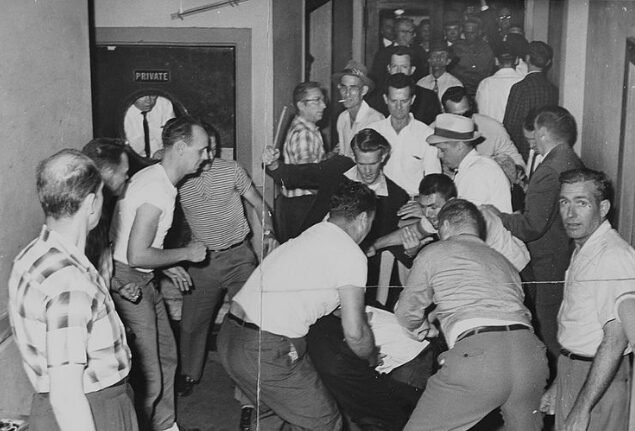
By challenging the laws and customs that upheld segregation in the South, the Freedom Riders forced the federal government to take action and helped pave the way for the broader successes of the Civil Rights Movement. Image: A mob of white people attacking Freedom Riders in Birmingham, Alabama.
Continuation and Escalation of the Rides
Despite the brutality faced by the original group, the Freedom Rides did not end in Alabama. CORE had intended to end the ride in New Orleans, but given the violence, many of the original riders were unable to continue. However, the Student Nonviolent Coordinating Committee (SNCC), a group of college students deeply involved in the Civil Rights Movement, decided to continue the rides.
On May 17, 1961, a new group of Freedom Riders, many of them SNCC members, resumed the journey from Nashville. These riders also faced arrest and violence, but their determination to continue despite these challenges inspired more activists to join.
In Montgomery, Alabama, the riders were attacked again by a violent mob, but this time the response from the federal government was more direct. U.S. Attorney General Robert F. Kennedy sent federal marshals to protect the riders, though the violence continued, and the riders were frequently arrested as they moved from state to state.
The Riders Reach Jackson, Mississippi
The Freedom Riders’ strategy was to force the federal government to enforce desegregation laws by creating a situation that could not be ignored. When they reached Jackson, Mississippi, on May 24, 1961, they were immediately arrested upon entering the segregated facilities. The state of Mississippi adopted a strategy of arresting the riders rather than allowing mobs to attack them, which reduced the immediate violence but did not diminish the riders’ resolve.
Despite being jailed—many were sent to the notoriously brutal Parchman State Penitentiary—the riders continued their protest from behind bars. Their nonviolent persistence garnered increasing national attention and sympathy, putting further pressure on the federal government to act.
Federal Intervention and Legal Impact
The Kennedy administration, under growing pressure, began to take more decisive action. Attorney General Robert Kennedy petitioned the Interstate Commerce Commission (ICC) to enforce stricter regulations against segregation in interstate travel. On September 22, 1961, the ICC issued new rules that required the removal of “whites only” and “colored” signs from bus stations, and mandated desegregation of interstate bus seating, restrooms, and lunch counters.
These regulations went into effect on November 1, 1961, effectively ending segregation in interstate travel. The Freedom Rides had succeeded in forcing the federal government to uphold civil rights laws that had previously been ignored in the South.
Legacy of the Freedom Rides

Image: The Old Montgomery Greyhound Station, site of the May 20, 1961 violence, is preserved as the Freedom Rides Museum
The Freedom Rides were a major turning point in the Civil Rights Movement. They demonstrated the power of nonviolent direct action to bring about change, even in the face of severe violence and oppression. The rides also highlighted the deep-seated racism that still existed in the South and the complicity of local and state governments in maintaining segregation.
The courage of the Freedom Riders inspired other civil rights campaigns, including the continued efforts of the SNCC and the Southern Christian Leadership Conference (SCLC). The rides also helped to galvanize broader public support for the Civil Rights Movement, setting the stage for future legislative victories, including the Civil Rights Act of 1964 and the Voting Rights Act of 1965.
Violence at the Anniston Trailways Terminal, at 901 Noble St., is commemorated with a mural (2012 photo)
Major Facts About the Freedom Rides
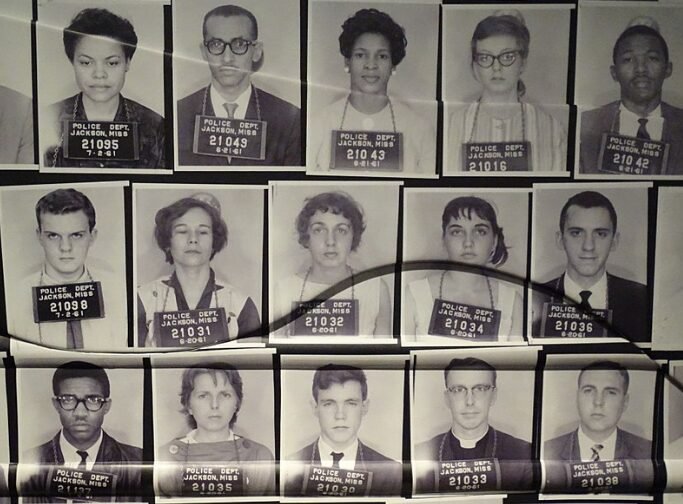
The Freedom Riders’ bravery not only changed the course of American history but also continues to inspire movements for social justice around the world. Image: Mugshots of Freedom Riders, as displayed at the Center for Civil and Human Rights in Atlanta, Georgia
- Inception by CORE: The Freedom Rides were organized by the Congress of Racial Equality (CORE) to challenge segregation in interstate travel, building on the earlier Journey of Reconciliation in 1947.
- Legal Precedents: The rides tested compliance with two Supreme Court rulings: Morgan v. Virginia (1946), which banned segregation on interstate buses, and Boynton v. Virginia (1960), which extended this ban to bus terminals.
- First Ride on May 4, 1961: The first group of Freedom Riders departed from Washington, D.C., on May 4, 1961, with the goal of reaching New Orleans.
- Violence in Alabama: The rides faced extreme violence in Alabama, particularly in Anniston and Birmingham, where buses were firebombed, and riders were beaten by mobs.
- Continuation by SNCC: After the original CORE riders were unable to continue, members of the Student Nonviolent Coordinating Committee (SNCC) picked up the cause and continued the rides.
- Federal Response: The Kennedy administration was initially reluctant to intervene but eventually provided federal marshals for protection and pressured the Interstate Commerce Commission to enforce desegregation.
- Arrests in Jackson, Mississippi: Upon reaching Jackson, Mississippi, riders were arrested for using segregated facilities, leading to continued protests from within the jails.
- Impact on Civil Rights Law: The Freedom Rides led to the Interstate Commerce Commission enforcing new desegregation rules for interstate travel, which went into effect on November 1, 1961.
- Legacy: The Freedom Rides are remembered as a crucial moment in the Civil Rights Movement, demonstrating the effectiveness of nonviolent resistance and contributing to the eventual passage of landmark civil rights legislation.
- Cultural and Historical Recognition: The Freedom Riders’ actions have been commemorated in books, documentaries, and museums, and many of the riders themselves have been honored for their courage and contributions to the fight for civil rights.
Frequently Asked Questions about the Freedom Rides

The legacy of the Freedom Rides is a testament to the power of grassroots activism and the importance of standing up for justice, even when the odds seem insurmountable. Image: A mural commemorating the violence at the Anniston Trailways Terminal, at 901 Noble St.
Here are some questions and answers based on the information about the Freedom Riders:
Who were the Freedom Riders?
The Freedom Riders were groups of both African American and white civil rights activists who took bus trips through the American South in 1961 to protest and challenge the segregation of bus terminals. Their goal was to use facilities designated for “whites only” in bus stations across Southern states.
What was the primary goal of the Freedom Rides in 1961?
The primary goal of the 1961 Freedom Rides was to test the Supreme Court’s 1960 decision in Boynton v. Virginia, which ruled that segregation of interstate transportation facilities, including bus terminals, was unconstitutional. The Freedom Riders sought to enforce this ruling by using segregated facilities across the South.
Who organized the 1961 Freedom Rides, and what previous action inspired them?
The 1961 Freedom Rides were organized by the Congress of Racial Equality (CORE). They were inspired by a similar effort known as the 1947 Journey of Reconciliation, which tested the 1946 U.S. Supreme Court ruling in Morgan v. Virginia that declared segregated bus seating unconstitutional.
What was significant about the composition of the 1961 Freedom Riders compared to the 1947 Journey of Reconciliation?
A significant difference between the 1961 Freedom Rides and the 1947 Journey of Reconciliation was the inclusion of women in the later initiative, reflecting an evolution in civil rights activism.
What happened when the first group of Freedom Riders reached Rock Hill, South Carolina, on May 12, 1961?
In Rock Hill, South Carolina, on May 12, 1961, violence erupted when John Lewis, an African American seminary student, along with other Freedom Riders, was attacked while attempting to enter a whites-only waiting area.
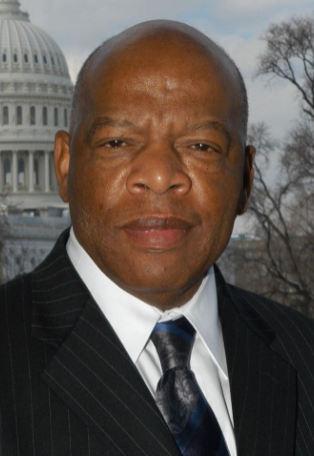
Always a proponent of nonviolent activism, the Alabama-born social justice warrior also participated in the Selma to Montgomery marches in 1965, a march which was aimed at securing voting rights for many disenfranchised African Americans and other minorities living in the United States.
What role did Birmingham Public Safety Commissioner Bull Connor play during the Freedom Rides?
Birmingham Public Safety Commissioner Bull Connor admitted that he knew the Freedom Riders were arriving and that violence awaited them, but he deliberately did not provide any police protection at the bus station because it was Mother’s Day.
How did the Freedom Riders continue their journey after the violent incidents in Alabama?
After the violent incidents in Alabama, CORE initially struggled to find a bus driver willing to continue the journey. However, Diane Nash, a SNCC activist, organized a new group of students from Nashville, Tennessee, to continue the Freedom Rides. With federal intervention and police escort arranged by U.S. Attorney General Robert F. Kennedy, the rides resumed on May 20, 1961.
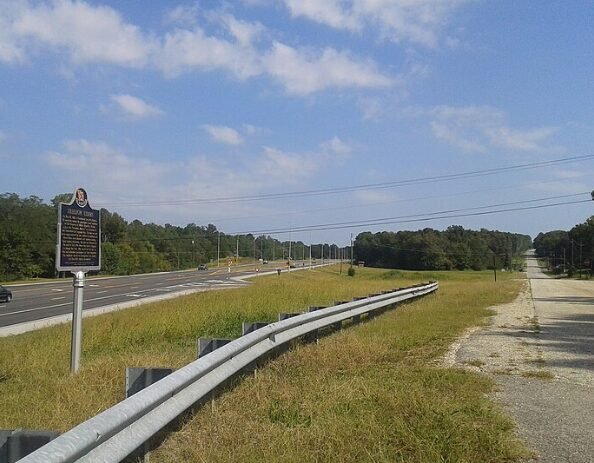
On May 14, 1961, in Anniston, Alabama, an angry mob of about 200 white people surrounded the Greyhound bus carrying the Freedom Riders. The mob pursued the bus, and when its tires blew out, someone threw a bomb into the bus. The Freedom Riders escaped as the bus burst into flames but were then brutally beaten by the mob outside. Image: The Greyhound bus attack site (center) is south of Anniston on Old Birmingham Highway (right)
What was the outcome of the Freedom Rides in Jackson, Mississippi?
When the Freedom Riders reached Jackson, Mississippi, on May 24, 1961, they were arrested for using whites-only facilities and sentenced to jail time. Despite this, the rides continued, attracting more national and international attention to the civil rights movement.
What was the long-term impact of the Freedom Rides?
The Freedom Rides led to increased national and international support for the civil rights movement. The sustained efforts of the Freedom Riders eventually pressured the Interstate Commerce Commission to issue regulations in the fall of 1961 prohibiting segregation in interstate travel facilities.





