French Academic Painter William-Adolphe Bouguereau
William-Adolphe Bouguereau (1825–1905) was one of the most celebrated academic painters of 19th-century France, renowned for his technical skill, classical themes, and mastery of the human form. His life and work embody the ideals of academic art, and his career reflects both the admiration and critique that academic art faced during his time.
Bouguereau’s dedication to realism, meticulous attention to detail, and love for classical subjects made him immensely popular in his lifetime, though his reputation suffered with the rise of modernist art movements. Today, the French painter is regarded as a master of classical beauty, whose works are revisited by contemporary audiences seeking the timeless qualities of the academic tradition.
Early Life and Training
William-Adolphe Bouguereau was born on November 30, 1825, in La Rochelle, France, into a family of wine and olive oil merchants. His early years were marked by a deep connection to religion and nature, partly influenced by his uncle Eugène, a Catholic priest, with whom Bouguereau stayed when he was twelve. This religious background, combined with an appreciation for nature, would later inform his artistic themes and style. Although his parents originally intended him to pursue the priesthood, Bouguereau showed a remarkable talent for art, drawing inspiration from classical literature and religious stories.
In his teens, Bouguereau attended a Catholic college in Pons, where he received instruction in drawing and painting from Louis Sage, a student of the esteemed neoclassical painter Ingres. This early exposure to classical methods instilled a respect for form, precision, and traditional techniques that Bouguereau would maintain throughout his career. Eventually, Bouguereau’s family recognized his passion for art, and in 1841 he was allowed to attend the Municipal School of Drawing and Painting in Bordeaux, where he received further instruction and excelled as one of the top students.
To support his journey to becoming a professional artist, Bouguereau worked as a shop assistant, hand-coloring lithographs and creating small paintings. These efforts, along with his own savings, funded his move to Paris in 1846, where he enrolled in the prestigious École des Beaux-Arts. There, he studied under François-Édouard Picot, an accomplished academic painter who became Bouguereau’s mentor. Under Picot, Bouguereau refined his techniques in anatomy, historical costumes, and classical themes, developing a style characterized by smooth lines, polished surfaces, and careful compositions.
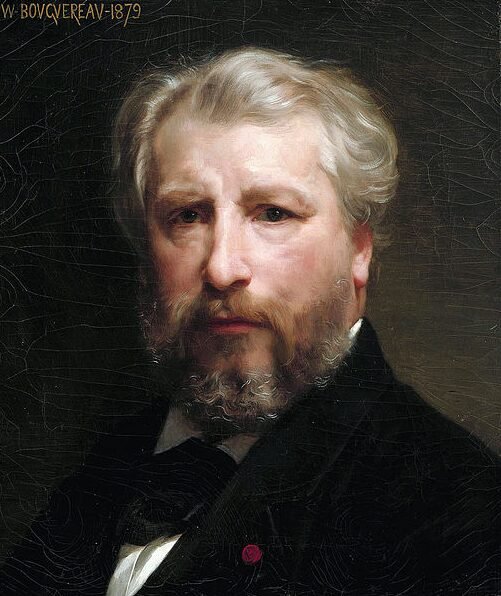
Image: Self-portrait of Bouguereau.
Prix de Rome and Italian Influence
The turning point in Bouguereau’s career came with his pursuit of the Prix de Rome, a prestigious award granted to outstanding students at the École des Beaux-Arts. The prize allowed winners to study in Rome, where they would gain firsthand experience with Renaissance masterpieces and ancient artifacts. After several attempts, Bouguereau finally won the award in 1850 with his painting Shepherds Find Zenobia on the Banks of the Araxes. His victory allowed him to travel to Italy, where he studied the works of Renaissance masters like Raphael, Michelangelo, and Titian. This period in Rome solidified Bouguereau’s dedication to classical themes, meticulous technique, and his idealized portrayals of the human form.
Bouguereau’s time in Italy greatly influenced his artistic philosophy. He admired the balanced compositions, anatomical precision, and harmonious forms of ancient Greek and Roman art, which he studied in depth. This experience reinforced his belief in the importance of classical beauty and the ability of art to transcend the ordinary, a perspective he brought back with him to France.
Rise to Fame in France
Upon returning to France, Bouguereau’s career gained momentum as he established himself within the Paris Salon, the annual exhibition held by the Académie des Beaux-Arts. The Salon was the most influential platform for artists in France, and exhibiting there brought significant recognition and commercial success. Bouguereau’s early works, such as Dante and Virgil in Hell (1850), showcased his ability to balance classical themes with modern sensibilities, appealing to a wide range of audiences.
Throughout the 1850s and 1860s, Bouguereau produced works that combined mythological, religious, and allegorical subjects, earning praise for his precise anatomy and idealized portrayals. His paintings, such as The Birth of Venus (1879) and Nymphs and Satyr (1873), exemplify his interest in the human form, especially the female figure, which he rendered with a sense of grace and ethereal beauty. Bouguereau’s style became synonymous with elegance, attention to detail, and technical mastery, qualities that made his work highly sought after by collectors.
Themes and Style
Bouguereau’s work can be divided into several major themes: mythological scenes, religious works, allegorical paintings, and genre scenes featuring women and children. In his mythological works, Bouguereau brought classical figures to life in idealized, yet sensuous, portrayals. The Birth of Venus and Psyche et L’Amour (1889) reflect his ability to capture the beauty of the human form within a mythological framework, evoking the classical beauty of Greek and Roman art.
In his religious paintings, Bouguereau combined realism with idealization, presenting biblical figures with the same grace he applied to mythological subjects. Works like Pietà (1876), painted after the death of his son Georges, reveal a personal depth and sincerity that reflect Bouguereau’s own grief. These works demonstrate his ability to communicate complex emotions while adhering to the academic style of polished surfaces and harmonious compositions.
Bouguereau also created genre scenes that depicted rural and domestic life, often featuring young women and children in idealized settings. Works such as The Knitting Girl (1869) and The Little Shepherdess (1889) capture the innocence and beauty of everyday moments, appealing to viewers’ sense of nostalgia and affection for simpler times. These paintings reflected his appreciation for rural life, which he associated with purity and moral integrity.
Technique and Artistic Process
Bouguereau’s meticulous technique was central to his artistic success. He approached each painting with a series of preparatory sketches and studies, ensuring that every element was carefully planned. This process involved detailed anatomical studies, oil sketches, and compositional adjustments, all aimed at achieving harmony and perfection. His careful method resulted in a “licked” finish, a smooth, polished surface that minimized visible brushstrokes, lending his paintings a lifelike, photographic quality.
His approach reflected the academic tradition’s emphasis on skill, discipline, and mastery over one’s craft. Bouguereau’s expertise in painting skin, hands, and feet was particularly admired, as he could render flesh with a luminosity and softness that enhanced the realism of his figures. This polished style made him a master of academic painting but also attracted criticism from avant-garde artists who saw his works as overly refined and lacking spontaneity.
Reception and Criticism
While Bouguereau was highly regarded among academic circles and affluent patrons, he faced criticism from the emerging avant-garde movements, particularly the Impressionists. Artists like Degas and Manet viewed Bouguereau’s style as overly polished and conventional, often using the term “Bouguereauté” to describe the slick, “licked” finish they disapproved of. This tension between academic and modern art reflected a broader shift in the art world, as Impressionism, with its loose brushwork and focus on natural light, gained prominence.
Despite the criticism, Bouguereau’s popularity continued to grow, especially among wealthy collectors in the United States. His work, such as Nymphs and Satyr, found its way into prominent collections, and he received numerous honors, including the Legion of Honor and the title of Commander. Bouguereau was also a respected teacher, influencing generations of artists at the Académie Julian, where he encouraged students to pursue the academic style. Notable artists such as Elizabeth Jane Gardner, whom he later married, were among his students.
Personal Life and Later Years
Bouguereau’s personal life was marked by both success and tragedy. His first wife, Nelly Monchablon, bore him five children, but he outlived four of them, enduring profound personal loss that influenced his work. After Nelly’s death in 1877, Bouguereau married Elizabeth Jane Gardner, his former student and a talented painter. Gardner supported him in both his career and personal life, enabling Bouguereau to continue his rigorous artistic production.
Despite changing tastes in the art world, Bouguereau remained steadfast in his dedication to academic art until his death on August 19, 1905. He continued to paint with remarkable productivity, often completing over twenty works per year. Even as modernism gained popularity and Bouguereau’s work began to fall out of favor, he remained committed to his belief in beauty, order, and technical mastery.
Legacy and Resurgence of Interest
Bouguereau’s reputation declined in the early 20th century as modern art movements, particularly Impressionism, Cubism, and Surrealism, reshaped the art world. His work was dismissed by critics as conservative, and he became emblematic of an outdated academic tradition. However, in the latter half of the 20th century, particularly in the 1980s, there was a revival of interest in figurative and academic art, leading to a renewed appreciation for Bouguereau’s skill and dedication.
Retrospective exhibitions, such as those held by the Milwaukee Art Museum and the Memphis Brooks Museum, reintroduced his work to contemporary audiences, highlighting his technical brilliance and timeless appeal. Today, Bouguereau’s works are highly valued, with paintings fetching millions at auction. Collectors and art enthusiasts recognize him as a master of academic painting, whose focus on beauty, harmony, and human form offers a counterpoint to the abstract and conceptual trends that followed him
Frequently Asked Questions
When and where was William-Adolphe Bouguereau born?
Bouguereau was born on November 30, 1825, in La Rochelle, France.
What early influences shaped Bouguereau’s artistic development?
Bouguereau grew up in a religious family and developed a deep appreciation for nature, religion, and discipline while staying with his priest uncle. These influences shaped his meticulous and disciplined artistic style.
How did Bouguereau’s formal art education begin?
Bouguereau studied under artist Louis Sage in Pons, then moved to Bordeaux where he hand-colored lithographs and created small paintings. In 1846, he moved to Paris, enrolled at the École des Beaux-Arts, and studied under the academic painter François-Édouard Picot.
What significant prize did Bouguereau win early in his career, and how did it impact him?
Bouguereau won the Prix de Rome with Shepherds Find Zenobia on the Banks of the Araxes, allowing him to study in Italy. This experience influenced his focus on classical themes, the human form, and precise technique.
Which classical influences did Bouguereau admire during his studies in Italy?
Bouguereau admired Renaissance artists like Raphael and Michelangelo, as well as ancient Greek and Roman art. These influences inspired his lifelong dedication to classical subjects and refined technique.
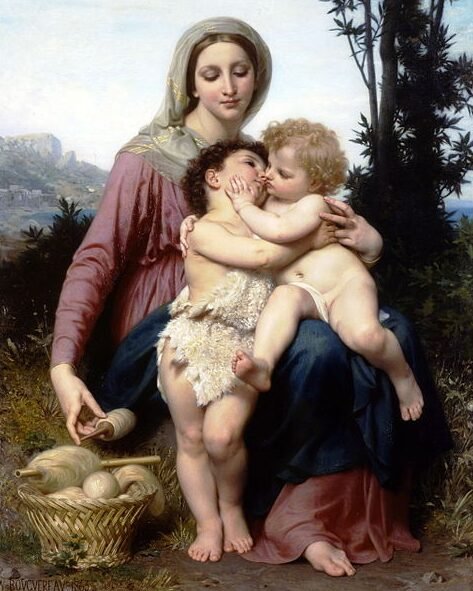
Image: “The Holy Family”, an 1863 work by Bouguereau.
How did Bouguereau’s career progress after he returned to France?
He gained momentum by showcasing his works at the Paris Salon, gaining praise for his classical themes and realistic depictions of the human body, which attracted wealthy patrons and led to commissions for private and public art.
What were the common themes in Bouguereau’s works?
He frequently depicted mythological and religious subjects, including goddesses, nymphs, and madonnas, all portrayed with technical perfection and attention to human anatomy.
Which accolade did Bouguereau receive in 1859?
Bouguereau was awarded the Legion of Honor in 1859, solidifying his status within the French academic art community.
What role did Bouguereau have at the Académie Julian?
Bouguereau taught at the Académie Julian for many years, influencing a new generation of artists and helping shape the careers of students like Henri Matisse.
How did avant-garde artists view Bouguereau’s work?
Avant-garde artists, especially the Impressionists, criticized Bouguereau’s polished style, calling it “Bouguereauté” to imply an overly smooth finish that lacked spontaneity.
How did Bouguereau’s personal life and tragedies impact his work?
Bouguereau experienced significant personal loss, including the death of four of his five children and his first wife, Nelly. His grief influenced religious paintings, such as Pietà, created in tribute to his son Georges.
Who was Elizabeth Jane Gardner in Bouguereau’s life?
Elizabeth Jane Gardner was Bouguereau’s former student and second wife, who supported him and helped manage his household, allowing him to continue his artistic pursuits.
What characterized Bouguereau’s later years as an artist?
He remained dedicated to his craft, producing over twenty paintings each year even as modernist movements gained popularity. He continued to work until his death in 1905.
How did Bouguereau’s reputation evolve after his death?
Bouguereau’s work fell out of favor as modernism rose, but a revival in the 1980s renewed appreciation for his technical skill and classical beauty, leading to high auction prices and major retrospectives.





