Goethe: The Great German Poet and Philosopher
Johann Wolfgang von Goethe (1749–1832) is celebrated as one of the greatest writers in the German language and a towering figure in Western intellectual history. A polymath, Goethe’s contributions extended far beyond poetry and drama, encompassing fields like science, philosophy, and politics. His writings influenced generations of artists, thinkers, and scientists, and his works remain a cornerstone of German literature and culture.

Johann Wolfgang von Goethe’s life and works encompass an extraordinary range of achievements in literature, science, philosophy, and the arts. Image: An 1810 portrait of Goethe by German painter Gerhard von Kügelgen.
Who really was Johann Wolfgang von Goethe? And what were his main contributions to various fields?
In This comprehensive exploration of Goethe’s life and major works, WHE sheds light on the intellectual journey of a man whose thoughts and writings shaped the course of European thought and culture.
Early Life and Education (1749–1765)
Johann Wolfgang von Goethe was born on August 28, 1749, in Frankfurt am Main, into a wealthy bourgeois family. His father, Johann Caspar Goethe, was a lawyer, and his mother, Catharina Elisabeth Textor, was from a prominent family. Young Goethe was given a privileged education at home, where he studied Latin, Greek, French, Italian, and English. His father was determined to give him a broad and rigorous education, exposing him to literature, music, and art, as well as the natural sciences.
Goethe’s early exposure to literature and classical works, combined with his innate curiosity and wide-ranging intellect, laid the foundation for his later literary and intellectual achievements. His early interest in languages, combined with his inquisitiveness about nature and the human condition, would influence his later work in multiple disciplines.
University and Early Literary Success (1765–1775)
In 1765, Goethe entered the University of Leipzig to study law, as his father wished. However, Goethe was more interested in literature, art, and theater than legal studies. In Leipzig, he encountered contemporary writers and thinkers and began to develop his own style. His first works were light and playful, including his collection of poems Annette, inspired by his relationship with Anna Katharina Schönkopf.
Goethe’s experience in Leipzig was transformative for his literary ambitions. He began writing poetry seriously and took up drawing and painting as well. His first published work, Die Laune des Verliebten (The Lover’s Caprice), appeared in 1767 and was followed by the pastoral drama Die Mitschuldigen (The Accomplices).
After a serious illness in 1768, Goethe returned to Frankfurt, where he continued his law studies. In 1770, he moved to Strasbourg to complete his degree. It was here that he met Johann Gottfried Herder, an influential philosopher and literary critic, who introduced Goethe to the Sturm und Drang movement. Herder’s ideas about folk culture and poetry had a significant impact on Goethe, inspiring him to explore themes of nature, emotion, and individualism.

Image: A portrait of Goethe by German artist Joseph Karl Stieler.
The Sorrows of Young Werther (1774) and the Sturm und Drang Movement
Goethe’s early literary career was defined by his association with the Sturm und Drang (Storm and Stress) movement, which emphasized emotion, individuality, and a rebellion against the rationalism of the Enlightenment. His novel The Sorrows of Young Werther (1774) became the defining work of this period and made Goethe an overnight literary sensation.
The Sorrows of Young Werther tells the tragic story of a young man who falls in love with a woman engaged to another man. His intense emotional suffering ultimately leads to his suicide. The novel resonated deeply with young readers across Europe and contributed to the cult of sensibility that characterized the Romantic era. Goethe’s portrayal of unrequited love, emotional turmoil, and the alienation of the individual struck a chord with the disillusionment of the age. The novel’s impact was so profound that it led to a wave of copycat suicides, known as “Werther fever,” leading some cities to ban the book.
Despite the success of Werther, Goethe became wary of its impact. He later distanced himself from the novel, feeling that it reflected an immature and overly sentimental view of life. However, it remained one of his most famous works and solidified his reputation as a leading figure of German literature.
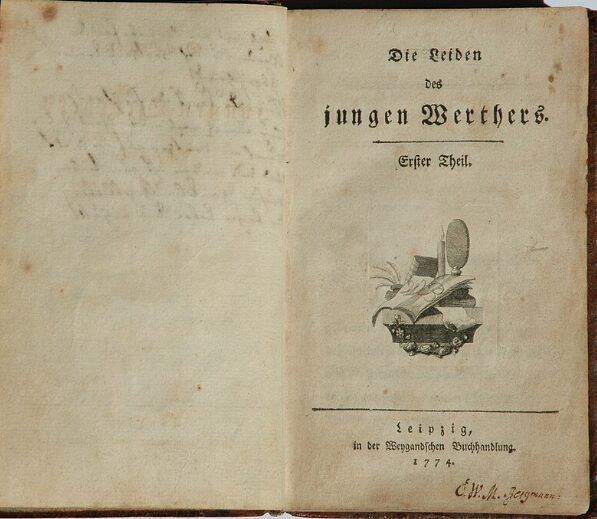
The first edition of The Sorrows of Young Werther (1774) by Goethe is a tragic romantic novel.
Move to Weimar and Weimar Classicism (1775–1805)
In 1775, Goethe was invited to Weimar by Duke Karl August of Saxe-Weimar-Eisenach. Weimar was a small but culturally vibrant court, and Goethe’s arrival marked the beginning of a long and fruitful relationship with the city. Goethe quickly became a central figure in Weimar’s intellectual and artistic life, and in 1782, he was ennobled by the Duke, becoming Johann Wolfgang von Goethe.
Goethe took on numerous political and administrative roles in Weimar. He served as a member of the Duke’s privy council, oversaw infrastructure projects, and implemented reforms at the University of Jena. He also became involved in scientific research, particularly in the fields of botany, anatomy, and geology. Despite his many responsibilities, Goethe continued to write, producing works that would come to define Weimar Classicism.
One of the most important developments during this period was Goethe’s friendship with Friedrich Schiller, a playwright, poet, and philosopher. The two men collaborated on numerous projects and together helped shape the Weimar Classicism movement, which sought to synthesize the ideals of classical antiquity with Enlightenment rationalism. Their collaboration produced some of the most important works of German literature and philosophy.
Scientific Work: The Metamorphosis of Plants (1790)
Goethe’s interests were not confined to literature. He was also deeply engaged in scientific pursuits, particularly in the study of nature. In 1790, he published The Metamorphosis of Plants, a work that explored his theory of plant morphology. Goethe proposed that all plant forms are variations of a single archetype, an idea that anticipated later developments in evolutionary biology.
Goethe’s scientific work was often met with skepticism by his contemporaries, but he considered his contributions to science to be just as important as his literary achievements. His studies in color theory, for instance, challenged the prevailing Newtonian view of light and color.
In his Theory of Colors (1810), Goethe argued that color is perceived through the interaction of light and darkness, and that human perception plays a key role in the experience of color. While his color theory did not gain widespread acceptance in the scientific community, it influenced later thinkers, including philosophers such as Arthur Schopenhauer and artists like J.M.W. Turner.

Wilhelm Meister’s Apprenticeship (1795–96) and the Bildungsroman
One of Goethe’s most significant contributions to Western literature was his novel Wilhelm Meister’s Apprenticeship, published between 1795 and 1796. The novel is considered the prototype of the Bildungsroman, or coming-of-age novel, and it follows the personal and professional development of Wilhelm Meister as he embarks on a journey of self-discovery.
Wilhelm Meister’s Apprenticeship explores themes of education, art, and the search for meaning in life. The novel’s structure, which focuses on the protagonist’s gradual maturation and understanding of the world, became a model for countless subsequent works in the genre. The German philosopher Arthur Schopenhauer later hailed it as one of the four greatest novels ever written.
The Faust Legend (1808 and 1832)
Perhaps Goethe’s most famous work is Faust, a dramatic poem that he worked on for most of his life. The first part of Faust was published in 1808, and the second part appeared posthumously in 1832, just before Goethe’s death. The story is based on the Faust legend, which tells of a scholar who makes a pact with the devil, exchanging his soul for unlimited knowledge and worldly pleasures.
Goethe’s Faust is much more than a simple retelling of the legend. It explores profound philosophical themes, including the nature of knowledge, the limits of human ambition, and the tension between good and evil. In Faust Part I, the protagonist, Faust, is a disillusioned scholar who yearns for deeper meaning in life. He makes a pact with Mephistopheles, a devilish figure who offers to satisfy Faust’s desires in exchange for his soul. The first part ends with Faust’s tragic involvement with Gretchen, a young woman whose life is destroyed by their relationship.
Faust Part II, which Goethe worked on for decades, is more abstract and philosophical. It spans multiple settings and eras, exploring themes of politics, economics, and art. Unlike the traditional Faust legend, Goethe’s version concludes with Faust’s redemption, as he strives for higher ideals and is ultimately saved by divine grace.
Faust is considered one of the greatest works of Western literature. Its complexity, depth, and exploration of universal themes have made it a cornerstone of the literary canon, influencing writers, philosophers, and artists for centuries.

Faust I, first edition, 1808
Later Years and Legacy (1805–1832)
The final decades of Goethe’s life were marked by both personal loss and literary triumph. In 1805, Goethe’s close friend and collaborator Friedrich Schiller died, leaving him deeply saddened. However, Goethe continued to write and publish important works, including Elective Affinities (1809), a novel that explores the conflict between passion and social obligation, and West-Eastern Divan (1819), a collection of poems inspired by Persian literature.
Goethe’s later years also saw him become an international figure. His works were translated into numerous languages, and he corresponded with writers and intellectuals across Europe. In 1831, Goethe completed the second part of Faust, bringing to a close one of the most ambitious literary projects in history.
Goethe died on March 22, 1832, at the age of 82, in Weimar. His death marked the end of an era in German literature and thought, but his influence continued to grow. Throughout the 19th and 20th centuries, Goethe’s ideas and works were celebrated by philosophers, including Friedrich Nietzsche and Sigmund Freud, as well as by writers like Thomas Mann and Hermann Hesse. His concept of Weltliteratur (world literature) anticipated a more interconnected and global approach to literary studies.

Goethe’s Influence on Music, Art, and Philosophy
Goethe’s influence extended far beyond the realm of literature. His works inspired numerous composers, including Wolfgang Amadeus Mozart, Ludwig van Beethoven, Franz Schubert, Hector Berlioz, Franz Liszt, Richard Wagner, and Gustav Mahler, many of whom set Goethe’s poems to music.
Goethe’s ideas about art, particularly his color theory, also influenced painters and visual artists. The English artist J.M.W. Turner, for instance, was deeply inspired by Goethe’s views on the interplay of light and color.
Philosophically, Goethe’s impact was profound. His emphasis on individualism, emotional depth, and the interplay between nature and human experience resonated with thinkers like Ralph Waldo Emerson, who included Goethe in his influential work Representative Men, alongside figures like Plato and Shakespeare. Goethe’s works also had a lasting impact on the development of existentialism and modernist literature.

Questions and Answers: Johann Wolfgang von Goethe

Goethe, by German painter Luise Seidler
What were Goethe’s main contributions to various fields?
Goethe was a poet, playwright, novelist, scientist, statesman, theater director, and critic. His contributions spanned literature, aesthetic criticism, and scientific treatises on subjects like botany, anatomy, and color theory.
Which novel helped establish Goethe’s literary prominence, and what movement did it align with?
Goethe’s first novel, The Sorrows of Young Werther (1774), brought him literary fame. The novel is associated with the Sturm und Drang movement, which emphasized emotion and individualism and sought to break away from the rationalism of the Enlightenment.
When did Goethe move to Weimar, and why was this city significant for his career?
Goethe moved to Weimar in November 1775 following the success of Werther. Weimar was an intellectual and cultural hub, where Goethe became a central figure under the patronage of Duchess Anna Amalia.
What role did Duke Karl August of Saxe-Weimar play in Goethe’s life?
Duke Karl August ennobled Goethe in 1782 and appointed him to various political and administrative roles, including serving on the Duke’s privy council and overseeing projects like the reconstruction of the Ducal Palace and the development of Weimar’s botanical gardens.
What was Goethe’s first major scientific work, and what was its focus?
Goethe’s first major scientific work, The Metamorphosis of Plants (1790), focused on plant morphology. In it, Goethe proposed that all plant forms are derived from a single primal plant, an idea that anticipated later developments in evolutionary biology.

Image: A painting of Goethe by German artist Ferdinand Jagemann.
How did Goethe contribute to German theater, and what key relationship did he form during this period?
In 1791, Goethe became the managing director of the Weimar theater, where he helped shape German theater. During this time, he formed a close friendship with Friedrich Schiller, marking the beginning of Weimar Classicism. They collaborated on numerous plays and intellectual projects.
What major works did Goethe produce during the Weimar Classicism period?
During this period, Goethe published his second major novel, Wilhelm Meister’s Apprenticeship, which is considered a foundational work of the Bildungsroman genre. He also wrote the verse epic Hermann and Dorothea and the first part of his famous drama Faust.
What is Faust about, and why is it significant?
Faust is a dramatic poem about a scholar who makes a pact with the devil in exchange for worldly knowledge and pleasures. It is considered one of the defining works of Western literature, exploring themes of ambition, knowledge, and human striving.
Who were some of Goethe’s intellectual contemporaries, and how did they influence his work?
Goethe’s intellectual circle in Weimar included figures such as Johann Gottlieb Fichte, Johann Gottfried Herder, and the Humboldt brothers, Wilhelm and Alexander. Their collective influence helped enrich Goethe’s interdisciplinary ideas, spanning literature, science, and philosophy.
How did Goethe’s influence extend beyond Germany, and who recognized his legacy internationally?
Goethe’s influence crossed national borders. American philosopher Ralph Waldo Emerson included Goethe in his work Representative Men, listing him alongside Plato, Shakespeare, and Napoleon as one of the great minds of history.

How did Goethe’s work impact music, and which composers set his poems to music?
Goethe’s poems were set to music by several renowned composers, including Mozart, Beethoven, Schubert, Berlioz, Liszt, Wagner, and Mahler, cementing his influence in the world of music.
What biographical work provides insights into Goethe’s thoughts and conversations?
Conversations with Goethe, written by Johann Peter Eckermann in 1836, is a biographical work that offers valuable insights into Goethe’s reflections on art, science, and philosophy.

Goethe’s legacy as a writer, thinker, and scientist has endured for centuries. His works continue to influence literature, music, philosophy, and biology, and are celebrated for their depth, innovation, and impact on Western culture. Image: Goethe memorial in Leipzig, Germany.