Karl Marx
Karl Marx was a German philosopher who was renowned for his revolutionary thinking that served as the basis for many communist regimes in the twentieth century, when Marxism became the official ideology of the German Social Democrats. Together with fellow social science theorist, Friedrich Engels, Marx published “The Communist Manifesto” in 1848. For how influential his ideas became, Marx is generally considered one of the greatest thinkers in modern history.
In the article below, World History Edu explores the life and major works of Karl Marx, including his views about capitalism.
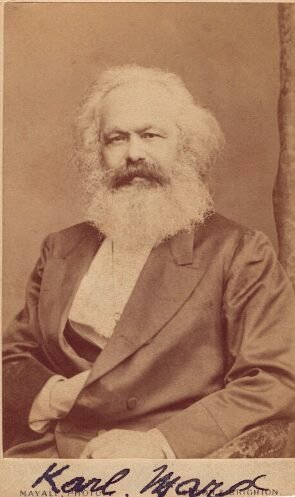
Karl Marx was a German philosopher, political theorist, economist, historian, sociologist, journalist, and revolutionary socialist. He is best known for his works “The Communist Manifesto” and “Das Kapital.” Image: Marx photographed by John Mayall, 1875
Biography
Marx was born in Trier, Prussia to Heinrich Marx and Henriette Pressburg. The Marx family lived a comfortable life thanks to Heinrich’s job as a lawyer. Despite coming from a Jewish background Heinrich was not a religious person and considered himself a follower of the Enlightenment movement. Karl’s mother mother, Henriette, was from a successful Dutch family who founded the Philips Electronics company.
Marx had eight siblings and eventually became the oldest surviving boy out of them when his older brother Moritz passed away.
He attended Trier High School, and in 1835, enrolled at the University of Bonn. Although he had wanted to study literature and philosophy, his father encouraged him to pursue law.
While he was in college, Marx had an active social life. He joined the Poets’ Club, that included political activists and served as the president of the Tavern Club, which was a drinking club where the group also discussed political ideologies.

Born in Trier in the Kingdom of Prussia, Marx pursued his studies at the universities of Bonn, Berlin, and Jena, obtaining a doctorate in philosophy from the latter in 1841. Image: Marx’s birthplace, now Brückenstraße 10 in Trier, housed his family in five rooms. Purchased by the Social Democratic Party of Germany in 1928, it is now a museum dedicated to him.
In 1836, Marx left the university due to poor grades and transferred to the University of Berlin, where he studied law and philosophy. That same year he announced his engagement to Jenny von Westphalen, who was from a noble family and had been childhood friends with Marx. Their relationship was met with much controversy since the couple were from different social classes and religions. Nonetheless, they married seven years later in 1843.

Jenny came from an aristocratic Prussian family. Her father, Ludwig von Westphalen, was a baron and a government official. Her mother was Amalia Julia Carolina von Westphalen. Image: Jenny von Westphalen in the 1830s
While at the University of Berlin, Marx grew increasingly interested in the philosopher Georg Wilhelm Friedrich Hegel, whose thoughts and ideas had spurred several discussions among philosophical circles in Europe.
He joined the Young Hegelians in 1837 with other popular theologians Bruno Bauer and David Friedrich Strauss. The group often critiqued Christianity and advocated against the Prussian monarchy.
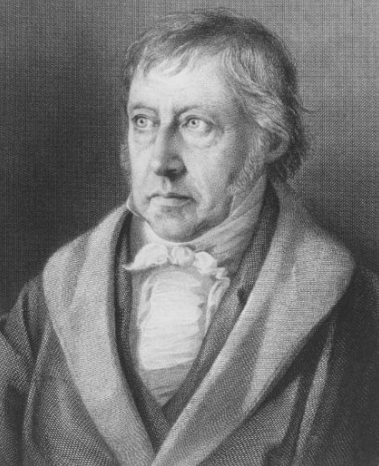
Image: Portrait of G.W.F. Hegel (1770-1831)
Writing and Journalism Career
Around the late 1830s, Marx also took up fiction and non-fiction writing and completed his first novel “Scorpion and Felix”, as well as a drama “Oulanem”. He also wrote several poems, which he dedicated to his wife Jenny.
In 1841, after shifting his focus from fiction to other writing projects, he completed his doctoral thesis “The Difference Between the Democritean and Epicurean Philosophy of Nature.” His work was met with much criticism among professors at his university, so he submitted his work to the University of Jena and received his PhD.
The following year, Marx became a journalist and started contributing to Rheinische Zeitung (Rhineland News) newspaper, which spoke against the Prussian monarchy in one of its issues. As a result, Russian Tsar Nicholas I ordered the paper to be closed.
In 1843, Marx moved to Paris and worked for the radical left-wing newspaper German-French Annals (Deutsch-Französische Jahrbücher). During his time in France, he started building ties in the French and German societies. He also befriended German socialist Friedrich Engels in Paris. The two men were said to have met on 28 August 1844 the Café de la Régence, beginning a lifelong friendship and academic collaboration.
In 1845, Marx was expelled from France for his controversial thoughts and moved to Brussels, Belgium.
While in Brussels, Marx published “The Holy Family” with Engels. The two men also published a set of manuscripts called “The German Ideology.” Marx also wrote “The Poverty of Philosophy” in 1847. These literary works inspired his most famous work “The Communist Manifesto.”
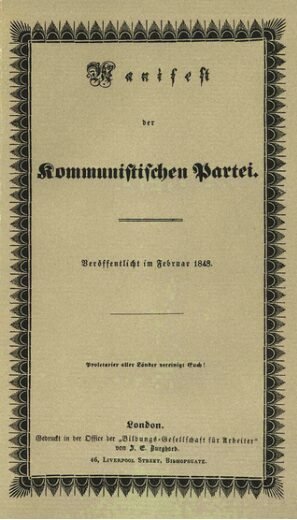
Marx’s main works include “The Communist Manifesto” (1848), co-authored with Friedrich Engels, and the three-volume “Das Kapital” (1867–1894). Image: The first edition of The Manifesto of the Communist Party, published in German in 1848
The Revolution
In 1848, several waves of revolutions broke throughout Europe. Marx moved to Paris and eventually moved with his family to London. While in London, he wrote two pamphlets “The Class Struggles in France” and ‘The 18th Brumaire of Louis Bonaparte.”
Marx’s Religious Beliefs
Marx famously described religion as the “opium of the people” (“Die Religion ist das Opium des Volkesis”) in his critique of Hegel’s “Philosophy of Law.” He viewed religion as a tool of exploitation, believing that it only existed because social conditions continued to be oppressive. In other words, religion was a reflection of the economic injustices in societies and that the problems found in religion were found in society as well.
He had three reasons for his dislike and criticism of religion. Marx felt it was irrational and made little sense, that religion was an escape for society to avoid the real problems of life.
He was also of the view that religion stripped human beings of their dignity, leaving them subservient and accepting whatever came to them.
Lastly, he found religion to be extremely hypocritical. Marx felt that although religion had some valuable principles, it largely supported the activity of oppressors.
Philosophy
Over the course of time, Marx has been regarded for his groundbreaking thoughts and philosophies. His thoughts sparked conversations in various subjects, including economics, history, philosophy, and politics. His works even helped in the establishment of sociology as an academic field.
In contemporary times, Marx’s work helps many theorists to make sense of social events and structures that continue to shape the lives of humanity.
Marx expressed his thoughts in economics in “Large Capital Volume I” and “The Communist Manifesto.” His observations helped many understand the correlation between market competitions and technological advances, as well as the role of boom or bust cycles. Some of his early works also touched on globalization and the importance of international trade.
He viewed capitalism as more than economic system. Instead, he saw it as a system of social relations. Marx held several philosophical views about human societies, including human nature, labor and class struggles, and international relations.
Although he had many views during his time, Marx was never able to fully pursue a career in philosophy due to his radical views. Most of his works didn’t become popular until the following century and continued to be studied in various academic fields.
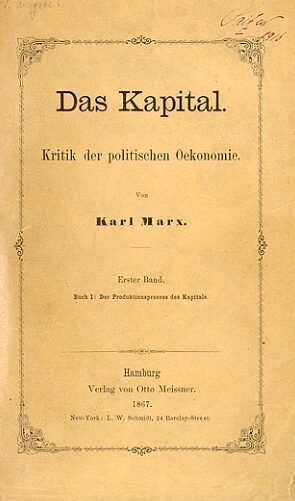
“Das Kapital” is a critical analysis of political economy, particularly capitalism, and is considered one of Marx’s most important works. It examines the nature of capital, labor, and economic development. Image: The first volume of Das Kapital
Later Life and Death
In the early 1880s, Marx’s health started to decline. He still continued to make contributions in politics. He criticized the German government in “Critique of the Gotha Programme” (1875).
When his health continued to fail after the death of Jenny, he travelled to Algeria for treatment.
Marx eventually passed away in 1883 from bronchitis and pleurisy.
Because he had renounced his citizenship, he was declared stateless and was buried in London. He was survived by his two daughters, Eleanor and Laura.

Tomb of Karl Marx in London, England
Did you know…?
Jenny Carolina and Jenny Laura Marx, both born in 1869, were named after their mother, Jenny von Westphalen. In fact, all the Marx daughters were named Jenny to honor their mother. This tradition highlights the significant influence and respect Karl Marx had for his wife.

Image (left to right) Karl Marx (1818–1883), Friedrich Engels (1820–1895), and Marx’s daughters: Jenny Caroline (1844–1883), Jenny Julia Eleanor (1855–1898), and Jenny Laura (1845–1911). Photograph c. 1864.
Legacy
Karl Marx’s writings and works greatly led to the creation of modern sociology and is regarded as one of the leading pioneers of social science.
Marx’s works also inspired several theories, including “Creative destruction”, “Crisis theory”, “Quantitative Economic History”, and “World Systems Theory.”
His writings had a significant impact on world politics and led to the development many popular ideologies, including Leninism, Maoism, Luxemburgism, and Trotskyism among many others.
Also, his writings sparked several communist revolutions worldwide in the twentieth century, including China, North Korea, and Cuba. The difference in political ideologies sparked the Cold War, which was a war on ideologies between the capitalist West and Communist East.

The theory of surplus value, detailed by Marx in “Das Kapital,” is the difference between the value produced by labor and the wages paid to labor. Marx viewed this surplus value as the source of exploitation and class struggle in capitalist societies. Image: Marx and Engels in the printing house of the Neue Rheinische Zeitung. E. Capiro, 1895
Marx and Engels monument was erected at the Marx-Engels Forum in Berlin-Mitte. A solo statue of Marx can also be found in Trier.
He appeared on a 1968 Soviet Union postal stamp on his 150th birthday.
Marx’s works inspired Russian Leader, Vladimir Lenin, eventually leading to the formation of the Soviet Union led by the Communist Party.
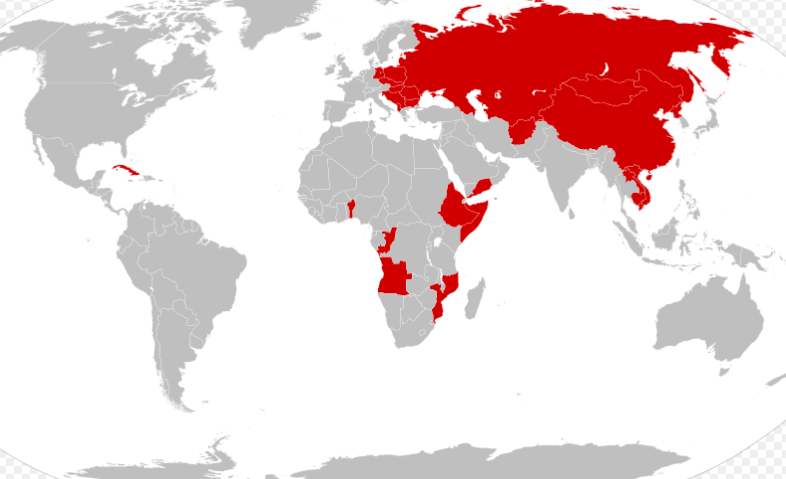
Image: A map showing countries that declared themselves socialist states under the Marxist-Leninist or Maoist definition between 1979 and 1983, marking the greatest territorial extent of socialist states. The highlighted countries include the Soviet Union, China, Vietnam, Laos, Cambodia, North Korea, Cuba, Angola, Mozambique, Ethiopia, Benin, and Afghanistan.
Questions and Answers about Karl Marx

Image: Karl Marx in 1882
Karl Marx was a German philosopher, political theorist, economist, historian, sociologist, journalist, and revolutionary socialist. He is best known for his works “The Communist Manifesto” (1848), co-authored with Friedrich Engels, and the three-volume “Das Kapital” (1867–1894).
Below are some of the most asked question about Karl Marx:
What are the primary works of Karl Marx, and what do they address?
The primary works of Karl Marx are “The Communist Manifesto” and “Das Kapital.” “The Communist Manifesto” outlines Marx’s ideas and revolutionary program, while “Das Kapital” employs his critical approach of historical materialism to analyze capitalism.

Historical materialism is a theory developed by Karl Marx which posits that the material conditions of a society’s mode of production fundamentally determine its organization and development. Image: Karl Marx Monument in Chemnitz (known as Karl-Marx-Stadt from 1953 to 1990)
Where and when was Karl Marx born?
Karl Marx was born in Trier in the Kingdom of Prussia on 5 May 1818.
Which universities did Karl Marx attend?
Karl Marx studied at the universities of Bonn, Berlin, and Jena, receiving a doctorate in philosophy from the University of Jena in 1841.
Who was Karl Marx’s wife?

Jenny von Westphalen was a significant support to Karl Marx throughout his career. She helped him with his writing and political work, and they shared a deep intellectual and emotional bond. Jenny died on December 2, 1881, in London, England. Image: Karl Marx’s wife – Jenny von Westphalen
Karl Marx’s wife was Jenny von Westphalen, born on February 12, 1814, in Salzwedel, Kingdom of Prussia. They married on June 19, 1843.
Jenny came from an aristocratic Prussian family; her father, Ludwig von Westphalen, was a baron. She was a significant support to Marx, assisting with his writings and political work. They had seven children, though only three daughters—Jenny, Laura, and Eleanor—survived to adulthood. Jenny von Westphalen died on December 2, 1881, in London, England.
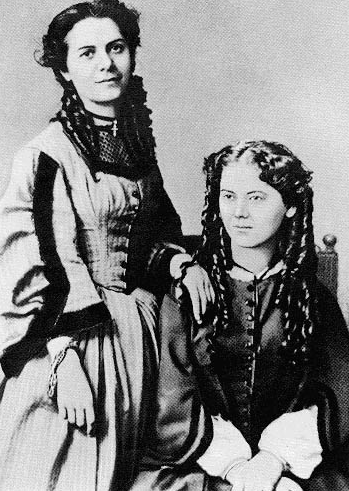
Jenny Carolina and Jenny Laura Marx (1869)
Who was Friedrich Engels, and what was his relationship with Marx?
Friedrich Engels was a philosopher, social scientist, and close collaborator of Karl Marx. They met in Paris in 1844 and co-authored “The Communist Manifesto.” Engels was Marx’s closest friend and collaborator. In 1848, Marx and Engels wrote “The Communist Manifesto.” Marx was also expelled from Belgium and Germany, leading to his move to London in 1849.

Friedrich Engels was a German philosopher, social scientist, and close collaborator of Karl Marx. They co-authored “The Communist Manifesto” and worked together on many other projects.

What was Marx’s involvement in the International Workingmen’s Association?
From 1864, Marx was involved in the International Workingmen’s Association (First International), where he fought against the influence of anarchists led by Mikhail Bakunin.
What does Marx argue about the development of human societies?
Marx argued that human societies develop through class conflict. In capitalist societies, this conflict manifests between the ruling classes (bourgeoisie) that control the means of production and the working classes (proletariat) that sell their labor power for wages.

Friedrich Engels was a German philosopher, social scientist, and close collaborator of Karl Marx. They co-authored “The Communist Manifesto” and worked together on many other projects. Image: A monument dedicated to Karl Marx and Engels in Shanghai, China
What did Marx predict about the future of capitalism?
Marx predicted that capitalism would produce internal tensions leading to its self-destruction and replacement by a socialist mode of production. He believed that class antagonisms under capitalism would lead to the working class’s development of class consciousness and eventual political power, resulting in a classless, communist society.
How did Marx view the role of the working class in revolution?
Marx believed that the working class should carry out organized proletarian revolutionary action to overthrow capitalism and achieve socio-economic emancipation.

Marx’s ideas have had a profound impact on socialist thought and political movements. In the 20th century, revolutionary governments identifying as Marxist established socialist states in many countries. His work in economics has influenced modern heterodox theories of labor and capital. Image: Portrait of German philosopher Karl Marx
What are some theoretical variants of Marxism?
Theoretical variants of Marxism include Leninism, Marxism-Leninism, Trotskyism, and Maoism.
What is Marx’s critique of capitalism based on?
Marx’s critique of capitalism is based on his theory of historical materialism, which posits that capitalism inherently leads to the alienation of the worker, crises of overproduction, and economic crises due to its contradictions between the forces and relations of production.
What did Marx propose as the end goal of the proletarian revolution?
Marx proposed that the end goal of the proletarian revolution was to establish a dictatorship of the proletariat, a transitional state that would eventually wither away, leading to a stateless, classless, and communist society.
Where did Karl Marx die, and where is he buried?
Karl Marx died stateless in 1883 and was buried in Highgate Cemetery in London, England.
What are some of the Famous statues of Karl Marx?

Marx believed that capitalism inherently leads to the exploitation and alienation of workers. He argued that it would eventually produce internal tensions leading to its self-destruction and replacement by socialism. Image: Karl Marx statue in Trier, Germany
Several famous statues of Karl Marx can be found around the world, commemorating his influence and legacy. These statues not only honor Marx’s contributions to philosophy, economics, and political theory but also serve as cultural and historical landmarks in their respective locations.
Here are some notable ones:
Trier, Germany
- Location: Birthplace of Karl Marx
- Description: A 5.5-meter tall bronze statue of Karl Marx, gifted by China to mark the 200th anniversary of his birth in 2018. It stands on Simeonstiftplatz near his birthplace.
Berlin, Germany
- Location: Marx-Engels Forum
- Description: A prominent statue featuring both Karl Marx and Friedrich Engels, created by sculptor Ludwig Engelhardt. It is a popular site for tourists and locals alike.
Moscow, Russia
- Location: Near the Bolshoi Theatre
- Description: A large granite statue of Karl Marx, inscribed with “Workers of the world, unite!” in Russian. It was erected in 1961 and remains an iconic monument.
Chemnitz, Germany
- Location: City center
- Description: A massive bust of Karl Marx, also known as the “Nischel” (Saxon dialect for “head”). Chemnitz was formerly known as Karl-Marx-Stadt from 1953 to 1990.
London, England
- Location: Highgate Cemetery
- Description: The grave of Karl Marx, featuring a large bronze bust. The headstone is inscribed with the final line from the Communist Manifesto, “Workers of all lands unite,” and a quote from Marx’s 11th thesis on Feuerbach.
Shanghai, China
- Location: Fudan University
- Description: A statue of Karl Marx along with Friedrich Engels, located on the university campus, reflecting the influence of Marxist thought in Chinese academia.
Karlovy Vary, Czech Republic
- Location: Karlovy Vary
- Description: A statue in this famous spa town, acknowledging Marx’s visits there in the 1870s.

Karl Marx has left a profound and lasting impact on philosophy, political theory, economics, sociology, and history. His critical analysis of capitalism, class struggle, and historical materialism continues to influence contemporary thought and political movements worldwide. Image: 1948 Soviet Union stamp, featuring Marx and Engels, commemorating the 100th anniversary of the Manifesto





