Gustavus Adolphus
Gustavus Adolphus was born on December 9, 1594, in Stockholm, Sweden, as the eldest son of Duke Charles of the House of Vasa and Christina of Holstein-Gottorp. His father deposed King Sigismund III Vasa, his Catholic cousin who ruled both Sweden and Poland, leading to a period of religious and dynastic conflict.
Ascension to the Throne
Gustavus Adolphus was declared king in 1611 at the age of sixteen following his father’s death. Unlike many young monarchs, he was given full control of the government at the age of seventeen, bypassing the usual regency.
From the beginning, his reign was defined by warfare. He inherited three major conflicts from his father: against Denmark-Norway, Russia, and Poland-Lithuania. These wars would shape his strategic mindset and establish Sweden as a formidable military power. The war against Denmark, known as the Kalmar War (1611–1613), ended with Sweden paying an indemnity to regain lost territories, but the conflicts with Russia and Poland were more consequential in shaping his legacy.

A portrait of Gustavus Adolphus during the battle at Breitenfeld.
Military Reforms and Strategy
Gustavus Adolphus is often regarded as the “father of modern warfare” due to his innovative military strategies. His approach integrated mobility, discipline, and the use of combined arms. Prior to his reforms, European armies relied on massive formations and static engagements, but Gustavus introduced smaller, more flexible units that could adapt to battlefield conditions.
One of his most significant innovations was the improvement of Sweden’s artillery. Traditionally, cannons were heavy and difficult to move, but Gustavus introduced lightweight, mobile artillery that could be repositioned quickly during battle. This allowed for more effective bombardments and better battlefield coordination. He also reorganized infantry tactics, using shallow formations that enabled rapid maneuvering and increased firepower.
His cavalry, rather than relying solely on shock charges, was trained to engage in skirmishes and support infantry. This combined-arms approach, where cavalry, infantry, and artillery worked in concert, gave Sweden an edge over its adversaries. His logistical organization ensured that armies were well-supplied, reducing dependence on looting and maintaining discipline.
The Polish-Swedish War and Baltic Dominance
Gustavus Adolphus turned his attention to Poland-Lithuania in the Polish-Swedish War (1626–1629), a conflict stemming from Sigismund III’s claims to the Swedish throne. The campaign began with an invasion of Livonia and saw several notable engagements, including the Battle of Wallhof (1626), where his troops demonstrated superior tactics. However, despite military success, the war concluded with the Truce of Altmark, which granted Sweden control over key Baltic ports, securing its dominance in the region.
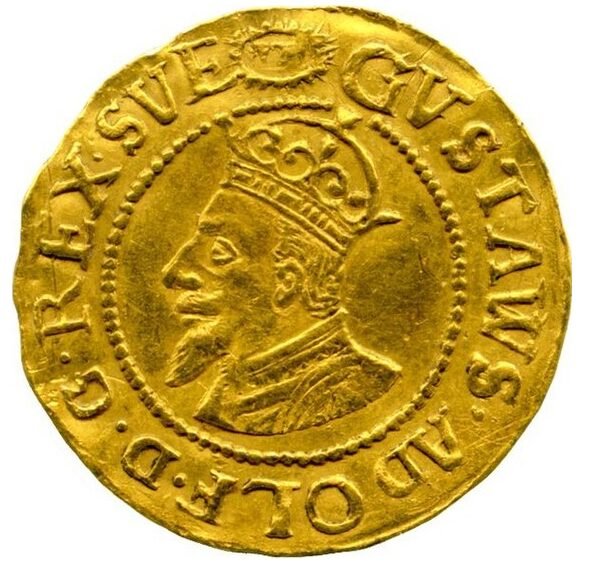
Gold coin of Gustavus Adolphus.
Beyond his battlefield achievements, Gustavus Adophus’s administrative reforms strengthened Sweden’s government and laid the groundwork for future stability.
Intervention in the Thirty Years’ War
By 1630, the c, a massive conflict between Catholic and Protestant forces in the Holy Roman Empire, was raging. Protestant forces, facing severe setbacks, looked to Gustavus Adolphus for leadership. With funding from France, he led Sweden into the war, landing in northern Germany in June 1630. His entry shifted the balance of power in favor of the Protestant cause.
The Battle of Breitenfeld (1631) marked his most significant victory. Facing the Catholic forces led by Count Tilly, Gustavus Adolphus’s superior tactics overwhelmed the opposition. His forces exploited their mobility and firepower to rout the enemy, proving the effectiveness of his military reforms. This victory solidified Sweden’s position in Europe and showcased Gustavus as one of the era’s greatest generals.
History of the Catholic Church: How and When Did Catholicism Begin?
The High Point and the Battle of Lützen
Following his success at Breitenfeld, Gustavus Adolphus pushed deeper into Germany, securing Protestant territories. In 1632, he launched an invasion of Bavaria, a key Catholic stronghold. He won the Battle of Rain, forcing the withdrawal of Catholic forces. His goal was to establish a Protestant-controlled Germany that could act as a buffer against the Habsburgs.
His final battle took place at Lützen on November 6, 1632. In heavy fog and smoke, he became separated from his troops while leading a cavalry charge. He was shot multiple times and fell from his horse, dying on the battlefield. Although his forces won the battle, his death left Sweden without its charismatic leader, leading to internal struggles and eventual setbacks in the war.

An engraving depicting Adolphus.
Political and Administrative Legacy
Beyond the battlefield, Gustavus Adolphus was a skilled administrator who implemented significant reforms in Sweden. He established a centralized bureaucracy that improved tax collection, allowing for better funding of the military. One of his most notable reforms was the introduction of parish registration, which enabled more efficient taxation and conscription.
His governance model balanced the monarchy’s power with that of the Riksdag (Swedish Parliament), which played a role in administrative decisions. This created a more stable political structure that continued after his death. Additionally, he promoted education and founded the University of Tartu in Estonia in 1632, demonstrating his commitment to intellectual advancement.
Reputation and Historical Impact
Gustavus Adolphus remains one of Sweden’s most celebrated monarchs and a key figure in European history. His military innovations influenced future generals, including Napoleon Bonaparte and Carl von Clausewitz. His tactics, particularly his use of mobile artillery and combined arms, set the foundation for modern military doctrine.
Despite his military prowess, some historians argue that his reputation has been exaggerated. While he undoubtedly revolutionized warfare, many of his innovations were refinements of existing strategies rather than entirely new concepts. However, his ability to implement these tactics effectively and his success on the battlefield remain undisputed.
His intervention in the Thirty Years’ War preserved Protestantism in Germany and prevented complete Habsburg domination. While Sweden’s dominance waned after his death, his reign marked the height of Swedish influence in European affairs.

Bust of Adolphus.
Death and Commemoration
Gustavus Adolphus’s death at Lützen was a significant blow to the Protestant cause. Sweden continued to fight under the leadership of Axel Oxenstierna, but without his leadership, the momentum began to wane. The Swedish army suffered a decisive defeat at Nördlingen in 1634, leading to a shift in the war’s dynamics.
In 1633, the Swedish Riksdag officially granted him the title “Gustavus Adolphus the Great,” the only Swedish monarch to receive such an honor. His memory is celebrated in Sweden, with statues, schools, and streets named after him. Gustavus Adolphus Day, observed on November 6, commemorates his legacy.
In addition to his historical impact, Gustavus Adolphus has been featured in literature, music, and historical fiction. The power metal band Sabaton referenced him in their song “The Lion from the North,” while his life has been depicted in numerous historical dramas and novels.
Frequently Asked Questions
What were Gustavus Adolphus’s major military innovations?
He introduced mobile artillery, integrated combined arms tactics, and used shallow infantry formations for greater flexibility in battle. His reforms improved battlefield coordination and mobility, influencing future military strategies.
How did Gustavus Adolphus impact the Thirty Years’ War?
His intervention in 1630 shifted the balance in favor of Protestant forces, securing key victories such as the Battle of Breitenfeld (1631). His leadership prevented Habsburg domination in Germany.
Why is Gustavus Adolphus called the “father of modern warfare”?
He pioneered the use of flexible formations, mobile artillery, and efficient logistics, setting a foundation for modern military doctrines later used by generals like Napoleon.
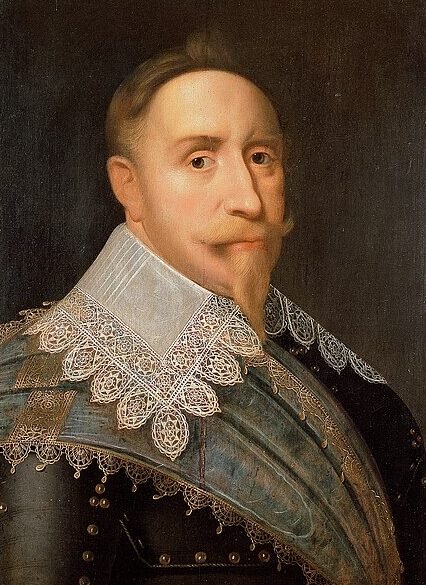
Portrait of Adolphus by Flemish artist Jacob Hoefnagel.
What was the significance of the Battle of Lützen (1632)?
Although a Swedish victory, Gustavus Adolphus was killed in the battle, leaving Sweden without its key leader, which eventually led to a loss of momentum in the Thirty Years’ War.
How did Gustavus Adolphus strengthen Sweden’s government?
He reformed taxation, introduced parish registration, and created a centralized bureaucracy, ensuring stable governance and efficient military funding.
What role did Gustavus Adolphus’s navy play in Sweden’s expansion?
He modernized the Swedish navy, allowing for troop transport and supply lines across the Baltic, securing Sweden’s dominance in the region.
How is Gustavus Adolphus commemorated today?
Sweden honors him with Gustavus Adolphus Day (November 6), and statues, schools, and streets bear his name. His military achievements remain influential in historical studies.
What was Gustavus Adolphus’s long-term impact on Europe?
His military strategies influenced later warfare, Sweden emerged as a major power, and his intervention preserved Protestantism in Northern Europe.





