
The Hagia Sophia in Nicaea following its restoration in 2012.
The Hagia Sophia Mosque in İznik is also known as Ayasofya Orhan Camii. The structure is a significant historical and religious monument located in İznik (ancient Nicaea), Turkey. Originally constructed as a Byzantine-era basilican church, it was later converted into a mosque following the Ottoman conquest.
Over the centuries, it has undergone multiple transformations, reflecting the changing political, religious, and cultural dynamics of the region. This structure, situated within the old walled city of İznik, has played a key role in Byzantine and Ottoman history.
Today, the Hagia Sophia of Nicaea stands as a functional mosque, embodying centuries of architectural and religious evolution.
Early Christian Beginnings
The first church on the site of Hagia Sophia in İznik dates back to the 4th century, during the reign of Constantine the Great or his successors. This period saw a surge in the construction of Christian places of worship as the Roman Empire gradually transitioned from paganism to Christianity. The church likely served as a key religious center in Nicaea, which was an important city in early Christian history.
READ MORE: Why did Roman Emperor Constantine the Great convert to Christianity?
Justinian’s Reconstruction in the 6th Century
During the 6th century, under the rule of Emperor Justinian I (r. 527–565 CE), the church was rebuilt as part of his broader efforts to restore and construct Christian monuments across the empire. Justinian, known for commissioning the Hagia Sophia in Constantinople, sought to reinforce the religious and political significance of Christianity. The redesigned structure in İznik followed the basilican plan, featuring a central nave flanked by aisles, a common architectural style of Byzantine churches.
Role in the Second Council of Nicaea (787 CE)
One of the most defining moments in the history of the Hagia Sophia in İznik was its role as the venue for the Second Council of Nicaea in 787 CE. This ecumenical council was convened to address the controversial issue of Iconoclasm, a theological dispute over the veneration of religious images. The council, attended by bishops and theologians from across the Byzantine world, ultimately affirmed the use of icons in Christian worship, marking the end of the first period of Byzantine Iconoclasm.
Destruction and Reconstruction in the 11th Century
The original Justinian-era church was destroyed by an earthquake in the 11th century. In response, Byzantine architects reconstructed the building around 1065 CE, incorporating elements of both earlier Byzantine styles and contemporary architectural influences. This iteration of the church survived until the Ottoman conquest of İznik in 1331.
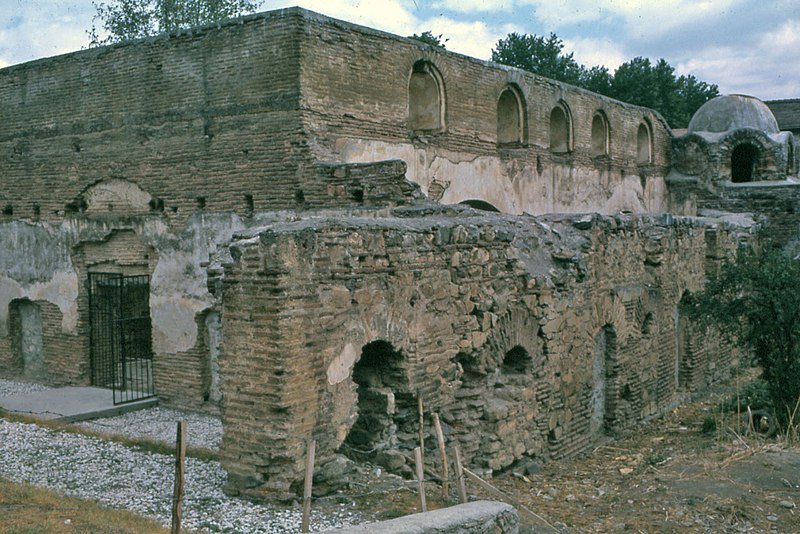
The remains of the Hagia Sophia, captured in a 1962 photo by Italian photographer Paolo Monti.
Ottoman Conversion and Adaptation
The Fall of Nicaea and the Transformation into a Mosque (1331)
In 1331, Orhan Ghazi, the second ruler of the nascent Ottoman state, captured Nicaea and converted the Hagia Sophia church into a mosque, renaming it Orhan Camii. This was part of a broader Ottoman strategy to integrate Byzantine cultural and religious heritage into their expanding empire.
The conversion involved modifications to the church’s structure, including the addition of a mihrab (prayer niche) oriented towards Mecca. Despite these changes, much of the original Byzantine layout and design elements remained intact.
Renovations Under Sultan Suleiman the Magnificent (16th Century)
During the reign of Suleiman the Magnificent (1520–1566), the mosque underwent significant renovations. A minaret was added, and the structure was repaired following damage from fires. Mimar Sinan, the chief Ottoman architect of the era, was commissioned to decorate and reinforce the mosque, integrating traditional Ottoman-Islamic design elements while preserving aspects of the Byzantine structure.
Secularization and Museum Era (1935-2011)
In 1935, under the secularist reforms of Mustafa Kemal Atatürk, the Hagia Sophia Mosque was repurposed as a museum. This change was part of a larger national effort to promote Turkey’s rich historical and cultural heritage, emphasizing a secular identity. The transformation was met with mixed reactions, as it marked a break from the building’s religious functions.
Between 2007 and 2011, significant restoration work was undertaken to preserve the site’s historical integrity. However, debates arose over whether the building should remain a museum or be restored as a place of worship. These discussions reflected broader tensions in Turkey regarding secularism, religious heritage, and historical conservation.
Reconversion to a Mosque (2011 – Present)
In November 2011, the Turkish government reconverted the site into a mosque, resuming Islamic prayers after decades of secular use. The decision was part of a broader movement in Turkey to restore religious functions to former mosques, including the more famous Hagia Sophia in Istanbul, which was reconverted from a museum to a mosque in 2020.
Today, the Hagia Sophia Mosque in İznik is an active place of worship while also attracting tourists and historians interested in its Byzantine and Ottoman past. Efforts continue to preserve both its Christian and Islamic heritage, ensuring that visitors can appreciate its layered history.
Most Transformative Events in the History of Turkey in the 20th Century
Architectural Features
Overall Structure and Layout
The Hagia Sophia Mosque follows a basilican plan, consisting of:
- A central nave with two side aisles.
- A clerestory wall originally featuring five windows.
- Large triple arcades supported by columns, remnants of its Byzantine origins.
Byzantine Elements
Despite its Ottoman modifications, many Byzantine features remain:
- Opus sectile flooring, an intricate mosaic technique.
- A secondary dome over the choir area.
- A partially preserved synthronon, a semicircular stepped seating arrangement for clergy.
- Traces of Byzantine frescoes, though many were removed or covered.
Ottoman Modifications
Following its conversion into a mosque, the building underwent changes, including:
- The addition of a mihrab to indicate the qibla (direction of prayer).
- A minaret, constructed in the 16th century.
- Interior Islamic calligraphy, added in later restorations.
Today, Hagia Sophia Mosque in İznik stands as both a place of worship and a symbol of cultural heritage, preserving the memory of the diverse civilizations that shaped its existence.
Significance in Christian and Islamic Heritage
The Hagia Sophia in İznik is unique as it embodies both Byzantine Christian and Ottoman Islamic heritage. As the site of the Second Council of Nicaea, it holds immense religious importance in Christian history. Meanwhile, its role as one of the earliest mosques of the Ottoman Empire cements its place in Islamic architectural and cultural history.
Tourism and Academic Interest
Today, the site attracts:
- Historians and archaeologists, who study its layered past.
- Tourists, drawn by its blend of Byzantine and Ottoman elements.
- Religious scholars, interested in its ecumenical significance.
Frequently Asked Questions
When was the first church built on this site?
The first church was constructed in the 4th century, later rebuilt by Emperor Justinian I in the 6th century.
What historical event took place here in 787?
The Second Council of Nicaea was held in the church, ending the first period of Byzantine Iconoclasm.
When was the church converted into a mosque?
After the Ottoman conquest in 1331, it was converted into the Orhan Mosque.
Why was the building turned into a museum in 1935?
Under Mustafa Kemal Atatürk’s regime, it was designated as a museum as part of secular reforms.
What architectural changes did the Ottomans make?
They added a mihrab, a minaret, and commissioned Mimar Sinan to decorate the walls.
When was it reconverted into a mosque?
It was restored for worship in November 2011.
Why is its restoration controversial?
The conversion of a historic Byzantine church into a mosque remains a sensitive issue due to its religious and cultural significance.





