Henry St John, 1st Viscount Bolingbroke
Henry St John, 1st Viscount Bolingbroke, born in 1678, was a prominent English political figure, philosopher, and writer who played a significant role in the early 18th-century British political scene.
His career was marked by his shifting alliances, philosophical works, and influence on the Tory party, as well as his involvement with the Jacobite movement, which ultimately led to his exile.
Bolingbroke’s life and writings left a lasting legacy in the fields of political theory, literature, and government opposition.
Early Life and Education
Bolingbroke was born into an influential family at the family estate of Lydiard Tregoze in Wiltshire. His father, Sir Henry St John, and mother, Lady Mary Rich, came from prominent families, which set the stage for Henry’s involvement in public life.
Although it was previously believed that he was educated at Eton College and Oxford University, there are no records to confirm this, and some historians suggest he may have attended a Dissenting academy instead. This ambiguity about his education did not prevent him from developing a broad and deep knowledge of politics, history, and philosophy, interests he would pursue throughout his life.
After completing his education, Bolingbroke embarked on an extended tour of Europe, visiting France, Italy, and Switzerland, where he developed a strong command of the French language and absorbed the political and cultural currents of the time. This experience abroad contributed to his later diplomatic efforts and provided him with a cosmopolitan outlook that would influence his political theories.
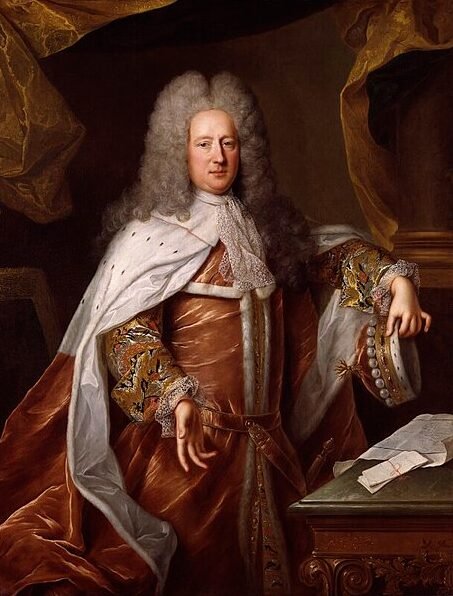
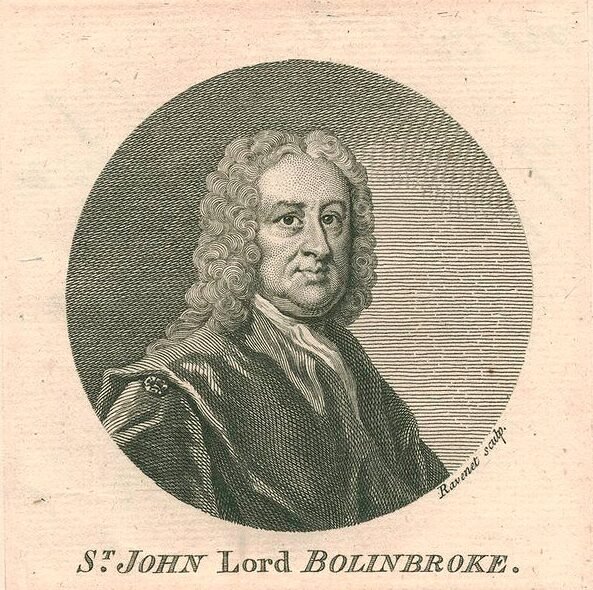
Image: A portrait of Bolingbroke by French painter Alexis Simon Belle.
Early Political Career
Bolingbroke entered Parliament in 1701 as a Tory representative for Wootton Bassett. He quickly established himself as a skilled orator and adept political player, aligning himself with Robert Harley, a powerful Tory politician who would later become Earl of Oxford. Under Harley’s mentorship, Bolingbroke gained influence in the House of Commons and rose through the ranks of the Tory party.
When Queen Anne ascended to the throne in 1702, Bolingbroke’s fortunes rose with the Tories’ growing power. He took office as Secretary at War in Harley’s government, collaborating with John Churchill, the Duke of Marlborough, who led Britain’s military campaigns in the War of Spanish Succession.
Bolingbroke’s position allowed him to exercise influence over military matters, an opportunity that helped him build his political reputation. However, when Harley’s power diminished in 1708, Bolingbroke was forced to resign and retreat to his country estate.
The War of Spanish Succession and Diplomatic Efforts
In 1710, the political tides shifted again, and Bolingbroke re-entered government as Secretary of State, resuming his partnership with Harley. Bolingbroke’s tenure coincided with a push to end the War of Spanish Succession, a costly conflict that had divided Britain’s political leaders. While some Whigs favored continuing the war to weaken France, Bolingbroke argued that Britain’s interests would be better served by negotiating peace independently of its allies.
Bolingbroke’s influence over the peace negotiations led to the Treaty of Utrecht in 1713, a controversial agreement that granted Britain several territorial and commercial gains. These included the acquisition of Gibraltar and Minorca, which secured British naval access to the Mediterranean. While the treaty solidified Britain’s position as a global power, it also angered the Whigs and others who believed that Bolingbroke’s approach had compromised Britain’s honor by abandoning its allies. In recognition of his role in securing peace, Bolingbroke was elevated to the peerage as Viscount Bolingbroke in 1712, a title that granted him a seat in the House of Lords.
Break with Harley and Rise to Power
As Bolingbroke gained prominence, his relationship with Harley began to deteriorate. Harley’s cautious approach to governance clashed with Bolingbroke’s more ambitious vision for the Tory party, leading to growing friction between the two men. Their rivalry came to a head in 1714, when Bolingbroke aligned himself with Queen Anne’s confidante, Lady Abigail Masham, and advocated for a stronger, more centralized Tory government.
Bolingbroke promoted the Schism Act, a law that aimed to restrict Dissenters (Protestants who did not conform to the Church of England) from teaching. This legislative initiative reflected Bolingbroke’s desire to cement the power of the Anglican Church and bolster Tory influence.
Despite his growing power, Bolingbroke’s success was short-lived. In 1714, Queen Anne’s health declined, and with her death, the political landscape shifted dramatically. The new monarch, George I, favored the Whigs, and Bolingbroke found himself without allies in the new administration. He was dismissed from his position as Secretary of State and soon faced accusations of treason for his alleged attempts to support the exiled James Francis Edward Stuart (the “Old Pretender”) and restore the Stuart monarchy.
Exile and Jacobite Involvement
To avoid prosecution, Bolingbroke fled to France in 1715, where he openly allied himself with the Jacobite cause, supporting the Old Pretender’s attempt to reclaim the British throne. He took on a leadership role in the exiled Stuart court, serving as James’s foreign minister. However, the 1715 Jacobite uprising was poorly organized and ultimately failed, leaving Bolingbroke disillusioned with the Jacobite leadership. Moreover, the death of King Louis XIV of France, a supporter of the Jacobites, weakened their position, as his successor, Louis XV, sought peace with Britain.
Disenchanted, Bolingbroke severed ties with the Jacobite cause and began seeking a royal pardon from the British government. His break with the Jacobites in 1716 allowed him to distance himself from the failed uprising, and in 1723, he was granted permission to return to England. Although his titles were partially restored, he was barred from resuming his seat in the House of Lords, effectively excluding him from active political life.
Philosophical Writings and Influence on Political Theory
During his years in exile, Bolingbroke turned to writing and reflection, producing a body of work that would shape political thought in Britain and beyond. In his Reflections upon Exile (1717), Bolingbroke explored the themes of isolation, loss, and the fickleness of political fortune. His letter to Sir William Wyndham, written around the same time, defended his actions during his political career and critiqued the political establishment. This letter, regarded as one of his finest compositions, was later published posthumously in 1753 and remains a valuable insight into his political philosophy.
Bolingbroke’s writings in The Craftsman, a periodical critical of the government, helped popularize ideas of constitutional government and systematic opposition. Through these essays, he developed the concept of a “country party,” a political faction that would serve as a check on the government’s power. He argued that an opposition party dedicated to defending liberty was essential for a healthy political system. His belief in systematic opposition influenced later political movements in Britain and contributed to the development of the modern concept of a parliamentary opposition.
The Idea of a Patriot King
One of Bolingbroke’s most influential works, The Idea of a Patriot King, outlined his vision for a monarch who would rise above partisan politics to govern with the nation’s best interests at heart. Written in the 1730s but not published until after his death, this essay argued that a true “patriot king” would act independently of political factions, uniting the country and promoting virtue. Bolingbroke’s idea of a disinterested monarch, free from the influence of court and party politics, offered an idealized vision of kingship that resonated with those disillusioned by the perceived corruption of George I’s Whig administration.
Bolingbroke’s concept of a patriot king had a lasting impact on British political thought and inspired figures such as Frederick, Prince of Wales, who saw himself as a potential unifier of the British people. Bolingbroke’s writings on this topic influenced Enlightenment thinkers and found an eager audience among American patriots in the colonies, including Thomas Jefferson and John Adams.
Final Years and Legacy
After his return to England, Bolingbroke purchased an estate at Dawley, near Uxbridge, where he entertained literary figures such as Alexander Pope and Jonathan Swift. His close association with these writers placed him at the heart of a vibrant intellectual circle, and his philosophical discussions with them influenced the works they produced during this period. Bolingbroke contributed ideas and insights to Pope’s An Essay on Man, helping to shape the themes of the poem.
Bolingbroke continued his opposition to the government, aligning himself with Frederick, Prince of Wales, and other critics of Robert Walpole’s administration. He wrote a series of essays in The Craftsman, criticizing Walpole’s policies and calling for reform. Although Bolingbroke’s influence declined after Walpole’s fall from power, his ideas about systematic opposition and political accountability left a lasting mark on British politics.
In the 1740s, Bolingbroke retired to France, where he continued his philosophical studies. His Letters on the Study of History, published posthumously in 1752, offered his reflections on the cyclical nature of history and the importance of learning from the past. In this work, Bolingbroke argued that history follows a pattern of birth, growth, and decline, a perspective that influenced Enlightenment thinkers who sought to understand the rise and fall of civilizations.
Bolingbroke returned to England for the final years of his life, settling in Battersea. He continued to write, although his health declined. In 1749, he published The Patriot King in response to the unauthorized publication of an earlier version of the text. This work represented his final statement on the ideal of patriotic leadership, reinforcing his belief in a monarchy that transcended factionalism. He died in 1751 at the age of 73 and was buried at the parish church in Battersea.
Intellectual Legacy
Bolingbroke’s ideas on opposition politics, liberty under the law, and the role of a patriotic monarch significantly influenced the political discourse of his time. His belief in the importance of a “country party” to oppose corruption and defend constitutional principles provided a foundation for later developments in British political life. Although his reputation suffered due to his involvement with the Jacobites and his tumultuous political career, Bolingbroke’s writings remained influential among Enlightenment thinkers.
In the American colonies, his work resonated with leaders who valued his vision of constitutional limits on government and his emphasis on liberty. Figures like John Adams and Thomas Jefferson found inspiration in Bolingbroke’s critiques of monarchy and his advocacy for republican principles. Bolingbroke’s conception of liberty as something protected and ensured by the law, rather than an absence of law, contributed to the ideological underpinnings of the American Revolution.
Bolingbroke’s literary and philosophical circle, which included luminaries like Pope and Swift, cemented his position as a major figure in English letters. His style, wit, and intellectual rigor influenced a generation of writers and thinkers. Though his political career was marked by controversy and exile, Bolingbroke’s contributions to political philosophy and opposition politics have endured, shaping discussions of government, freedom, and leadership well beyond his time. His legacy is that of a complex, ambitious, and intellectually formidable figure who left an indelible mark on British and American political thought.
Frequently Asked Questions
Where was he born?
Henry St John, 1st Viscount Bolingbroke, was born in 1678 at Lydiard Tregoze in Wiltshire.
His parents were Sir Henry St John and Lady Mary Rich, daughter of the 3rd Earl of Warwick.
Where did Bolingbroke likely receive his education?
Though some sources claim he attended Eton and Oxford, there are no records confirming this. He may have studied at a Dissenting academy.
What role did travel play in Bolingbroke’s early life?
His travels across Europe in his youth allowed him to acquire fluency in French and establish relationships with key political figures.
Who did Bolingbroke marry, and how did his lifestyle continue?
In 1700, he married Frances Winchcombe, though he maintained a reputation for a licentious lifestyle.
When did Bolingbroke first enter Parliament, and which party did he represent?
He entered Parliament in 1701 as a Tory MP for Wootton Bassett.
Who did Bolingbroke align with early in his political career?
He aligned with Robert Harley, a leading Tory, which helped him gain influence in the House of Commons.
What role did Bolingbroke assume after Queen Anne’s accession?
He was appointed Secretary at War in Harley’s government, working closely with the Duke of Marlborough.

Queen Anne ruled Great Britain from 1702 to 1707.
Why did Bolingbroke leave office in 1708, and when did he return?
He left office when Harley was dismissed but returned in 1710 as Secretary of State in Harley’s ministry.
What were some of the controversial measures Bolingbroke supported?
He supported a property qualification for MPs and a tax on newspapers.
How did Bolingbroke contribute to ending the War of Spanish Succession?
He conducted back-channel negotiations with France, leading to the Treaty of Utrecht in 1713.
What title was Bolingbroke given in 1713, and what was its significance?
He was elevated to the peerage as Viscount Bolingbroke, marking his growing influence.
Why did Bolingbroke’s relationship with Harley deteriorate?
Tensions over power and prestige led to a rift between them.
What position did Bolingbroke take regarding the Hanoverian succession?
He advocated for a harsh stance on the Hanoverian succession, aligning with Queen Anne’s confidante, Lady Masham.
What happened to Bolingbroke after Queen Anne’s death in 1714?
With George I favoring the Whigs, Bolingbroke lost influence, was dismissed from office, and was implicated in Jacobite plots.
Why did Bolingbroke flee to France in 1715, and what role did he assume there?
To escape treason charges, he fled and became foreign minister in the Jacobite court of James Francis Edward Stuart.
What led Bolingbroke to abandon the Jacobites and seek a royal pardon?
Disillusioned by the failed Jacobite uprising and weakening support, he broke ties and obtained a pardon in 1723.
Where did Bolingbroke settle upon returning to England?
He settled at Dawley, near Uxbridge, and reconnected with literary figures like Alexander Pope and Jonathan Swift.
What was The Craftsman, and why was it significant?
The Craftsman was a periodical critical of Walpole’s government in which Bolingbroke’s ideas of a “country party” opposing the “court party” were popularized.
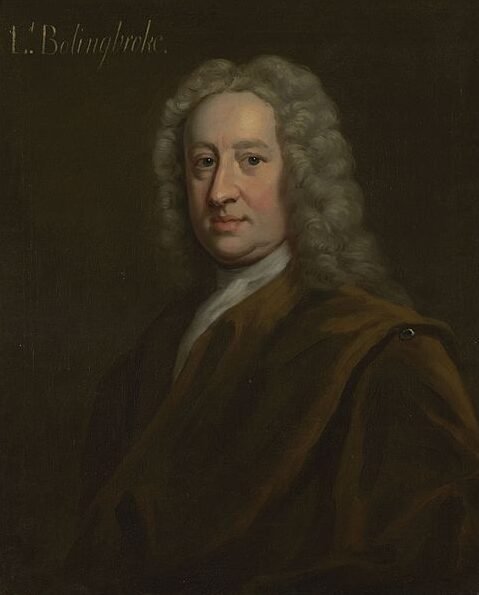
Image: Bolingbroke’s portrait by Irish painter Charles Jervas.
What concept did Bolingbroke introduce in The Patriot King?
He proposed the idea of a “patriot king” who would serve above partisan interests for the good of the nation.
What philosophical view did Bolingbroke express in Letters on the Study of History?
He described history as a cycle of birth, growth, and decline of governments, influencing Enlightenment thinkers.
With which prominent figure did Bolingbroke align himself later in life?
He aligned with Frederick, Prince of Wales, providing him with political guidance.
How did Alexander Pope’s unauthorized publication of The Patriot King affect Bolingbroke?
Bolingbroke was deeply dismayed by the unauthorized publication, which caused a rift between him and Pope.
What impact did Bolingbroke’s ideas have on political philosophy?
His thoughts on systematic opposition, a “country party,” and constitutional government influenced later political thought, particularly among Enlightenment thinkers and American Founders.
Bolingbroke saw liberty as protection under the law, influencing figures like John Adams and Thomas Jefferson.