Henry VII of England
Henry VII, originally Henry Tudor, was born on January 28, 1457, at Pembroke Castle in Wales. His father, Edmund Tudor, 1st Earl of Richmond, died before Henry was born, leaving his young mother, Margaret Beaufort, to raise him. Margaret was a descendant of John of Gaunt, the son of Edward III, which gave Henry a claim—though contested—to the English throne. Henry’s father was of Welsh descent, and his lineage from the Tudors of Penmynydd played a crucial role in securing Welsh support for his later campaign for the crown.
Raised under the guardianship of his uncle, Jasper Tudor, Henry’s early life was shaped by the political turbulence of the Wars of the Roses, a dynastic struggle between the rival houses of Lancaster and York. When Edward IV reclaimed the throne in 1471, Henry, a Lancastrian claimant, was forced into exile in Brittany, where he remained for 14 years under the protection of Duke Francis II.
The Road to the Throne
While in exile, Henry’s claim to the throne gained traction among those opposed to Richard III, who had seized the crown after the controversial disappearance of his nephews, the Princes in the Tower. With the support of the Woodville family, who had been loyal to Edward IV, and financial assistance from the French monarchy, Henry launched an invasion of England in 1485.
On August 22, 1485, Henry’s forces met Richard III’s army at the Battle of Bosworth Field. Despite being outnumbered, Henry secured victory, thanks in part to the defection of powerful noblemen, including Lord Stanley. Richard III was killed in battle, making Henry the last English king to claim his crown through military conquest.

Silver coin of Henry VII.
Consolidating Power
Henry’s first act as king was to declare himself monarch retroactively from August 21, 1485, ensuring that those who had fought against him at Bosworth could be legally deemed traitors. His coronation took place on October 30, 1485, and he secured parliamentary recognition of his reign.
To strengthen his position, Henry married Elizabeth of York in January 1486. This union between the rival houses of Lancaster and York symbolized the end of the Wars of the Roses and helped solidify his claim to the throne. To reinforce this image of unity, he adopted the Tudor Rose as a symbol of the new dynasty.
Rebellions and Challenges
Despite his marriage, Henry faced several challenges to his reign. In 1487, supporters of the Yorkist cause rallied behind Lambert Simnel, a boy they claimed was Edward, Earl of Warwick. The rebellion ended with Henry’s victory at the Battle of Stoke Field, which effectively ended the Wars of the Roses.
A more serious threat emerged in the form of Perkin Warbeck, who claimed to be Richard of Shrewsbury, one of the missing Princes in the Tower. Warbeck gained support from various European rulers, including James IV of Scotland. Henry dealt with this challenge decisively, capturing and executing Warbeck in 1499.
Economic and Administrative Reforms
Henry VII’s reign was marked by financial prudence and administrative efficiency. He sought to stabilize England’s economy, implementing new taxation policies and introducing bonds and recognizances to control the nobility. His approach to governance was meticulous, with an emphasis on fiscal responsibility.
Henry VII’s aggressive tax policies generated wealth but caused resentment, leading to the execution of his tax collectors after his death.
His government utilized Justices of the Peace to enforce law and order, reducing the power of overmighty nobles. The Court of Star Chamber became a key instrument in suppressing opposition and maintaining centralized authority.
Foreign Policy and Diplomacy
Henry’s foreign policy aimed to secure England’s position through diplomatic marriages and alliances. In 1489, he signed the Treaty of Medina del Campo with Spain, arranging the marriage of his son, Arthur, Prince of Wales, to Catherine of Aragon. This alliance was intended to strengthen ties between England and Spain.
Henry also secured peace with Scotland through the Treaty of Perpetual Peace in 1502, which included the betrothal of his daughter Margaret to James IV of Scotland. Additionally, he negotiated trade agreements, such as the Magnus Intercursus with the Netherlands, boosting England’s economic prosperity.

Coat of Arms used by Henry VII.
Later Years and Death
Henry’s later years were marred by personal tragedies. In 1502, his son and heir, Arthur, died unexpectedly, forcing Henry to place his hopes on his second son, Henry, Duke of York. The following year, his wife, Elizabeth of York, died in childbirth, leaving Henry grief-stricken.
His health deteriorated in the last years of his reign, and he died on April 21, 1509, at Richmond Palace. He was buried alongside Elizabeth of York in Westminster Abbey. His death marked the beginning of the reign of his son, Henry VIII.
By successfully consolidating power and ensuring a peaceful transition of the throne, Henry VII secured his legacy as one of England’s most effective, if often overlooked, monarchs.
Legacy
Henry VII’s reign established the Tudor dynasty, bringing stability to England after decades of civil strife. His financial reforms left the monarchy in a strong economic position, and his diplomatic strategies secured alliances that would shape England’s future. Though he ruled with a cautious and often ruthless hand, his reign laid the foundations for the powerful Tudor monarchy that followed.
Timeline of Henry VII of England (1457–1509)
- 1457 – Born on January 28 at Pembroke Castle, Wales, to Margaret Beaufort and Edmund Tudor.
- 1461 – Yorkist Edward IV becomes king, and Henry is placed under the guardianship of William Herbert.
- 1471 – Following Edward IV’s return to power, Henry flees to Brittany for 14 years.
- 1483 – Henry, backed by exiled Lancastrians, vows to marry Elizabeth of York to unite rival factions.
- 1485 – Defeats Richard III at the Battle of Bosworth Field on August 22, claiming the English throne.
- 1486 – Marries Elizabeth of York in January, formally ending the Wars of the Roses.
- 1487 – Crushes the last Yorkist rebellion at the Battle of Stoke Field.
- 1491 – Perkin Warbeck claims to be Richard, Duke of York, sparking Yorkist revolts.
- 1497 – Warbeck is captured and later executed.
- 1502 – Son and heir, Arthur, dies, prompting betrothal of Prince Henry to Catherine of Aragon.
- 1509 – Dies on April 21 at Richmond Palace; succeeded by Henry VIII.
Frequently Asked Questions
How did Henry VII claim the English throne?
He won the throne by defeating Richard III at the Battle of Bosworth Field in 1485, ending the Wars of the Roses.
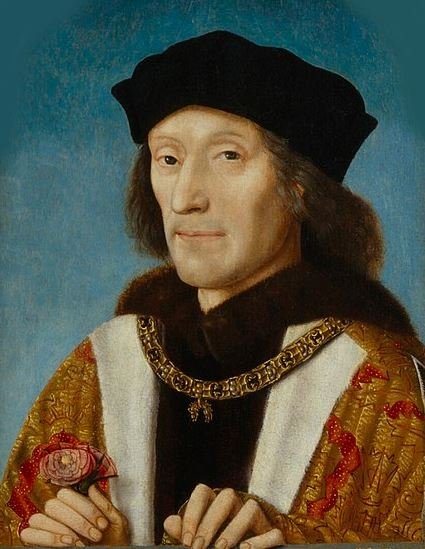
A painting portraying Henry VII.
What was Henry VII’s primary strategy to secure his rule?
He strengthened his claim by marrying Elizabeth of York, uniting the rival houses of Lancaster and York.
How did he consolidate royal authority?
He reduced the power of the nobility using financial bonds and recognisances, and strengthened the role of Justices of the Peace.
What economic policies did Henry VII implement?
He promoted trade, increased taxation, and enforced strict financial control, making the monarchy financially stable.

A painting of Henry VII (in the middle) with his Advisors
How did he handle threats to his reign?
Henry VII crushed rebellions, including those led by Lambert Simnel and Perkin Warbeck, and executed potential Yorkist claimants.
What was the significance of the Treaty of Medina del Campo?
It secured an alliance with Spain, leading to the marriage of his son Arthur to Catherine of Aragon.
How did Henry VII influence England’s foreign policy?
He avoided costly wars, formed strategic alliances, and signed trade agreements like the Magnus Intercursus.
What was his role in naval expansion?
He improved England’s navy by funding shipbuilding and commissioning the first dry dock at Portsmouth.
What were Henry VII’s key diplomatic successes?
He signed treaties with France and Scotland, reducing external threats and strengthening England’s position in Europe.
How did Henry VII’s reign end?
He died in 1509, leaving a financially stable kingdom to his son, Henry VIII.
Henry VII of England is best known for establishing the Tudor dynasty. He strengthened the monarchy, and laid the groundwork for England’s future stability.





