Hiran Minar
Hiran Minar is a 17th-century Mughal-era complex located in Sheikhupura, Punjab, Pakistan. This magnificent structure was built during the reign of Emperor Jahangir to commemorate his beloved pet antelope, Mansraj. The monument serves as an embodiment of the Mughal rulers’ affinity for nature, their deep connection with animals, and their tradition of game hunting. The Hiran Minar complex is not only an architectural masterpiece but also a testament to Mughal-era recreational and cultural practices.
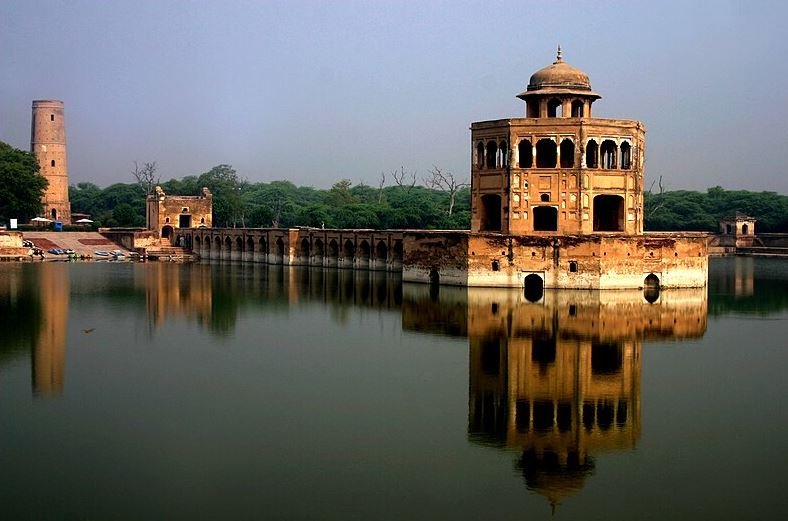
A view of the Hiran Minar.
Location and Accessibility
Hiran Minar is situated in Sheikhupura, approximately 40 kilometers northwest of Lahore. The site is easily accessible via the M2 Motorway, which connects Lahore to Islamabad.
Close to the Hiran Minar complex lies the Sheikhupura Fort, another architectural wonder from the early Mughal period.
The area around Hiran Minar was historically a royal hunting reserve, where emperors and nobility indulged in game hunting while enjoying the serene wilderness.

Historical Significance
The Hiran Minar was constructed in 1606 CE by Emperor Jahangir, who had a strong inclination toward nature and wildlife.
The minaret was built as a monument to his beloved pet antelope, Mansraj. The Persian custom of commemorating animals with tomb markers is reflected in the design of the minar.
Jahangir, despite being an avid hunter, held a deep emotional bond with Mansraj. Tragically, during one of his hunting expeditions, he accidentally killed his cherished companion. To express his grief and to honor Mansraj, he ordered the construction of Hiran Minar, which has stood the test of time as a symbol of love and reverence for animals.
The Hiran Minar complex stands as a remarkable example of Mughal architecture, showcasing their love for nature, artistic grandeur, and architectural ingenuity.
Architectural Features
The Hiran Minar complex exhibits classic Mughal architectural elements that highlight symmetry, grandeur, and functionality. The complex consists of the minaret, a large water tank, an octagonal pavilion, and a causeway.
The Minaret
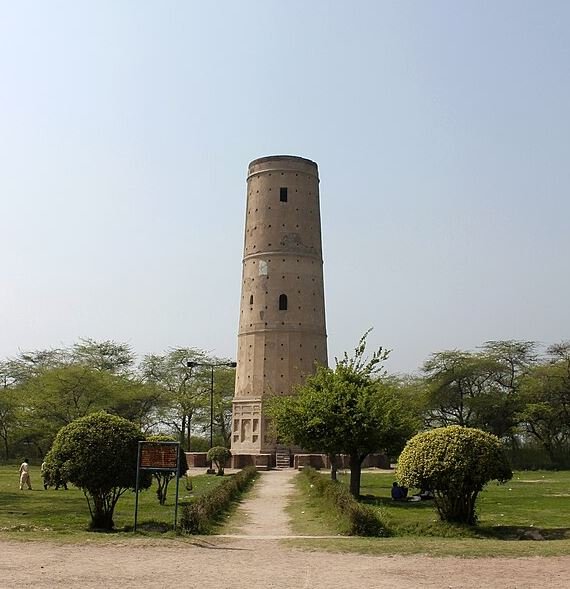
The minaret of the Hiran Minar.
The minaret of Hiran Minar stands at a height of 30 meters. The base of the tower is octagonal, transitioning into a circular form as it rises above a height of 3.90 meters.
The minaret is adorned with 210 square holes symmetrically arranged in 14 rows. Inside the tower, a spiral staircase consisting of 108 steps leads to the top.
The exterior and interior of the minaret were originally decorated with lime plaster and fresco paintings, some traces of which remain visible today.
Additionally, a eulogy dedicated to Mansraj is inscribed on the minaret, signifying the emotional depth behind its construction.
The Pool
A vast rectangular water tank measuring 229 meters by 273 meters forms the heart of the Hiran Minar complex. Each side of the tank features a gently sloping brick ramp, designed to provide easy access for animals and hunters. During the Mughal era, this tank was supplied with water through an intricate hydraulic system that collected rainwater from the surrounding area.
The Pavilion
An octagonal, two-story pavilion built during the reign of Shah Jahan is situated at the center of the water tank. Topped with a chhatri (a dome-shaped pavilion), this structure resembles the Sher Mandal at Purana Qila in Delhi. The pavilion was likely used for leisure and relaxation by the Mughal royals. The entrance to the baradari (pavilion) is through a rectangular vestibule adorned with pointed arches. The interior walls feature recessed niches, and the dome ceilings are decorated with intricate honeycomb patterns.

The pavilion of the Hiran Minar.
The Causeway
A causeway, supported by 21 arched pillars, connects the main gateway to the baradari in the center of the water tank. A square platform midway along the causeway provides a resting point. The causeway enhances the visual symmetry of the complex and was an essential element of the Mughal-era architectural style, ensuring accessibility to the central pavilion.
Hydraulic System
The Hiran Minar complex features a unique and sophisticated water collection system. Each corner of the tank has a small square building with an underground water collection system that was designed to keep the tank filled. The Mughal engineers implemented a system of rainwater collection and channeling from the Aik rivulet to ensure a steady water supply. Although only one of these systems remains exposed today, historical accounts suggest that it played a crucial role in maintaining the ecological balance of the hunting reserve.
Mughal Relationship with Nature
The construction of Hiran Minar underscores the Mughal tradition of maintaining game reserves and creating harmonious spaces where wildlife and human leisure could coexist. Jahangir, in particular, was known for his keen interest in botany, zoology, and the natural sciences. His detailed memoirs, Tuzuk-e-Jahangiri, highlight his passion for documenting the flora and fauna of his empire. The establishment of hunting reserves such as the one at Sheikhupura provided Mughal emperors with an opportunity to immerse themselves in the wilderness while still enjoying the comforts of royal architecture.
Legal Protection and UNESCO Recognition
Recognizing the historical and architectural significance of Hiran Minar, the British colonial administration declared it a protected site under the Ancient Monuments Reservation Act of 1904. Later, in 1975, it was included under Pakistan’s Antiquities Act. Today, Hiran Minar and its associated structures are listed on the provisional UNESCO World Heritage list, signifying their cultural and historical importance.
Comparison with Other Hiran Minars
Hiran Minar in Sheikhupura is often compared to another structure with the same name in Fatehpur Sikri, India. While the Fatehpur Sikri Hiran Minar is a different architectural prototype, both monuments serve as commemorative structures linked to Mughal emperors’ relationships with animals. The Sheikhupura Hiran Minar, however, is distinct due to its inclusion of an elaborate tank, a baradari, and its larger scale.
Today, the Hiran Minar complex attracts historians, architects, and tourists, offering a glimpse into the rich cultural heritage of the Mughal era.
Frequently Asked Questions
Why was Hiran Minar built?
Jahangir constructed the minar in 1606 as a tribute to his pet antelope, continuing the Persian tradition of honoring animals with tomb-markers.
Where is Hiran Minar located?
It is situated in Sheikhupura, about 40 km northwest of Lahore, near Sheikhupura Fort, and accessible via the M2 Motorway.
What are the main architectural features of Hiran Minar?
The complex includes a 30-meter-high minaret, a large water tank, an octagonal pavilion, and a causeway supported by 21 arched pillars.

What is unique about the minaret?
The cylindrical tower has 210 square holes, spiral staircases, six tiers, and inscriptions in honor of Mansraj.
What is the significance of the water tank?
The massive rectangular tank provided water for wildlife and included a sophisticated hydraulic system for water collection.
What is the role of the pavilion?
The two-story octagonal pavilion, built under Shah Jahan, served as a royal retreat and resembles Delhi’s Sher Mandal.
Is Hiran Minar a protected heritage site?
Yes, it was protected under the Antiquities Act (1916) and is listed on UNESCO’s Provisional World Heritage list.





