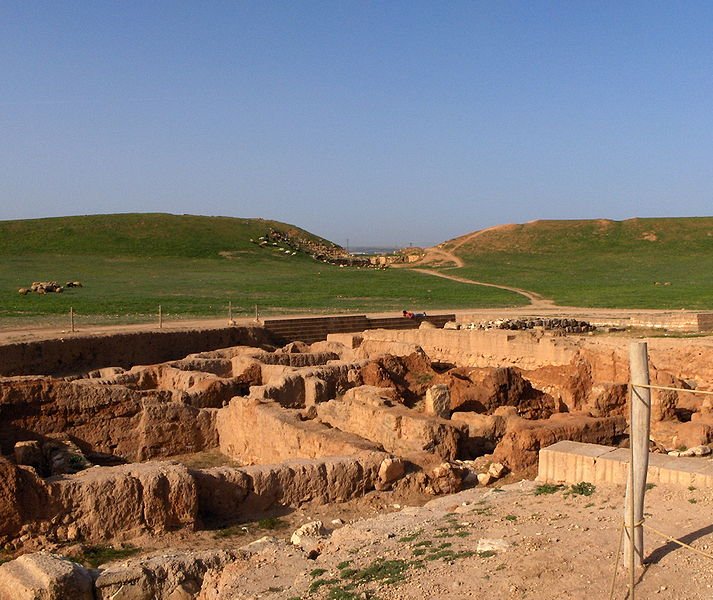
The “Damascus Gate” along with the remains of the outer wall.
Ebla, located near modern-day Tell Mardikh in Syria, was a significant early kingdom in the Near East during the 3rd and early 2nd millennia BC. Known for its role as a powerful trading and political center, Ebla rivaled contemporary civilizations like Egypt and Mesopotamia. Its discovery in the 20th century reshaped historical perspectives on ancient Syria, proving it to be a cradle of centralized civilization and challenging assumptions that Mesopotamia and Egypt were the only dominant powers in the Early Bronze Age.
Historical Timeline
Early Settlement (c. 3500 BC)
Ebla’s origins trace back to the Early Bronze Age, starting as a small settlement. Over time, it expanded into a city supported by agriculture and trade.
The First Kingdom (c. 3000–2300 BC)
During this period, Ebla emerged as a dominant power in northern Syria, with control over a vast network of city-states and vassals. Its prosperity peaked in the “archive period” (2400–2300 BC), when the famous Ebla tablets were created. However, it met its first destruction, likely caused by Akkadian campaigns under Sargon or Naram-Sin, or possibly by Mari in retaliation for military conflicts.
The Second Kingdom (c. 2300–2000 BC)
Ebla was rebuilt under a new dynasty, retaining cultural and political continuity with its first kingdom. It became a vassal of the Ur III dynasty of Mesopotamia, maintaining its significance as a trade hub. The second kingdom ended with destruction by fire, possibly due to Hurrian invasions.
The Third Kingdom (c. 2000–1600 BC)
Amorite settlers rebuilt Ebla as a fortified, planned city, aligning it politically with the kingdom of Yamhad (Aleppo). The city flourished as a trade center but was eventually destroyed by the Hittite king Mursili I around 1600 BC, marking the end of its prominence.
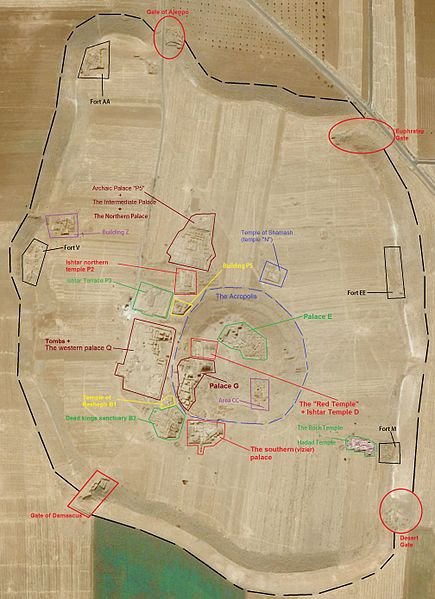
Ebla’s landmarks
Geography and Governance
At its zenith, Ebla controlled an area extending from the Euphrates to the coastal mountains of Syria, with influence over more than 60 vassal states. Its government was a monarchy supported by a robust administrative system. The vizier, the king’s chief official, wielded significant power, often leading military campaigns. The city also maintained regional governance through governors and local administrators.
Economy and Trade
Ebla’s economy was rooted in agriculture, herding, and a vast trade network that spanned the Near East and beyond. Goods such as timber, textiles, and handicrafts were exported to regions as far as Mesopotamia, Egypt, Cyprus, and even Afghanistan. Artifacts from distant lands, including Sumerian, Egyptian, and Anatolian items, testify to its extensive commercial connections.
Language and Culture
Ebla’s archives, written in both Sumerian and Eblaite (an early Semitic language), provide insights into the region’s linguistic and administrative practices. The Eblaite language is considered an East Semitic dialect with features distinct from Sumerian.
Eblaite society was notable for its relatively egalitarian approach to gender, with women holding influential roles in governance and religion. Cultural life included music, acrobatics, and religious festivals, reflecting a rich and diverse tradition.
Religion
Ebla was a polytheistic society with a pantheon dominated by North Semitic deities. Unique gods like Kura and Barama were central to its religious practices, alongside regional and Mesopotamian deities such as Dagan and Ishtar (also known as Inanna). Religious ceremonies often revolved around royal rituals and city-wide festivals.
The Ebla Tablets
Discovered in the royal archives of Palace G, the Ebla tablets (c. 2500–2350 BC) are among the most significant archaeological finds of the 20th century. These cuneiform records include administrative documents, trade agreements, and early lexicons, shedding light on the political, economic, and cultural life of ancient Ebla. The archive is considered the world’s oldest library.
Architecture and Urban Planning
Ebla’s urban layout reflected its status as a major city-state. It included a central acropolis with royal palaces and temples, surrounded by a lower town fortified with walls and gates. Architectural innovations, such as multi-room palaces and ziggurat-like temples, emphasized both functionality and religious significance.
Decline and Legacy
Ebla’s third destruction by the Hittites marked its decline, reducing it to a minor settlement in subsequent centuries. Despite this, its discovery in the 20th century revealed its historical significance as an early center of civilization, trade, and governance in the ancient Near East.
Archaeological Discoveries
Excavations at Tell Mardikh, led by Italian archaeologists starting in 1964, uncovered the city’s ruins, including palaces, temples, and the extensive archive of tablets. These findings revolutionized our understanding of early Syrian history and its interactions with neighboring civilizations.

Frequently Asked Questions
What were the key achievements of the First Eblaite Kingdom?
The First Eblaite Kingdom (c. 3000–2300 BC) established itself as a political and economic power, dominating northern Syria and creating one of the earliest known archives of cuneiform tablets. It also signed one of history’s earliest treaties with Abarsal.
How did Ebla maintain its economy?
Ebla prospered through a vast trading network, exporting textiles and timber and importing goods from regions as far as Afghanistan, Egypt, and Cyprus. Its economy was a mix of palace-controlled distribution and private enterprise.
What caused Ebla’s repeated destructions?
Ebla faced several destructions: the first (c. 2300 BC) was likely caused by the Akkadian Empire or neighboring city Mari. The second (c. 2000 BC) may have been due to Hurrian invasions, and the final destruction (c. 1600 BC) was by the Hittite king Mursili I.

What role did women play in Ebla?
Women in Ebla held high social status, equal salaries to men, and significant influence in state and religious affairs. Queens often shared power with kings in governance.
What was the Eblaite language, and why is it important?
Eblaite was an East Semitic language written in cuneiform. The Ebla tablets provided crucial insights into ancient Semitic languages, Sumerian lexicons, and political, economic, and cultural practices of the 3rd millennium BC.
What is the significance of the Ebla tablets?
The tablets, discovered in the royal archive, are one of the earliest libraries in history, containing records of trade, diplomacy, religion, and law. They revealed Ebla’s extensive network and contributed to understanding early archival practices.
What was Ebla’s religious structure?
Ebla’s religion was polytheistic, with a pantheon of North Semitic gods such as Kura and Ishara, alongside Mesopotamian deities like Utu. Rituals and festivals played a central role in royal and social life.





