How did Imperial Russia transition to the Soviet Union?
The transition from Imperial Russia to the Soviet Union is a profound and complex historical transformation that reshaped not only a nation but also had a significant impact on the global stage. This transition occurred over several tumultuous decades characterized by war, revolution, and civil strife.
Background: Imperial Russia in the Late 19th and Early 20th Century
By the late 19th century, Russia was an expansive empire under Tsarist autocracy. Despite its vast territorial reach, Russia was economically underdeveloped compared to Western European powers. It was predominantly agrarian, with the majority of its population living in rural poverty. The industrial revolution had arrived later in Russia and was concentrated in a few major cities.
The ruling Romanov dynasty, led by Tsar Nicholas II at the turn of the 20th century, was increasingly seen as out of touch with the needs of its people. The Tsar’s autocratic style of governance, resistance to political reform, and failure to address economic issues contributed to widespread discontent.
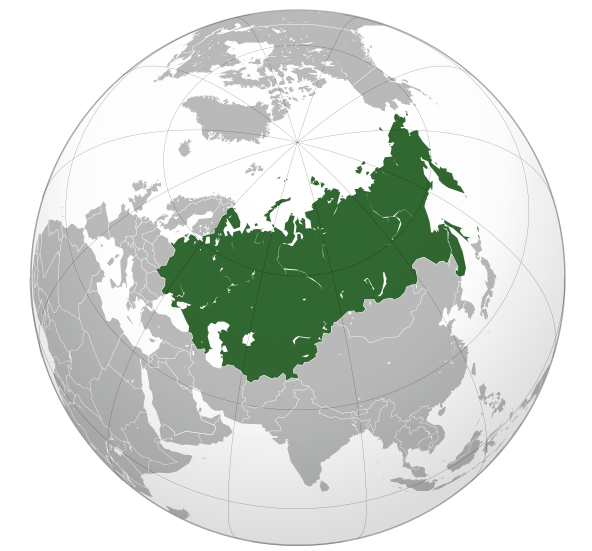
Russia’s ambition to be an imperial power was driven by the desire to expand territory, access new resources and markets, and enhance its geopolitical leverage. Image: Map of the Soviet Union between 1947 and 1991.
The Russo-Japanese War and the 1905 Revolution
The immediate catalyst for change came with the Russo-Japanese War of 1904-05. Russia’s defeat by Japan, a non-European power, was a significant blow to its national prestige and exposed the weaknesses of the Russian military and bureaucracy. The war’s unpopularity and the humiliating defeat sparked the Revolution of 1905, during which widespread protests and strikes demanded political and social reforms.
In response, Tsar Nicholas II was forced to concede some reforms, most notably the creation of a state Duma (parliament) in 1906. However, these reforms were limited, and the Tsar retained significant control over the government. The Duma was frequently dissolved if it opposed the Tsar’s policies, and real political power remained firmly with the monarchy.
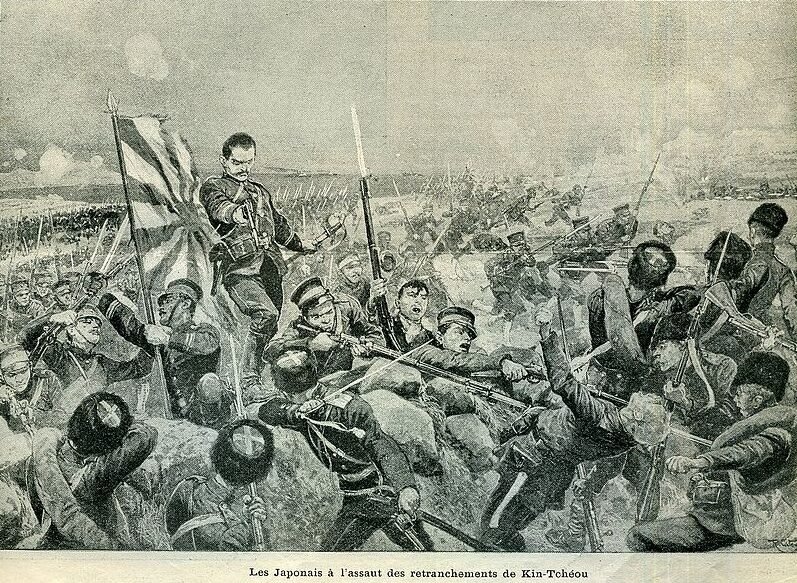
The Russo-Japanese War exposed the weaknesses of the Russian military and bureaucracy, leading to a national humiliation that exacerbated economic struggles and sparked widespread dissatisfaction and unrest, culminating in the Revolution of 1905. Image: An illustration of an attack by the Japanese forces on Russian army. during the war.
World War I and the February Revolution
The situation deteriorated further during World War I. Russia’s involvement in the war from 1914 was initially popular, but support waned as casualties mounted and economic conditions worsened. By 1917, Russia was in crisis. Military defeats, food shortages, and inflation were rampant, severely undermining public support for the war and the Tsarist regime.
In March 1917 (February in the Julian calendar, hence the name February Revolution), protests broke out in the capital, Petrograd (now Saint Petersburg), initially over the scarcity of bread. These protests quickly escalated into widespread demonstrations against the Tsarist regime. The army, crucial to the survival of any regime, was no longer willing to suppress the unrest, and many soldiers joined the demonstrators.
Faced with this untenable situation, Nicholas II abdicated on March 15, 1917. The Duma established a Provisional Government, sharing power with the Petrograd Soviet, an influential council representing workers and soldiers. This dual power structure, however, led to a paralysis of authority.

The October Revolution and the Rise of the Bolsheviks
The Provisional Government, led initially by Prince Lvov and then by Alexander Kerensky, continued the war effort and failed to address key issues such as land reform, peace, and bread, which most Russians desperately wanted. The government’s ineffectiveness provided a significant opportunity for the Bolsheviks, a radical socialist faction led by Vladimir Lenin.
Lenin, who had been in exile, returned to Russia in April 1917, famously traveling in a sealed train from Switzerland through Germany. He arrived with a simple yet powerful agenda encapsulated in his April Theses: “Peace, Land, and Bread.” The Bolsheviks promised to withdraw from the war, redistribute land to the peasants, and address workers’ grievances, gaining them substantial popular support.
In October 1917 (November in the Gregorian calendar), the Bolsheviks, seizing the moment of governmental weakness, led an armed insurrection in Petrograd. The “October Revolution” was relatively bloodless. The Bolsheviks captured key locations in the city, and the Provisional Government quickly collapsed.

The October Revolution led to the overthrow of the Provisional Government by Lenin’s Bolshevik Party. This marked the beginning of Bolshevik control, the withdrawal of Russia from World War I, and the initiation of significant social and economic reforms based on socialist principles. Image: Vladimir Lenin (1870 – 1924).
Did you know…?
Germany facilitated Lenin’s return to Russia from exile by providing him safe passage in a sealed train, hoping that his revolutionary leadership would further destabilize Russia and knock it out of World War I, thereby relieving pressure on German forces.
Civil War and the Creation of the Soviet Union
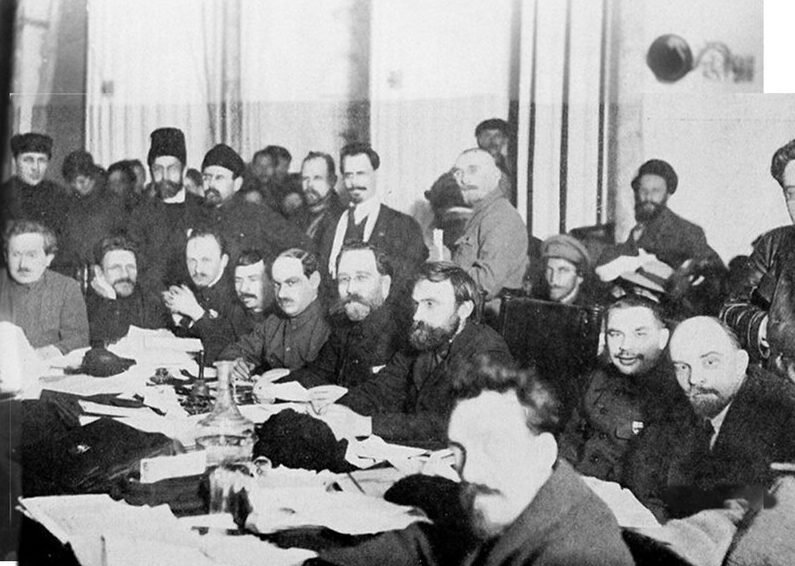
The Russian Civil War was primarily between the Bolshevik “Reds” and the anti-Bolshevik “Whites,” which included former imperial forces, nationalists, and foreign interventionists. Image: A 1920 photo of the Bolshevik Party meeting.
The Bolsheviks’ seizure of power led to the Russian Civil War from 1917 to 1922, a brutal conflict between the Bolshevik “Red” forces and the anti-Bolshevik “White” forces, which included monarchists, conservatives, liberals, and various nationalist groups supported by international forces from Britain, France, Japan, and the United States.
The Civil War was marked by significant brutality on both sides, with mass executions and severe repression. The Bolsheviks, under the leadership of Lenin, Trotsky, and others, managed to consolidate their hold on power through a combination of strategic brilliance and ruthless suppression of opposition.
In 1922, the Bolsheviks formally established the Soviet Union, a federal union of multiple Soviet republics, theoretically based on the principles of socialism and equality. The new state was intended to be a workers’ paradise but was in reality highly centralized and authoritarian.
Frequently Asked Questions
Here are some questions and answers based on the historical context and events from the early 1800s in Europe to the establishment of the Soviet Union:
What were the main reasons for Russia’s desire to be an imperial power in the 1800s?
Russia wanted to be an imperial power to compete with Western European nations such as Britain and France, seeking similar global influence and prestige. This ambition was driven by the desire to expand territory, access new resources and markets, and enhance its geopolitical leverage.
What factors contributed to Russia’s weaknesses in achieving imperial power status in the 1800s?
Russia faced several significant challenges, including its vast and often ungovernable size, economic underdevelopment, and poor leadership. These factors hindered effective administration and progress, making it difficult to match the prowess of more compact and industrialized Western European powers.

How did the Russo-Japanese War affect Russia’s international standing?
The Russo-Japanese War (1904-05) resulted in a humiliating defeat for Russia at the hands of Japan, a nation many Westerners considered backward. This defeat significantly undermined Russia’s prestige and exposed its military and technological weaknesses, altering its image as a dominant imperial power.
What were the immediate consequences of the Russo-Japanese War for Russia internally?
The war’s outcome sparked widespread discontent among the Russian populace, leading to the 1905 Revolution. This revolution forced Tsar Nicholas II to implement reforms, including the creation of a representative assembly, the Duma, to quell public unrest and address demands for political participation.
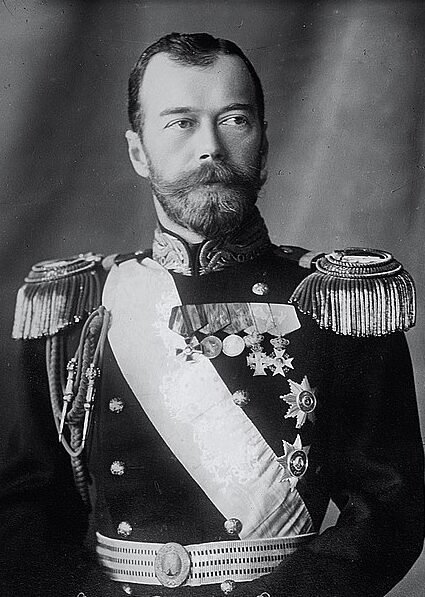
The Revolution of 1905 led to the creation of the Duma, a legislative body meant to share power with the Tsar. However, these reforms were limited as Tsar Nicholas II retained significant executive powers, leading to continued political discontent. Image: Nicholas II (1868 – 1918).
How did World War I impact Russia and contribute to the revolutionary climate?
World War I had devastating effects on Russia, exacerbating existing economic and social problems. The immense military losses, coupled with food shortages and a collapsing economy, deeply disillusioned the Russian people, setting the stage for widespread revolutionary sentiment and the eventual overthrow of Tsar Nicholas II in 1917.
What were the key events and outcomes of the 1917 Bolshevik Revolution?
The Bolshevik Revolution, led by Vladimir Lenin and the Bolshevik Party in October 1917, successfully overthrew the provisional government that had replaced the tsar earlier that year. The Bolsheviks established a communist government based on Marxist principles, aiming to create a classless society and end private property.

What triggered the Russian Civil War, and who were the main parties involved?
The Russian Civil War was triggered by opposition to the Bolsheviks’ seizure of power and their subsequent dictatorial and violent governance measures. The main parties were the Bolsheviks (Reds), who fought to maintain control of the government, and a diverse group of anti-Bolshevik forces (Whites), including monarchists, nationalists, and foreign nations, who opposed Bolshevik rule.
What were the consequences of the Russian Civil War?
The Russian Civil War, lasting from 1917 to 1922, resulted in significant loss of life and widespread destruction. It ultimately ended with the Bolsheviks consolidating power and establishing the Soviet Union in 1922. The war also led to severe repression, the creation of a one-party state, and the establishment of a centrally planned economy.
How did the establishment of the Soviet Union change the political landscape in Russia and internationally?
The establishment of the Soviet Union marked the world’s first communist state, significantly impacting the global political landscape by promoting the spread of communist ideologies and influencing revolutionary movements worldwide. Domestically, it transformed Russia into a state with centralized control over the economy and a repressive political regime under Communist Party rule.





