Human Burials in and around Stonehenge
Stonehenge, the iconic prehistoric monument located in Wiltshire, England, has long been the subject of fascination for its enigmatic origins, purpose, and construction. Among the many mysteries associated with it, one of the most intriguing aspects is the discovery of human burials in and around the monument.
These burials provide essential insights into the people who constructed, used, and revered Stonehenge across different periods in prehistoric Britain. The burials at Stonehenge not only shed light on the individuals interred but also on the broader social, cultural, and religious contexts of the time.
Stonehenge: An Overview
Before delving into the burials, it’s important to provide a brief overview of Stonehenge itself. The monument was constructed in several phases, with its origins dating back to around 3000 BCE. Initially, it consisted of a circular ditch and bank (often referred to as a “henge”), which was later supplemented by the iconic standing stones—large sarsens and smaller bluestones. Over the centuries, these stones were rearranged and modified, with the final layout taking shape around 2500 BCE.
Stonehenge’s purpose has been the subject of numerous theories, ranging from an astronomical observatory to a site for religious ceremonies. Recent archaeological research has emphasized its significance as a ceremonial or sacred landscape, where human activities related to death and burial played a central role.
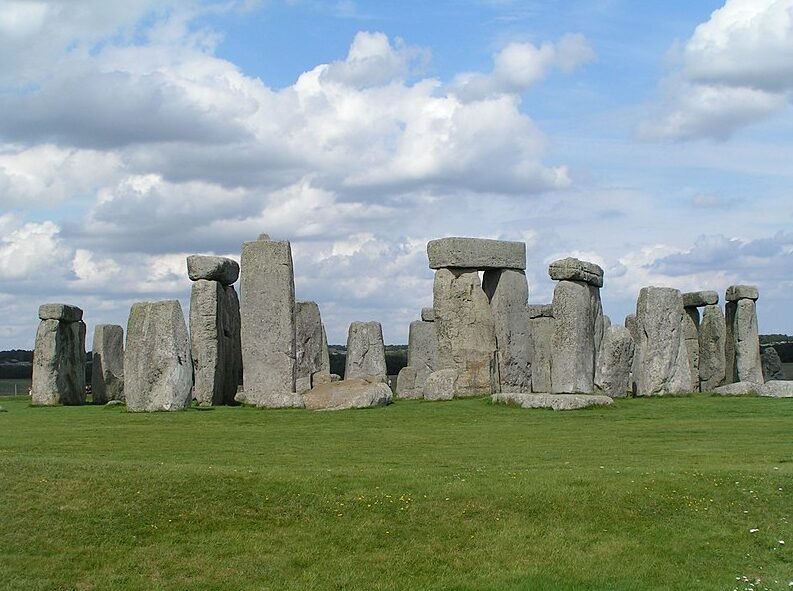
Stonehenge fascinates for its mysterious origins, purpose, and construction.
Early Burials at Stonehenge
The earliest evidence of human burial at Stonehenge comes from its initial phases, during the late Neolithic period. Around 3000 BCE, the monument’s outer ditch was dug, and within the ditch, a series of pits known as “Aubrey Holes” were created. These pits, named after the 17th-century English antiquarian John Aubrey who first identified them, contained a mixture of artifacts, such as animal bones, stone tools, and most notably, cremated human remains.
The cremation burials associated with the Aubrey Holes represent some of the earliest use of Stonehenge as a burial ground. Radiocarbon dating of these remains suggests that the site was used for burials over several centuries, starting from its initial construction phase. The presence of cremated remains rather than inhumations (full-body burials) is characteristic of the period and provides key insights into the funerary practices of the time.
The Significance of Cremation
Cremation was a common practice during the Neolithic period, particularly in southern Britain. The remains of individuals were burned on funeral pyres, and the resulting ashes and fragments of bone were collected and deposited in burial pits. At Stonehenge, these cremated remains were carefully placed in the Aubrey Holes and other locations around the monument.
The choice of cremation over inhumation may have been influenced by various factors, including religious beliefs, the desire to separate the spirit from the body, or practical considerations related to the environment. Whatever the reason, the cremation burials at Stonehenge reflect the broader cultural practices of the time and indicate that the site had a significant ritual or ceremonial function related to death.

Who Were the People Buried at Stonehenge?
Determining the identities of the individuals buried at Stonehenge is challenging, given the lack of written records and the fragmentary nature of the remains. However, recent advancements in archaeology, including isotopic analysis and DNA studies, have provided valuable clues.
One of the most important discoveries related to the Stonehenge burials was made in 2008, when archaeologists uncovered a grave containing the remains of a man dubbed the “Amesbury Archer.” The grave, located a few miles from Stonehenge, contained a wealth of grave goods, including gold ornaments, copper knives, and flint tools. Isotopic analysis of the Archer’s teeth revealed that he had grown up in the Alps region of central Europe, suggesting that people traveled long distances to visit or settle near Stonehenge. This discovery has led to the theory that Stonehenge may have been a site of international importance, attracting visitors from across Europe.
In addition to the Amesbury Archer, the remains of several other individuals have been found in and around Stonehenge, including those of women and children. This suggests that the site was not reserved exclusively for male elites but was a burial ground for a broader segment of society. Some of the individuals buried at Stonehenge may have been involved in the construction of the monument, while others may have been members of a ruling or priestly class responsible for its upkeep and ceremonial use.
The Beaker Culture and Later Burials
By around 2500 BCE, the construction of Stonehenge had reached its most recognizable form, with the erection of the large sarsen stones and the arrangement of the smaller bluestones in a circular pattern. This period also saw the emergence of the “Beaker culture” in Britain, characterized by the use of distinctive pottery vessels known as beakers, as well as advances in metallurgy and social organization.
The Beaker culture brought changes to burial practices, with a shift from cremation to inhumation. Individuals were often buried in barrows (earthen mounds) with a range of grave goods, including pottery, tools, and personal ornaments. Some of these barrows have been found in the vicinity of Stonehenge, indicating that the site continued to be a focus for burial and ritual activity during the early Bronze Age.
One of the most significant burials from this period is that of the “Boscombe Bowmen,” a group of individuals buried together in a grave near Stonehenge. The grave contained the remains of at least seven individuals, along with several beakers and other artifacts. Isotopic analysis of the bones revealed that the Bowmen had traveled from western Britain, further supporting the idea that Stonehenge was a site of regional or even national significance.
The Role of Stonehenge in Funerary Practices
The burials at Stonehenge provide important evidence for the role of the monument in prehistoric funerary practices. While the exact nature of the rituals performed at Stonehenge remains unclear, it is evident that the site was closely associated with death and burial from its earliest phases.
Some archaeologists have suggested that Stonehenge may have been part of a larger ceremonial complex, with different parts of the landscape serving different functions in the funerary process. For example, the nearby site of Durrington Walls, located just a few miles from Stonehenge, is thought to have been a settlement where people gathered for feasting and other activities related to the commemoration of the dead. The River Avon, which flows between Durrington Walls and Stonehenge, may have been used as a symbolic pathway for the souls of the deceased, with Stonehenge serving as the final resting place.
Stonehenge as an Ancestral Monument
One of the prevailing theories about Stonehenge is that it functioned as an ancestral monument, where the remains of the dead were venerated and where rituals were performed to honor the ancestors. The act of burying individuals within or near the monument would have reinforced its sacred status and established a connection between the living and the dead.
The use of Stonehenge as a burial site appears to have declined after the early Bronze Age, as new burial practices and monuments emerged elsewhere in Britain. However, its association with death and the ancestors likely continued to be an important aspect of its cultural significance, even as its use for burial diminished.
Recent Discoveries and Ongoing Research
In recent years, new discoveries have continued to shed light on the burials at Stonehenge and their significance. For example, excavations at the nearby Coneybury Anomaly and other sites have revealed additional cremation burials, as well as evidence of long-distance trade and interaction between different regions of Britain and Europe.
Advances in scientific techniques, such as isotopic analysis and ancient DNA research, have also allowed archaeologists to gain a better understanding of the individuals buried at Stonehenge. These techniques can provide insights into the diet, health, and geographic origins of the individuals, helping to build a more detailed picture of the people who lived and died in the shadow of the monument.
Conclusion
The burials at Stonehenge represent one of the most fascinating aspects of the monument’s long history. From the earliest cremation burials in the Neolithic period to the elaborate inhumations of the Beaker culture, the site served as a focal point for funerary practices and rituals for many centuries.
While much about these burials remains mysterious, ongoing research continues to provide new insights into the lives and deaths of the people associated with Stonehenge. These burials not only reveal the importance of Stonehenge as a sacred landscape but also highlight the complex social, cultural, and religious dynamics of prehistoric Britain.
Questions and Answers about Stonehenge

What are some theories about the purpose of Stonehenge?
Stonehenge has sparked numerous theories regarding its purpose. It has been suggested that it could have been a temple to the ancestors, an astronomical calendar, a healing center, or even a giant computer. It’s also possible that Stonehenge served multiple purposes throughout its 1500-year history.

Researchers have conducted experiments to explore how the Welsh bluestones and local sarsen stones were transported to Salisbury Plain and erected at Stonehenge. These experiments aim to understand the techniques and tools that prehistoric builders may have used. Image: Painting of the Stonehenge by Flemish artist Lucas de Heere.
What was the first structure built at Stonehenge?
The first monument built at Stonehenge around 3100 BCE was a circular earthwork, or “henge,” about 360 feet in diameter. This structure likely contained a ring of wooden posts or an early bluestone circle, with pits known as Aubrey Holes.
What was Stonehenge used for around 3000 BCE?
Around 3000 BCE, Stonehenge became a cremation cemetery, the largest known in Britain at the time.
How many cremation burials were discovered at Stonehenge during the 20th century?
Over 50 cremation burials were discovered at Stonehenge during the 20th century. It is estimated that a couple of hundred more burials remain in unexcavated areas of the site.
The majority of the cremated remains belong to adult males aged 25 to 45, suggesting that only select individuals, likely of high social status such as aristocrats or clan leaders, were buried at the site.
What is an example of an inhumation burial found at Stonehenge?
In 1978, a skeleton of a man was discovered in the outer ditch of Stonehenge. He had been shot with six flint-tipped arrows, indicating a possible execution or ritual sacrifice.
Who was the Amesbury Archer, and why is his burial significant?
The Amesbury Archer, whose burial was found about 4.5 km from Stonehenge, was a high-status individual buried between 2400 and 2150 BCE. His grave contained valuable items such as Beaker pots, flint arrowheads, gold hair ornaments, and metalworking tools. Isotope analysis revealed that the Archer had grown up in the Alps, suggesting long-distance migration and his possible involvement in Stonehenge’s construction.
What other burial was found near the Amesbury Archer?
A nearby burial of a younger man, likely related to the Amesbury Archer, was also discovered. This man, who had grown up around Salisbury Plain, was buried with gold ornaments, indicating strong ties between local and migrant communities.
Who were the Boscombe Bowmen, and what was their connection to Stonehenge?
The Boscombe Bowmen were a group of seven individuals buried together around 2300 BCE. Isotope analysis showed they had originated from Wales, and their grave goods suggest they were involved in transporting the Welsh bluestones to Stonehenge.
Who was the Boy with the Amber Necklace, and what is notable about his burial?
The Boy with the Amber Necklace was a teenage boy buried with 90 amber beads, discovered in 2010. Isotope analysis revealed that he had grown up in the Mediterranean, showcasing Stonehenge’s long-distance connections even after 1500 years of use.





