Humayun: The Second Mughal Emperor
Humayun was the second Mughal emperor who ruled over parts of modern-day Afghanistan, Bangladesh, India, and Pakistan from 1530 to 1540 and again from 1555 until his death in 1556.
Early Life and Background
Nasir al-Din Muhammad, commonly known as Humayun, was born on March 6, 1508, to Emperor Babur and his favorite wife, Maham Begum. He belonged to the Timurid dynasty and was raised in a royal environment that emphasized military training and governance. His mother was related to Sultan Husayn Bayqara, the Timurid ruler of Herat. As a prince, Humayun gained experience by governing regions under Babur’s rule, but his succession to the throne in 1530 at the age of 22 was fraught with challenges.
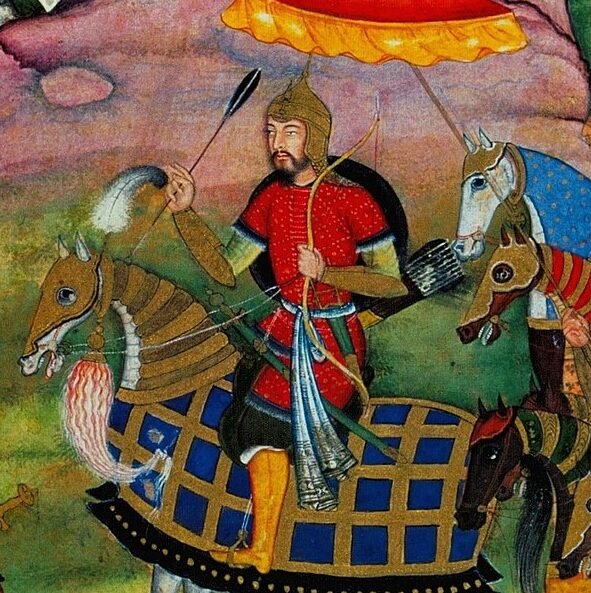
A depiction of Emperor Humayun
Ascension to the Throne
Humayun succeeded Babur on December 26, 1530, as the ruler of the Mughal territories in the Indian subcontinent. However, his ascension was not smooth, as his half-brother Kamran Mirza inherited Kabul and Kandahar. Kamran’s ambitions made him a significant rival, leading to conflicts that undermined Mughal unity. Unlike many monarchies that followed primogeniture, the Timurids adhered to the Central Asian tradition of dividing territories among multiple heirs, which often led to fratricidal struggles.
Early Reign and Challenges
Humayun’s reign began with internal dissent and external threats. Two major rivals, Sultan Bahadur of Gujarat in the southwest and Sher Shah Suri in the east, posed serious challenges. His initial campaigns focused on countering Sher Shah Suri but were interrupted by a threat from Gujarat. In 1535, Humayun achieved a temporary victory by annexing Gujarat, Malwa, and Champaner. However, instead of consolidating his control, he allowed internal politics to distract him, enabling Bahadur to reclaim his territories.
Meanwhile, Sher Shah Suri capitalized on Humayun’s divided focus. While Humayun successfully defended Agra, he failed to prevent Sher Shah from sacking Gaur in Bengal, significantly depleting the region’s wealth and resources.
Defeat by Sher Shah Suri
In 1539, Humayun suffered a devastating defeat at the Battle of Chausa, where Sher Shah Suri’s forces overwhelmed the Mughals. Humayun barely escaped by swimming across the Ganges River. The following year, at the Battle of Kannauj, he was again decisively defeated. Forced into exile, he fled through Rajasthan and Sindh, ultimately seeking refuge in the Safavid court of Persia.
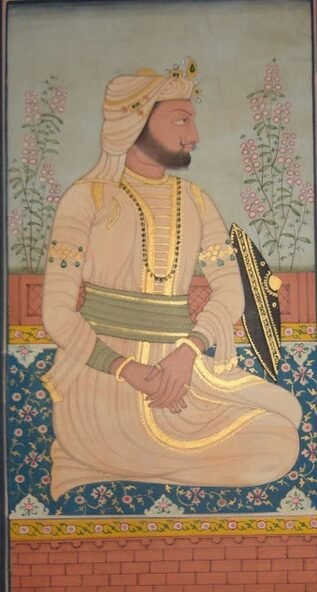
An illustration portraying Sher Shah Suri.
Exile in Persia and Persian Influence
Shah Tahmasp I of Persia received Humayun warmly, offering him military aid under the condition that he convert to Shia Islam. Though controversial, this strategic move secured him the support of the Safavids. With their backing, Humayun regained control of Kandahar in 1545 and later Kabul, successfully defeating his brother Kamran Mirza. His exile exposed him to Persian art, architecture, and administrative methods, which he later integrated into the Mughal court upon his return to India.
Restoration of the Mughal Empire
After the death of Islam Shah Suri in 1554, the Sur Empire weakened due to internal strife. Seizing the opportunity, Humayun, supported by Persian-trained forces, launched a campaign to reclaim his throne. Under the command of his loyal general Bairam Khan, Humayun’s army decisively defeated Sikandar Shah Suri at the Battle of Sirhind in 1555. On July 23, 1555, Humayun re-entered Delhi as the restored Mughal emperor.
Contributions to Mughal Administration and Culture
Humayun’s restoration was short-lived, but his influence was profound. He introduced Persian cultural elements, influencing Mughal court practices, language, and artistic traditions. Persian-style gardens and architectural elements began to flourish, a trend that reached its peak during Akbar’s and Shah Jahan’s reigns. His administrative reforms also laid the groundwork for Akbar’s future success.
Death and Legacy
On January 24, 1556, Humayun suffered a fatal accident. While descending the stairs of his library in Delhi’s Purana Qila, he slipped and sustained severe head injuries. He died three days later on January 27, 1556. His body was initially interred in Purana Qila but was later moved to his grand mausoleum in Delhi, commissioned by his chief wife, Bega Begum.
Although Humayun’s reign was tumultuous, he left behind a more unified and culturally rich empire for his son, Akbar, who would go on to become one of the greatest Mughal rulers.

Humayun depicted seating in a garden
Timeline of Humayun’s Life (1508–1556)
- 6 March 1508: Born as Nasir al-Din Muhammad Humayun to Babur and Māham Begum.
- 26 December 1530: Succeeds Babur as the second Mughal emperor at age 22.
- 1532: Defeats Afghan chieftains at the Battle of Daurah.
- 1535: Captures Gujarat but loses it within a year due to rebellion.
- 1539: Defeated by Sher Shah Suri at the Battle of Chausa.
- 1540: Loses the Battle of Kannauj; flees India, beginning 15 years of exile.
- 1544: Finds refuge in Persia under Safavid ruler Shah Tahmasp I.
- 1545: Recaptures Kandahar and Kabul from his brother Kamran Mirza.
- 1555: Reclaims Delhi and Agra, restoring Mughal rule.
- 24 January 1556: Suffers a fatal fall from his library stairs.
- 27 January 1556: Dies; succeeded by his son Akbar.
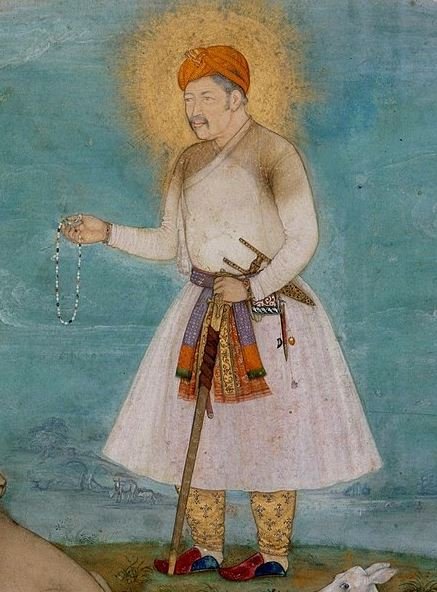
Portrait of Akbar, by Indian artist Govardhan.
Frequently Asked Questions about Mughal Emperor Humayun
How did Humayun lose and regain his empire?
He lost his empire to Sher Shah Suri in 1540 but regained it in 1555 with the help of the Safavid Persian Empire.
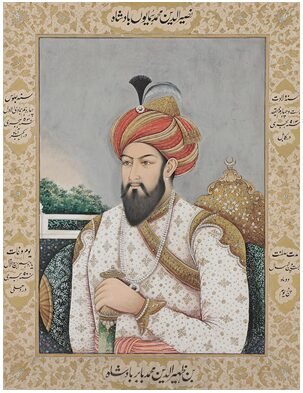
Portrait of Humayun
What was Humayun’s relationship with his brothers?
His half-brothers, especially Kamran Mirza, were his rivals, leading to internal conflicts that weakened his rule.
Why was Humayun’s exile significant?
During his exile in Persia, he adopted Persian cultural influences, which later shaped Mughal art, architecture, and administration.
What role did Sher Shah Suri play in Humayun’s reign?
Sher Shah Suri defeated Humayun at the Battle of Chausa (1539) and Kannauj (1540), establishing the Sur Empire and forcing Humayun into exile.
How did Humayun die?
He fell down the stairs of his library in Delhi while responding to the call to prayer and succumbed to his injuries three days later in 1556.
Who succeeded Humayun?
His son Akbar succeeded him at the age of 13, with Bairam Khan acting as his regent.
What was Humayun’s major architectural contribution?
Humayun’s Tomb in Delhi, commissioned by his wife Bega Begum, was the first grand Mughal garden tomb and a precursor to the Taj Mahal.
What impact did Persian culture have on Humayun’s court?
Persian influences, introduced during his exile, reshaped Mughal court traditions, language, art, and administration.
After losing his throne, Humayun visited Guru Angad, who reminded him of his failure to fight Sher Shah Suri, offering him spiritual guidance.
Why was Humayun’s rule considered unstable?
He struggled with internal rebellions, external threats, and personal weaknesses, including indulgence in luxury and opium use.
What is Gulbadan Begum’s contribution to Humayun’s legacy?
His sister, Gulbadan Begum, wrote Humayun Nama, providing a unique firsthand account of his life and reign.





