Ištaran was a significant deity in ancient Mesopotamia, particularly as the tutelary god of Der, an important city located near the Tigris River and close to the border of Elam.
His influence spanned from the Early Dynastic period through various later historical periods, including the Kassite, Neo-Assyrian, and Neo-Babylonian periods.
Ištaran was primarily recognized as a divine judge and associated with justice, the underworld, and serpents. Despite his high position within the Mesopotamian pantheon, much about Ištaran remains enigmatic due to the limited amount of surviving texts and information regarding his cult.
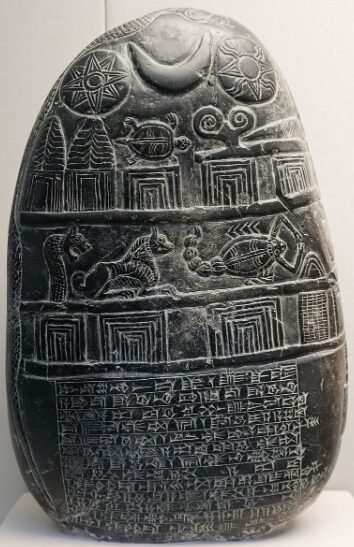
Known as a divine judge, his exact nature remains unclear, though he was associated with snakes and the snake god Nirah. He may have been depicted as serpentine. Image: Nirah, the snake god and messenger of Ištaran, depicted on the upper edge of a kudurru.
The Name and Origins of Ištaran
Ištaran’s name could be written in cuneiform using different logograms, such as dKA.DI and dMUŠ. The reading “Ištaran” was confirmed by British Assyriologist Wilfred G. Lambert in 1969. Before Lambert’s work, other names, such as Sataran, Satran, Gusilim, and Eatrana, were suggested as possible readings of the deity’s name. There are also variant spellings of Ištaran’s name, such as Iltaran and an Emesal (a dialect of Sumerian) form, Ezeran or Ezzeran.
The logogram dMUŠ, used to write Ištaran’s name, had other applications as well. It could designate his messenger, the serpent deity Nirah, the tutelary deity of Susa, Inshushinak, the tutelary god of Eshnunna, Tishpak, or the primordial river deity, Irḫan. Additionally, the logogram mulMUŠ could refer to the constellation Hydra, which might have been linked to Ištaran in Mesopotamian astronomical traditions.
There is debate among scholars regarding the origin of Ištaran’s name. Some believe the name is Semitic, while others suggest it might have Elamite origins due to Der’s proximity to Elam. Some scholars have proposed that Ištaran’s name might be etymologically related to Ishtar, the Mesopotamian goddess of love and war, but this theory has not been universally accepted.
It has also been further suggested that Ištaran’s name, which includes the suffix -an, might refer to “the two Ishtars,” potentially alluding to the morning and evening stars. This theory posits that Ištaran could have emerged from the syncretism of a local snake god and an Ishtar-like deity.
Another important title used to refer to Ištaran was Anu Rabû, or AN.GAL, meaning “Great Anu.” This title connects Ištaran to Anu, the supreme god of the Mesopotamian pantheon, and suggests that Ištaran may have been viewed as a significant cosmic figure. However, the exact nature of this connection remains unclear.
Character and Attributes of Ištaran
Despite his high position in the Mesopotamian pantheon, Ištaran’s character is not well understood. He was primarily known as a divine judge, and his just nature became proverbial.
Kings, including Gudea of Lagash and Shulgi of Ur, compared themselves to Ištaran in their inscriptions, emphasizing their roles as just rulers. An Old Babylonian adab hymn also compared Ištaran to Nergal, highlighting his just character.
Ištaran’s role as a divine judge has led some scholars to associate him with the underworld. In the god list An = Anum, he is listed near Ereshkigal, the queen of the underworld. Ištaran is also referred to in some Sumerian litanies and a late Assyrian ritual as a “dying god” whose death occurred in the summer, with his body beaten and his blood reaching the underworld.
In one text, Ištaran is directly equated with Dumuzi, another dying god closely associated with the underworld. Ištaran’s death, mourning, and revival align with the broader Mesopotamian tradition of seasonal cycles and the death and rebirth of deities like Dumuzi and Ningishzida.
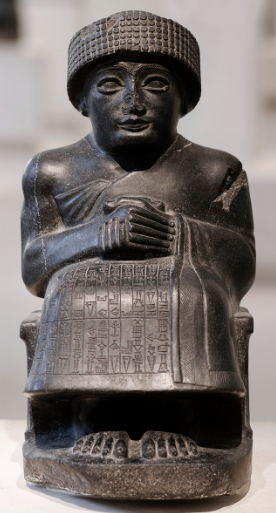
Statue of Gudea I, dedicated to the god Ningishzida
Though he was primarily a judge deity, Ištaran may have also been associated with healing. A text from Malgium contains a theophoric name, Ištarān-asû, with “asû” meaning healer or physician. This suggests that Ištaran may have played a role in healing rituals.
Additionally, his title Anu Rabû connects him to the sky, and some scholars believe that he may have had a celestial aspect. In Mesopotamian art, rays are sometimes depicted emanating from Ištaran’s shoulders, potentially symbolizing his connection to the heavens.
One of the more peculiar aspects of Ištaran’s iconography is his association with serpents. In Mesopotamian texts, his temple is described as being adorned with images of intertwined snakes, such as the mušḫuššu, a mythological dragon-like creature, and the horned viper. It is possible that Ištaran himself was sometimes depicted in a partially serpentine form.
Some scholars have argued that the humanoid figure with the lower body of a snake depicted on cylinder seals from the Sargonic period represents Ištaran. However, others believe this figure to be Nirah, Ištaran’s serpent messenger.
Ištaran may have belonged to a group of deities referred to as “Transtigridian snake gods.” These deities, including Ninazu, Ningishzida, Tishpak, and Inshushinak, were associated with both Mesopotamian and Elamite religious traditions. Wiggermann suggested that these snake gods developed in the cultural and religious borderlands between Mesopotamia and Elam, where their cults merged with local traditions.
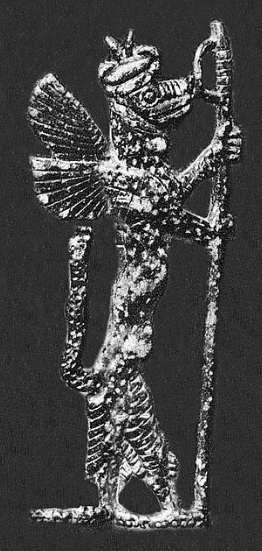
Mušḫuššu on a vase of Gudea
Family and Relationships of Ištaran
Ištaran was considered a son of Anu and Urash, though the evidence for this connection comes primarily from later god lists and texts. In the Old Babylonian Nippur god list, Ištaran is associated with Uruk, further connecting him to Anu, who was the principal god of the city of Uruk.
Some scholars have suggested that Ištaran and Inshushinak, the tutelary god of Susa, were considered sons of Tishpak, the city god of Eshnunna, based on their placement in the god list An = Anum. Ištaran was also grouped with other local gods, such as Ninazu and Shara, in lists of city deities.
In later texts, Ištaran is mentioned as having a wife, Šarrat-Deri, whose name means “Queen of Der” or “She of Der.” This suggests that Ištaran was paired with a local goddess who represented the city of Der.
Another goddess, Manzat, the divine personification of the rainbow, may have also been regarded as Ištaran’s wife. A syncretistic hymn to Nanaya indicates that Manzat was worshipped alongside Ištaran in Der, likely during the late second millennium BCE or early first millennium BCE.
Ištaran’s court included several minor deities. His primary attendant, or sukkal, was Nirah, a serpent deity who could also be considered Ištaran’s son. Another deity associated with Ištaran was Zīzānu, who is sometimes described as his son or the son of Qudma, Ištaran’s sukkal. Other deities in Ištaran’s retinue included Rāsu, Turma, and Itūr-mātiššu.
Ištaran’s Worship and Cult Centers
Ištaran was the chief deity of the city of Der, where his temple, Edimgalkalamma, or “House, Great Bond of the Land,” was located. Der was situated on the frontier between Mesopotamia and Elam, which contributed to the syncretism between Mesopotamian and Elamite religious traditions.
The earliest evidence for Ištaran’s worship comes from royal inscriptions from the Early Dynastic period. One such inscription, attributed to Entemena, records that Mesalim of Kish, acting on the command of Ištaran, demarcated the border between Lagash and Umma. Ištaran’s role as a neutral judge deity in resolving border disputes highlights his importance as a god of justice.
First mentioned in the Early Dynastic period, Ištaran continued to appear in various sources throughout Mesopotamian history.
Theophoric names invoking Ištaran first appear in the Early Dynastic period and continue to be found in later historical periods. During the Sargonic period, a mace head dedicated to Ištaran by Naram-Sin of Akkad was found in Ur, further attesting to Ištaran’s significance beyond Der. Gudea, the ruler of Lagash, also referred to Ištaran in his inscriptions, comparing himself to the god in matters of justice.
After the fall of the Third Dynasty of Ur, Der became an independent city-state, and its rulers were considered representatives of Ištaran. This parallels developments in other Mesopotamian city-states, such as Assur and Eshnunna, where local rulers were viewed as the earthly governors of their respective city gods, Ashur and Tishpak.
After the Ur III period, Der’s rulers were considered representatives of Ištaran. Later, Assyrians seized his statue multiple times to control Der’s population.
The Kassite kings also patronized Ištaran’s cult. A temple renovation project undertaken by one of the Kassite kings, either Kurigalzu I or Kurigalzu II, included the reconstruction of Edimgalkalamma. Additionally, several individuals bearing theophoric names invoking Ištaran appear in documents from the First Sealand dynasty, and the god’s name was used in Kassite and Elamite theophoric names, indicating the broader influence of Ištaran’s cult.
Ištaran’s importance continued into the Neo-Assyrian and Neo-Babylonian periods. Assyrian kings, including Shamshi-Adad V, Adad-nirari III, Sennacherib, Esarhaddon, and Ashurbanipal, repeatedly seized and returned Ištaran’s statue as a way to secure Der’s loyalty. Esarhaddon and Ashurbanipal both undertook renovations of Ištaran’s temple in Der, and Ištaran was invoked in Assyrian royal inscriptions as a god who aided the king in military campaigns.
Ištaran in Literature and Mythology
Ištaran appears in several Mesopotamian literary texts. In the Epic of Anzû, he is listed as one of the names of Ninurta, along with other deities who were considered equivalent to Ninurta, such as Zababa, Pabilsag, Inshushinak, and Lugal-Marada. This suggests that, in some contexts, Ištaran could be viewed as a manifestation of Ninurta, the god of war and agriculture.
In the Epic of Erra, Ištaran is depicted as a god who abandons the violent inhabitants of Der after they begin to act unjustly. He is also the only deity in the epic who resists Erra’s destructive rampage, emphasizing his role as a god of justice.
Ištaran is also mentioned in lamentations, where he is mourned alongside other dying gods such as Damu and Dumuzi. These texts highlight Ištaran’s association with death, rebirth, and the cyclical nature of the seasons.
READ MORE: Most Famous Myths from Ancient Mesopotamia





