Italian Painter Caravaggio

Born in Milan, Caravaggio’s works are praised for having incredible influence on Baroque painting. Image: Chalk portrait of Italian painter Caravaggio, c. 1621
Michelangelo Merisi da Caravaggio (1571–1610), commonly known as Caravaggio, was a groundbreaking Italian painter whose work had a lasting impact on the Baroque movement and the course of Western art. Known for his intense realism, dramatic use of light and shadow (chiaroscuro), and ability to bring biblical and mythological scenes to life with unprecedented emotional depth, Caravaggio remains one of the most influential figures in the history of art.
Early Life and Background
Caravaggio was born in the town of Caravaggio in Lombardy, Italy, on September 29, 1571. His family was relatively well-off, but their fortunes took a turn when his father, a stonemason and household manager for a local noble family, died in 1577, followed by Caravaggio’s mother in 1584. These early tragedies shaped the artist’s tumultuous personality and future works, many of which reflect themes of suffering, death, and redemption.
After his parents’ death, Caravaggio began his artistic training in Milan under the painter Simone Peterzano, who had been a student of Titian. Peterzano’s studio exposed Caravaggio to the work of northern Italian painters, particularly the realistic style of Lombard artists and the Venetian use of color and light. These early influences would later blend with Caravaggio’s distinctive approach to realism and dramatic lighting.
Move to Rome and Early Works
In 1592, Caravaggio moved to Rome, a city bustling with artistic patronage and opportunities for young artists. However, his early years there were marked by hardship. He struggled to find stable work and reportedly took on small commissions for minor artists. During this period, Caravaggio painted a series of still lifes and genre scenes, such as Boy with a Basket of Fruit (1593) and The Fortune Teller (1594), which already showed signs of his extraordinary skill in rendering naturalistic details and his fascination with everyday life.
Caravaggio’s breakthrough came when he joined the workshop of Giuseppe Cesari, a leading painter of the time. While there, Caravaggio’s talent caught the attention of Cardinal Francesco Maria del Monte, an influential art patron. Del Monte provided Caravaggio with both financial support and important commissions, marking the beginning of the artist’s rise to fame.
Dramatic Use of Chiaroscuro and Realism
Caravaggio’s early success was largely due to his radical departure from the idealized beauty and classical compositions that dominated Renaissance art. He rejected the use of idealized figures and instead painted his subjects with a raw, unflinching realism. His figures often bore the marks of life’s hardships—dirty feet, wrinkled skin, and expressions of deep emotion—bringing a sense of immediacy and humanity to his work.
One of Caravaggio’s most significant contributions to art was his mastery of chiaroscuro, the use of strong contrasts between light and dark to create a sense of depth and volume. This technique allowed him to heighten the drama of his compositions, focusing the viewer’s attention on the most important elements of the scene. His use of chiaroscuro can be seen in many of his early religious works, such as The Calling of Saint Matthew (1599–1600), where the interplay of light and shadow directs the viewer’s gaze towards the figures at the center of the narrative.
Major Works
The Calling of Saint Matthew (1599–1600)

The Calling of Saint Matthew (1599–1600) by Caravaggio depicts St. Matthew’s conversion through a dramatic beam of light and Jesus’ gesture, without using traditional divine imagery like angels or clouds.
One of Caravaggio’s most famous works, The Calling of Saint Matthew, was commissioned for the Contarelli Chapel in the Church of San Luigi dei Francesi in Rome. The painting depicts the moment when Jesus calls Matthew, a tax collector, to follow him as a disciple. Caravaggio places the scene in a contemporary setting, with the figures dressed in 16th-century clothing and situated in a dark, tavern-like room. The dramatic beam of light that illuminates the figures from the right side of the composition symbolizes divine intervention, while the shocked expression on Matthew’s face captures the human element of the narrative.
This work exemplifies Caravaggio’s ability to merge the sacred with the ordinary, creating a powerful and accessible depiction of a biblical story.
The Martyrdom of Saint Matthew (1599–1600)

The Martyrdom of Saint Matthew (1599–1600) by Caravaggio is located in the Contarelli Chapel, San Luigi dei Francesi, Rome, alongside The Calling of Saint Matthew and The Inspiration of Saint Matthew.
Another work from the Contarelli Chapel series, The Martyrdom of Saint Matthew, is a strikingly violent depiction of the saint’s execution. Caravaggio portrays the chaotic moment with a visceral realism, emphasizing the physical struggle and the saint’s imminent death. The use of chiaroscuro in this painting heightens the sense of urgency, as the figures seem to emerge from the dark background into a starkly lit foreground. The painting’s emotional intensity and brutal honesty were hallmarks of Caravaggio’s style, setting him apart from his contemporaries.
Judith Beheading Holofernes (1599)

Judith Beheading Holofernes (c. 1598–1602) by Caravaggio depicts Judith decapitating the Assyrian general Holofernes. It’s part of the Galleria Nazionale d’Arte Antica collection.
In Judith Beheading Holofernes, Caravaggio captures the climactic moment when the Jewish heroine Judith decapitates the Assyrian general Holofernes. The painting is a masterclass in chiaroscuro, with the figures illuminated against a dark background, their expressions and movements frozen in a moment of tension and violence. Judith’s focused determination and Holofernes’ horrified expression are rendered with a shocking level of realism, making the scene both captivating and disturbing.
This painting not only showcases Caravaggio’s technical skill but also his ability to convey psychological depth through facial expressions and body language.
David with the Head of Goliath (1610)

David with the Head of Goliath (1610). Location: Galleria Borghese, Rome
This late work by Caravaggio is a haunting depiction of the young David holding the severed head of Goliath. The painting is often interpreted as a self-portrait, with Caravaggio casting himself as the slain giant, reflecting his inner turmoil and guilt. David, holding the head with a mixture of sorrow and triumph, is bathed in light, while Goliath’s head is cast in shadow, emphasizing the themes of death and redemption.
The painting is both violent and introspective, with David’s melancholic expression contrasting with the gruesome nature of the scene. The use of light and shadow enhances the emotional depth of the painting, making it a poignant reflection on mortality and sin.
The Supper at Emmaus (1601)

The Supper at Emmaus (1601) by Caravaggio depicts the resurrected Jesus revealing himself to two disciples in Emmaus. Commissioned by Ciriaco Mattei, it is now housed in London.
The Supper at Emmaus depicts the moment when the resurrected Christ reveals his identity to two of his disciples during a meal. Caravaggio’s naturalistic treatment of the figures, combined with his dramatic use of light, creates a powerful sense of revelation. The astonished expressions of the disciples and the still-life details on the table emphasize the physicality of the scene, while the use of chiaroscuro directs the viewer’s attention to the central figure of Christ.
This work exemplifies Caravaggio’s ability to transform a biblical story into a deeply human and emotionally resonant moment.
The Death of the Virgin (1606)

Death of the Virgin (1606) by Caravaggio portrays the death of the Virgin Mary with stark realism. Controversial at its time, it is now part of the permanent collection at the Musée du Louvre, Paris.
Commissioned for the Church of Santa Maria della Scala in Rome, The Death of the Virgin was a highly controversial work that was ultimately rejected by the clergy. Caravaggio depicted the Virgin Mary as a lifeless, bloated figure, her body sprawled on a bed with little of the grace and beauty traditionally associated with her image. The raw realism of the painting, combined with the rumor that Caravaggio had used a drowned prostitute as his model, scandalized the Church. Despite this, the painting was later acquired by the Duke of Mantua and is now regarded as one of Caravaggio’s masterpieces.
The Beheading of Saint John the Baptist (1608)

The Beheading of Saint John the Baptist (1608). Location: St. John’s Co-Cathedral, Valletta, Malta
This monumental work was painted during Caravaggio’s time in Malta and is considered one of his greatest achievements. The painting depicts the beheading of Saint John the Baptist in a stark, prison-like setting. The executioner leans over the saint’s body, preparing to deliver the final blow, while a woman, likely Salome, watches from the side.
The composition is marked by its simplicity and the use of muted colors, but the emotional power of the scene is undeniable. The figures are illuminated by a single light source, casting deep shadows and heightening the sense of drama. The painting is also notable for its large scale and the inscription of Caravaggio’s signature in the blood of Saint John, symbolizing the artist’s personal connection to the themes of martyrdom and suffering.
Personal Life and Troubles
Caravaggio’s life was as tumultuous and dramatic as his art. Known for his fiery temper and violent behavior, he was frequently involved in street brawls and had multiple run-ins with the law. In 1606, Caravaggio killed a man during a fight over a disputed tennis match and fled Rome to avoid imprisonment. He spent the next few years moving between Naples, Malta, and Sicily, continuing to paint while living as a fugitive.
Despite his personal troubles, Caravaggio continued to produce some of his most powerful works during this period, including The Seven Works of Mercy (1607) in Naples and The Beheading of Saint John the Baptist (1608) in Malta. His later works show an even greater emphasis on psychological depth and dramatic intensity, with darker, more somber tones.
Final Years and Death
In 1608, Caravaggio was imprisoned in Malta after yet another violent altercation, but he managed to escape and flee to Sicily. His last years were marked by a sense of paranoia and desperation, as he sought a papal pardon for his crimes. In 1610, believing that he had been granted clemency, Caravaggio set out for Rome. However, he fell ill and died under mysterious circumstances in the coastal town of Porto Ercole on July 18, 1610, at the age of 38.
The exact cause of Caravaggio’s death remains unclear, with theories ranging from malaria to murder. Despite his short and turbulent life, Caravaggio’s influence on the art world was profound.
Legacy
Caravaggio’s revolutionary approach to painting had a lasting impact on the Baroque movement and beyond. His use of chiaroscuro and naturalism influenced countless artists, including Peter Paul Rubens, Diego Velázquez, and Rembrandt. The emotional intensity and psychological realism that characterize his work set a new standard for religious and mythological painting, making these subjects more relatable and accessible to viewers.
Caravaggio’s legacy also lies in his ability to challenge artistic conventions and push the boundaries of what was acceptable in art. His willingness to depict biblical figures as flawed, human characters—complete with dirty feet and worn faces—was a radical departure from the idealized forms of the Renaissance. In doing so, he brought a new level of humanity to religious painting, making the divine seem more immediate and real.
Questions and Answers: Caravaggio
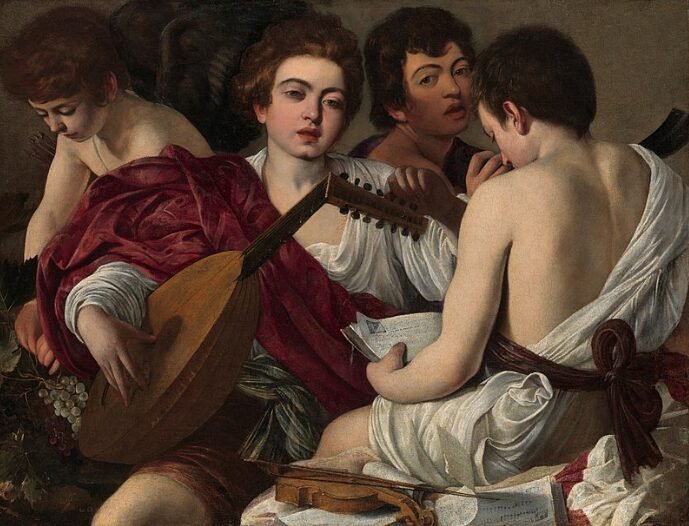
Caravaggio, born on 29 September 1571, was an influential Italian painter known for his realistic depictions of the human form and dramatic use of lighting. He was active mainly in Rome and played a crucial role in shaping the Baroque art movement. Image: The Musicians, 1595–1596, Metropolitan Museum of Art, New York
What is Caravaggio most famous for?
Caravaggio is best known for his mastery of chiaroscuro, a technique that uses strong contrasts between light and shadow, often referred to as tenebrism. His works vividly captured emotional intensity and often depicted scenes of violence, death, and human suffering.
How did Caravaggio’s style influence the Baroque movement?
Caravaggio’s dramatic use of lighting and emotional realism significantly impacted the Baroque style. His influence can be seen in the works of major artists like Peter Paul Rubens, Jusepe de Ribera, Gian Lorenzo Bernini, and Rembrandt. His followers, known as the “Caravaggisti” or “tenebrists,” adopted his techniques in their own works.
What personal challenges did Caravaggio face during his life?
Caravaggio had a volatile personality and was frequently involved in violent altercations. In 1606, he killed a man named Ranuccio Tommasoni in a brawl, leading to a death sentence that forced him to flee Rome. Throughout his life, he continued to encounter legal and personal troubles, including violent incidents in Naples and Malta.

Caravaggio’s works are housed in some of the world’s most prestigious museums, and his influence can be seen in the work of countless artists who followed in his footsteps. Image: Medusa (1597) by Italian painter Caravaggio. The oil on canvas mounted on wood shows the exact moment where Medusa’s head was cut off by Greek hero Perseus. The painting is now located in the Uffizi Museum in Florence, Italy.
Why did Caravaggio leave Rome?
After killing Ranuccio Tommasoni in 1606, Caravaggio fled Rome to escape a death sentence. He sought refuge in Naples, where he rebuilt his career, but his life remained marked by turmoil.
What happened during Caravaggio’s time in Naples and Malta?
In Naples, Caravaggio reestablished himself as a leading painter. He then traveled to Malta in 1607, hoping to receive a papal pardon for his crimes. However, he was involved in another violent altercation in 1608, leading him to flee to Sicily.
How did Caravaggio die?
Caravaggio died under mysterious circumstances in 1610 while traveling from Naples to Rome. Reports suggest he may have died from a fever, but there are theories that he could have been murdered or succumbed to lead poisoning.
What impact did Caravaggio’s art have after his death?
Although Caravaggio had a profound influence on Baroque painting, his style fell out of favor in the years following his death. It wasn’t until the 20th century that art historians began to reevaluate his importance, recognizing his contributions to the development of modern painting.
Who were the Caravaggisti?
The Caravaggisti were artists who were heavily influenced by Caravaggio’s techniques, particularly his use of chiaroscuro and realistic portrayal of human emotion. They adopted his dramatic style and helped spread his influence throughout Europe.
How did André Berne-Joffroy describe Caravaggio’s significance?
The 20th-century art historian André Berne-Joffroy stated, “What begins in the work of Caravaggio is, quite simply, modern painting,” highlighting Caravaggio’s role as a pioneer who reshaped the course of Western art.
What is tenebrism, and how did Caravaggio use it?
Tenebrism is a style of painting characterized by extreme contrasts between light and dark, with shadows dominating the composition. Caravaggio used tenebrism to focus attention on his subjects, creating intense drama and emotional impact in his works.
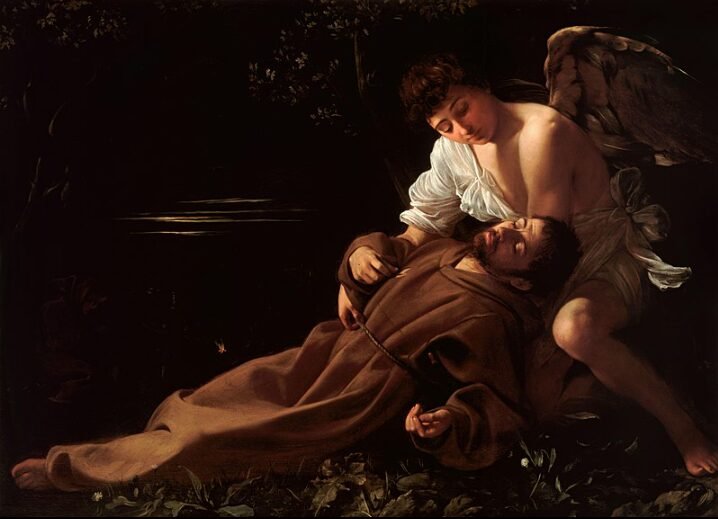
Despite the controversies and struggles that marked his life, Caravaggio’s art continues to captivate audiences with its dramatic intensity, technical brilliance, and profound emotional depth. Image: Saint Francis of Assisi in Ecstasy (c. 1595), Wadsworth Atheneum, Hartford
What themes did Caravaggio often explore in his paintings?
Caravaggio frequently depicted scenes of violence, death, emotional struggle, and human suffering. His works often focused on crucial moments of tension or conflict, rendered with raw realism and psychological depth.
Why did Caravaggio’s work fall out of favor after his death?
After Caravaggio’s death, the art world shifted toward more idealized and classical styles, which led to a decline in appreciation for his intense realism and dramatic style. His work was not widely recognized until the 20th century when interest in his groundbreaking techniques was revived.
In which cities did Caravaggio live during the last years of his life?
In the final four years of his life, Caravaggio moved between Naples, Malta, and Sicily, all while seeking a papal pardon for his crimes.
What marked Caravaggio’s approach to working on his paintings?
Caravaggio preferred working directly onto the canvas without using preparatory sketches. He used live models to capture a heightened sense of realism and immediacy in his subjects, contributing to the emotional power of his works.

Italian painter Caravaggio is celebrated as one of the greatest painters in the history of Western art. Image: Narcissus is a painting by the Italian Baroque master Caravaggio, painted circa 1597–1599. It is housed in the Galleria Nazionale d’Arte Antica in Rome.





