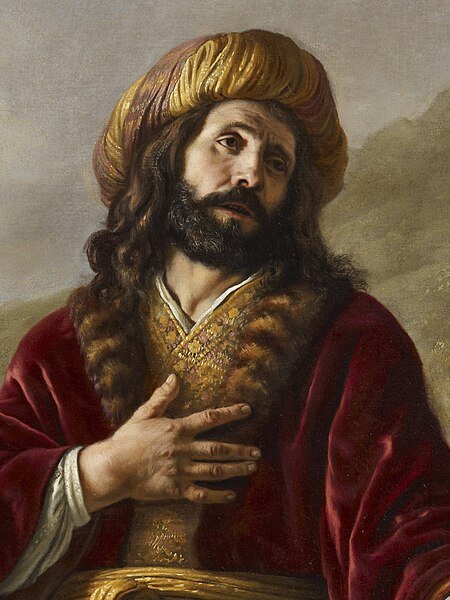
A close-up from “Jacob Seeking the Forgiveness of Esau” (1652) by Dutch artist Jan Victors.
Jacob, later named Israel, is a central figure in the Abrahamic religions, revered as the forefather of the Israelites. His story, primarily recorded in the Book of Genesis, is one of transformation, struggle, and divine encounters. As the son of Isaac and Rebecca, and the grandson of Abraham and Sarah, Jacob’s life is intricately woven into the fabric of biblical history. His experiences—from his birth, the acquisition of his brother Esau’s birthright, his marriages, his divine encounters, to his migration to Egypt—shape the legacy of the Israelite people.
Below, World History Edu delves into Jacob’s life, analyzing its historical, religious, and cultural significance.
Jacob’s Birth and Early Life
Jacob’s birth was accompanied by a prophecy. Rebecca, experiencing turmoil during her pregnancy, was told by God that two nations were in her womb and that the elder would serve the younger. This prophecy foreshadowed the lifelong rivalry between Jacob and his twin brother, Esau.
Esau, the firstborn, was described as a skillful hunter and a man of the field, while Jacob was a quiet man who dwelt in tents. Their differences extended beyond their personalities; Esau was favored by Isaac, whereas Jacob was favored by Rebecca. This parental favoritism laid the groundwork for future familial conflicts.
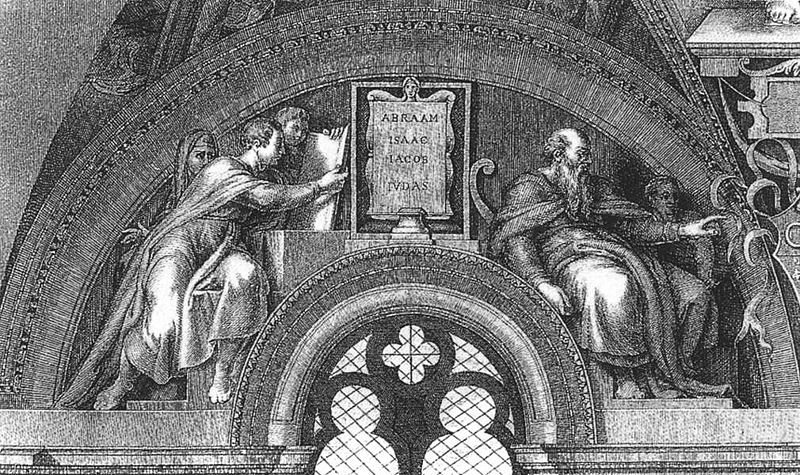
“Abraham, Isaac, Jacob, and Judah” by Italian sculptor Michelangelo Buonarroti, located in the Sistine Chapel, Vatican City.
The Birthright and the Blessing
Jacob’s defining early actions revolve around acquiring Esau’s birthright and blessing. One day, Esau returned from hunting, famished. Seizing the opportunity, Jacob offered Esau a bowl of lentil stew in exchange for his birthright, which Esau, valuing immediate gratification over his inheritance, accepted.
Later, as Isaac neared death, he intended to bestow his blessing upon Esau. However, Rebecca, remembering the prophecy, devised a plan for Jacob to receive the blessing instead. She dressed Jacob in Esau’s garments and covered his hands and neck with goatskins to mimic Esau’s hairy skin. The deception worked, and Isaac unknowingly blessed Jacob, granting him dominion over his brother and promising him divine favor. When Esau discovered the trickery, he vowed to kill Jacob, forcing him to flee to his uncle Laban in Haran.
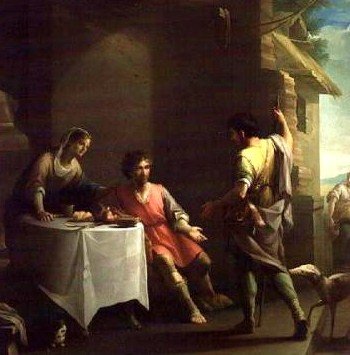
An 18th-century painting by Zacarias Gonzalez Velazquez depicting Jacob trading stew for Esau’s birthright.
Jacob’s Journey and Divine Encounters
On his way to Haran, Jacob had a life-changing vision at Bethel. He dreamt of a ladder reaching to heaven, with angels ascending and descending on it. God stood above the ladder and reaffirmed the covenant made with Abraham, promising Jacob numerous descendants and the land of Canaan. This vision symbolized Jacob’s spiritual journey and his future role as the father of the Israelite nation.
Upon arriving in Haran, Jacob fell in love with Rachel, Laban’s younger daughter. He agreed to work for Laban for seven years to marry her. However, Laban deceived Jacob by giving him Leah, Rachel’s older sister, instead. Jacob then worked another seven years to marry Rachel, marking a pivotal period of hardship and endurance in his life.
Jacob’s Family and Wealth
Jacob fathered twelve sons and one daughter through Leah, Rachel, and their handmaidens Bilhah and Zilpah. His twelve sons became the progenitors of the Twelve Tribes of Israel:
- Reuben
- Simeon
- Levi
- Judah
- Dan
- Naphtali
- Gad
- Asher
- Issachar
- Zebulun
- Joseph
- Benjamin
His daughter, Dinah, also played a significant, though tragic, role in biblical narratives.
Jacob’s growing wealth led to tensions with Laban. Using selective breeding techniques, Jacob ensured that his flocks prospered while Laban’s weakened. Recognizing the hostility from Laban’s sons, Jacob decided to return to Canaan with his family and possessions.
Jacob’s Struggle with God
Before re-entering Canaan, Jacob prepared to meet Esau, fearing his brother’s vengeance. The night before their meeting, Jacob wrestled with a mysterious figure—variously interpreted as an angel, a divine being, or God himself. This struggle lasted until dawn, when Jacob refused to let go until he received a blessing. The being renamed him Israel, meaning “he who struggles with God.” This event symbolizes Jacob’s transformation from a deceiver to one who strives with divine authority.
When Jacob finally met Esau, their reunion was unexpectedly peaceful. Esau embraced Jacob, signaling reconciliation. However, Jacob, wary of Esau’s intentions, declined his offer to travel together, settling instead in Shechem.
Jacob’s twelve sons became the foundation of the Israelite nation, and his legacy continues to shape religious and cultural traditions.
Jacob’s Later Years and Migration to Egypt
Jacob’s later years were marked by grief and restoration. His favored son, Joseph, was sold into slavery by his jealous brothers but later rose to prominence in Egypt as Pharaoh’s advisor. A severe famine forced Jacob’s family to seek food in Egypt, where they unknowingly encountered Joseph. When Joseph revealed his identity, Jacob was overjoyed and accepted Joseph’s invitation to settle in Egypt.
Jacob and his family migrated to Egypt, where Pharaoh welcomed them and granted them land in Goshen. Jacob lived in Egypt for seventeen years before passing away at the age of 147. Before his death, he blessed his sons, predicting the future of their descendants and shaping the destiny of the Israelite tribes.
Jacob’s Burial and Legacy
Jacob’s final request was to be buried in the Cave of Machpelah in Canaan, alongside his ancestors. Joseph honored this request, leading a grand procession to bury his father. This act symbolized the Israelites’ continued connection to the Promised Land.
Jacob’s legacy endures in the religious traditions of Judaism, Christianity, and Islam. In Judaism, he is revered as one of the three patriarchs. In Christianity, he is seen as a figure of faith and perseverance. In Islam, Yaqub (Jacob) is recognized as a prophet who guided his people in righteousness.
Historical and Scholarly Perspectives
The historicity of Jacob remains debated among scholars. Some, like William Albright, initially suggested that Jacob’s narrative could be traced back to the 19th century BCE. However, more recent scholarship, including the works of Thomas L. Thompson and William Dever, argues that these stories are later literary compositions with ideological significance rather than historical accounts.
Archaeological findings have not provided direct evidence of Jacob’s existence. However, similar names, such as Yaqub-Har, have appeared in ancient Egyptian texts, suggesting possible cultural parallels. The lack of definitive evidence does not negate the impact of Jacob’s story, as its significance lies in its theological and cultural contributions rather than in empirical validation.
Etymology of Jacob and Israel
The name Jacob (Yaʿaqōv) is traditionally linked to the Hebrew word for “heel,” referencing his birth, where he grasped Esau’s heel. This symbolizes his early struggle for dominance. The name Israel (Yisra’el) has been interpreted as “one who struggles with God,” reflecting Jacob’s pivotal wrestling encounter.
Whether seen as a historical figure or a theological archetype, Jacob’s story remains a cornerstone of biblical history, influencing generations across faiths and cultures.
Jacob in Religious Thought
In Jewish tradition, Jacob’s life exemplifies faith and resilience. His struggles and triumphs mirror the Jewish people’s endurance through history.
In Christianity, Jacob is included in the genealogy of Jesus and is viewed as a model of transformation and divine election.
In Islam, Jacob (Yaqub) is considered a prophet who remained steadfast in faith. The Quran emphasizes his wisdom, patience, and devotion to God.

Frequently Asked Questions
Who was Jacob in the biblical tradition?
Jacob, later named Israel, was a patriarch in the Hebrew Bible, regarded as the forefather of the Israelites. He was the son of Isaac and Rebecca, grandson of Abraham, and twin brother of Esau.
Why did Jacob receive the birthright instead of Esau?
Jacob bought Esau’s birthright for a bowl of stew and later, with Rebecca’s help, deceived his father Isaac into blessing him instead of Esau.
What was the significance of Jacob’s name change to Israel?
After wrestling with a mysterious being (interpreted as an angel or God), Jacob was renamed Israel, meaning “he who struggles with God,” symbolizing his transformation and the future nation of Israel.
How many children did Jacob have, and why are they important?
Jacob had 12 sons and one daughter, Dinah. His sons became the ancestors of the Twelve Tribes of Israel, forming the foundation of the Israelite nation.
Why did Jacob favor Joseph among his sons?
Joseph was the firstborn of Jacob’s favorite wife, Rachel, leading Jacob to show him favoritism, which caused jealousy among his brothers and led to Joseph’s enslavement in Egypt.
What role did Jacob play in the migration to Egypt?
Due to famine, Jacob and his family moved to Egypt after discovering that his son Joseph, whom he thought was dead, had risen to power in Pharaoh’s court.
Where was Jacob buried after his death?
Jacob died in Egypt at 147 years old but was taken back to Canaan and buried in the Cave of Machpelah, the ancestral burial site of the patriarchs.
Is there historical evidence for Jacob’s existence?
There is no direct archaeological evidence for Jacob’s existence, and scholars debate whether his story is historical or a later literary creation.
How is Jacob viewed in different religious traditions?
Judaism, Christianity, and Islam all revere Jacob as a patriarch and a man of faith, though interpretations of his life and character vary.
What is the significance of Jacob’s ladder vision?
Jacob’s vision of a ladder reaching heaven symbolized divine communication and reaffirmed God’s covenant with him, promising that his descendants would inherit the land of Canaan.





