
A portrait in Westminster Abbey, likely portraying Edward I, installed during his reign.
Edward I (1239–1307) was King of England from 1272 to 1307. Known as “Longshanks” for his height and “Hammer of the Scots” for his campaigns against Scotland, he was a formidable ruler, military strategist, and lawmaker.
Early Life and Background
Edward I, also known as Edward Longshanks and the Hammer of the Scots, was born on 17 or 18 June 1239 at the Palace of Westminster.
Edward was the eldest son of King Henry III and Eleanor of Provence. The name Edward, of Anglo-Saxon origin, was unusual for the Norman aristocracy but was chosen by his father due to his devotion to Edward the Confessor. Edward was baptized at Westminster Abbey three days after his birth.
As a child, he faced several health concerns but ultimately grew into a physically imposing figure, standing at about 6 feet 2 inches tall. His striking appearance, with long limbs and a drooping eyelid inherited from his father, made him an intimidating presence.
Marriage and Early Political Involvement
In 1254, at the age of 15, Edward married Eleanor of Castile, a politically strategic match arranged to secure Gascony against potential Castilian aggression. Eleanor was the half-sister of King Alfonso X of Castile. The marriage proved fruitful both politically and personally, as Eleanor later inherited Ponthieu in 1279, expanding Edward’s territorial control.
Edward was granted significant lands by his father, including Gascony, much of Ireland, and the Earldom of Chester. However, his influence was initially limited as his father retained control over the revenues from these lands.
Edward became embroiled in the political turmoil of his father’s reign. In 1258, tensions between King Henry III and his barons led to the drafting of the Provisions of Oxford, which sought to reform royal governance. Initially opposing the Provisions, Edward later aligned himself with the baronial reform movement, although he later reconciled with his father. His political actions at this time were opportunistic, as he sought to strengthen his personal position within the kingdom.
The Second Barons’ War and Edward’s Rise to Prominence
The Second Barons’ War (1264–1267) saw Edward playing a pivotal role in defending his father’s rule. Initially captured at the Battle of Lewes in 1264, he later escaped and led a royalist force to victory at the Battle of Evesham in 1265, where he decisively defeated Simon de Montfort. This battle marked the turning point of the war, restoring royal authority. Edward’s military prowess and leadership solidified his reputation as a formidable warrior and tactician.
Crusade and Accession to the Throne
With England pacified, Edward embarked on a crusade to the Holy Land in 1270 as part of the Ninth Crusade. Although the campaign achieved limited success, Edward’s efforts bolstered his reputation as a devout Christian warrior. While returning home in 1272, he received news of his father’s death. Edward took a slow route back to England, ensuring stability in his territories before his coronation in 1274 at Westminster Abbey.
Reforms and Governance
Edward I’s reign was characterized by extensive legal and administrative reforms. He sought to strengthen royal authority through the investigation of feudal liberties and the implementation of statutes that reformed criminal and property law.
The Quo Warranto inquiries examined the legality of private lordships, reinforcing the idea that all liberties derived from the Crown.
Additionally, his statutes, including the Statute of Westminster (1275) and Statute of Mortmain (1279), laid the foundation for England’s common law system.
Conquest of Wales
Edward turned his attention to Wales, where Llywelyn ap Gruffudd refused to submit to English authority. In 1277, Edward launched a campaign that resulted in Llywelyn’s surrender and the Treaty of Aberconwy. A renewed Welsh revolt in 1282 led to Edward’s full-scale invasion, culminating in Llywelyn’s death and the final conquest of Wales in 1283. Edward then constructed a series of formidable castles, including Caernarfon and Harlech, to consolidate English control. He also established English settlements, effectively colonizing Wales and integrating it into the English realm.
READ MORE: 10 Most Historic Castles in Britain
Conflict with Scotland
Following the death of Alexander III of Scotland in 1286, Edward was invited to arbitrate the Scottish succession crisis. He exploited this opportunity to assert overlordship over Scotland. When John Balliol, his chosen king, defied him by allying with France, Edward invaded in 1296, deposing Balliol and placing Scotland under direct English rule.
However, resistance emerged under William Wallace and later Robert the Bruce. Edward defeated Wallace at the Battle of Falkirk in 1298 but failed to crush the Scottish rebellion entirely. His brutal campaign in Scotland earned him the epithet “Hammer of the Scots.”
Kings and Queens of Scots: 10 Most Influential Scottish Monarchs and their Reigns
War with France and Internal Struggles
Edward’s reign was also marked by conflict with France. In 1294, King Philip IV of France confiscated Gascony, prompting Edward to declare war. This conflict drained England’s resources, necessitating heavy taxation. Edward’s financial demands led to tensions with both the nobility and the clergy. The issuing of the Confirmatio Cartarum in 1297 reaffirmed Magna Carta’s principles and constrained Edward’s ability to levy taxes without parliamentary consent.
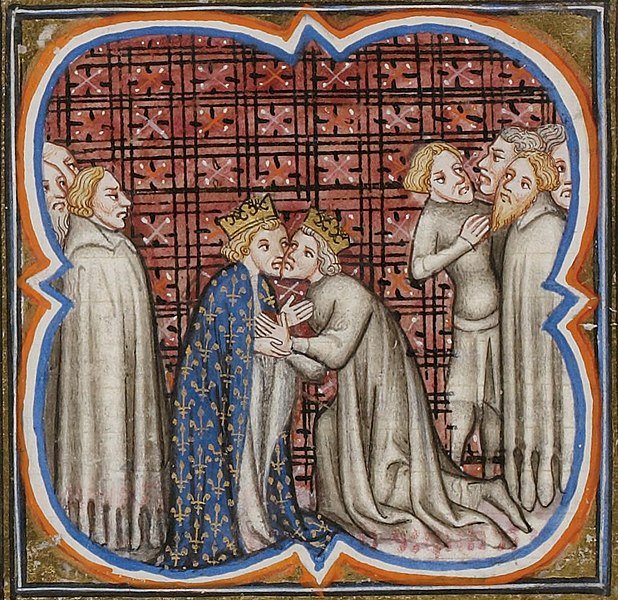
Edward I (right) paying homage to Philip IV of France (left) as his vassal in Aquitaine.
The Expulsion of the Jews
In 1290, Edward issued the Edict of Expulsion, expelling all Jews from England. This act, motivated by both financial and religious reasons, marked the culmination of years of increasing restrictions on Jewish communities. The expulsion remained in effect until the 17th century and significantly impacted England’s economic and social landscape.

Final Years and Death
Edward spent his final years attempting to subdue Scotland once more. In 1306, Robert the Bruce seized the Scottish throne, prompting Edward to launch another campaign. However, the aging king fell ill and died on 7 July 1307 at Burgh by Sands, near the Scottish border. His son, Edward II, inherited the throne, but he lacked his father’s military and administrative prowess, leading to further instability.
Edward I’s reign represents a significant period in medieval English history, marked by conquest, reform, and the consolidation of royal authority.
Frequently Asked Questions
What were Edward I of England’s major military campaigns?
He conquered Wales (1277–1283), built castles to establish English control, and launched wars against Scotland (1296–1307). He also fought France over Gascony and participated in the Ninth Crusade.
What role did Edward I play in Scotland?
After King Alexander III’s death, Edward asserted overlordship, deposed King John Balliol (1296), and waged war against Scottish resistance, including William Wallace and Robert the Bruce.
How did he manage taxation and finance?
He increased taxation to fund wars, heavily taxing clergy, nobles, and merchants. He expelled the Jews from England in 1290 after exploiting their wealth.
Why did Edward I expel the Jews from England?
In 1290, Edward issued the Edict of Expulsion, driven by financial motives, religious intolerance, and political bargaining with Parliament.
What was his legacy in Wales?
His conquest led to English rule, castle-building, and colonization, with Welsh laws suppressed and native resistance continuing intermittently.
What was his relationship with Parliament?
He strengthened Parliament’s role in taxation and governance, calling the “Model Parliament” in 1295, which included knights and burgesses alongside nobles and clergy.
How did Edward I of England die?
He died in 1307 while marching north to suppress Robert the Bruce’s rebellion in Scotland. His son, Edward II, inherited the throne but struggled to maintain his father’s authority.
How do historians view Edward I?
Opinions vary: some praise his legal reforms and strong kingship, while others criticize his brutality, expansionism, and oppressive policies in Wales, Scotland, and against the Jews.





