King William’s War (1688–1697)
King William’s War (1688–1697) was the first of a series of conflicts between England (later Great Britain) and France for control of North America, collectively known as the French and Indian Wars. It was the North American theater of the broader Nine Years’ War, a European conflict between King Louis XIV of France and a European coalition led by King William III of England. The war marked the beginning of nearly seven decades of intermittent warfare in North America as the European powers vied for dominance over the continent and its vast resources.

Image: A portrait of Louis XIV
Background and Causes
King William’s War, like many colonial conflicts of the time, had its roots in the political and religious rivalries of Europe. In the late 17th century, France and England were the two dominant powers in Europe, and their competition for territorial, commercial, and religious supremacy spilled over into their colonies in North America.
The immediate cause of King William’s War was the Glorious Revolution of 1688 in England, in which the Protestant William of Orange, ruler of the Dutch Republic, overthrew the Catholic King James II and took the English throne. Louis XIV of France, a Catholic monarch, supported James II’s claim to the English throne and opposed William’s ascension. This political rivalry escalated into the Nine Years’ War (1688–1697) in Europe, which pitted France against a coalition that included England, the Dutch Republic, the Holy Roman Empire, Spain, and several German states.
In North America, France and England had conflicting territorial ambitions. France sought to expand its colonies in New France (modern-day Canada and parts of the U.S.), while the English colonies, particularly those in New England, wanted to prevent French expansion. The two colonial powers also vied for control of the fur trade, fishing rights, and alliances with Indigenous nations, which were crucial to their military and economic goals in the New World.
The Role of Indigenous Nations
Indigenous nations played a crucial role in King William’s War, as both the French and the English sought to secure alliances with Indigenous groups to bolster their military efforts. The most important Indigenous nations involved were the Iroquois Confederacy, allied with the English, and the Wabanaki Confederacy, aligned with the French.
The Iroquois Confederacy, also known as the Haudenosaunee or Six Nations, was a powerful Indigenous alliance in the northeastern part of North America. By the late 17th century, the Iroquois had established trade and military alliances with the English colonies, particularly New York. Their main rivals were the French and their Indigenous allies, including the Wabanaki Confederacy, which consisted of several Algonquian-speaking nations in what is now Maine and the Canadian Maritimes.
For Indigenous nations, the war was not just about choosing between European allies but also about protecting their own territories, maintaining trade networks, and asserting their autonomy. Many Indigenous groups fought to preserve their land and influence in the face of growing European encroachment, often balancing relations between the French and English to their advantage.
The War in North America
King William’s War was characterized by a series of raids, skirmishes, and larger battles between French and English colonists, along with their respective Indigenous allies. The war took place mainly in the northeastern regions of North America, particularly New England, New France, and the frontier areas of present-day New York, New Hampshire, and Maine.
New France and the Canadian Frontier
In New France, the French, under the leadership of Governor Louis de Buade, Comte de Frontenac, adopted a strategy of launching raids on English settlements to disrupt their economy and morale. French forces, often accompanied by Indigenous allies, attacked English frontier towns, taking captives and destroying property.
One of the most notable French attacks occurred in 1690, when a force of French soldiers and Indigenous warriors attacked the town of Schenectady, New York. The raid resulted in the destruction of the town, the death of 60 residents, and the capture of many others, who were taken to Canada. The raid on Schenectady was part of a broader French strategy to keep the English colonies on the defensive and prevent them from organizing a coordinated attack on New France.
The French also targeted settlements in New England, with raids on towns such as Salmon Falls (in present-day New Hampshire) and Casco Bay (in present-day Maine). These attacks were devastating for the small, isolated English settlements, leading to widespread fear and insecurity among the colonists.
The New England Colonies
In response to the French raids, the New England colonies organized military expeditions against French settlements in New France. One of the most significant efforts was the 1690 expedition led by Sir William Phips, the governor of Massachusetts Bay Colony, to capture the French stronghold of Quebec. Phips gathered a fleet of ships and hundreds of soldiers for the campaign, but the expedition ended in failure. The English forces were unable to breach Quebec’s defenses, and the arrival of French reinforcements under Governor Frontenac forced Phips to retreat.
The New England colonies also sought to defend their frontier settlements by building forts and organizing local militias. However, these defenses were often insufficient to repel French and Indigenous attacks, and many English settlers were forced to abandon their homes and move to more secure areas.
Iroquois Involvement
The Iroquois Confederacy was a key player in the conflict, as they had long-standing rivalries with the French and their Indigenous allies. The Iroquois had suffered significant losses in earlier conflicts with the French, known as the Beaver Wars, and they sought to strengthen their alliance with the English to counter French influence in the region.
The Iroquois launched raids on French settlements in Canada, hoping to weaken New France and regain control of key fur trading routes. However, the French retaliated with their own raids, leading to a brutal cycle of violence between the Iroquois, the French, and their Indigenous allies. By the mid-1690s, the Iroquois were weakened by the conflict and sought peace with the French, culminating in the signing of the Great Peace of Montreal in 1701.
Major Battles and Events
While King William’s War did not feature large-scale battles typical of European wars, several significant raids, skirmishes, and military expeditions shaped the course of the conflict. Some of the major events include:
- Raid on Schenectady (1690): A combined force of French soldiers and their Indigenous allies attacked the frontier town of Schenectady in New York, killing 60 residents and capturing many others. The raid was part of a broader French strategy to disrupt English settlements and weaken their ability to attack New France.
- Expedition to Quebec (1690): In response to French raids, the New England colonies launched an expedition to capture the French city of Quebec. Led by Sir William Phips, the campaign ended in failure as the English forces were unable to breach Quebec’s defenses.
- Battle of Port Royal (1690): The English successfully captured the French settlement of Port Royal in Acadia (present-day Nova Scotia) but were unable to maintain control, and the French recaptured it soon after. This was one of several battles over control of Acadia during the war.
- Raids on English Settlements: French and Indigenous forces launched a series of devastating raids on English settlements in New England, including attacks on Salmon Falls and Casco Bay. These raids spread fear among the English colonists and disrupted their efforts to expand into the frontier regions.
- Iroquois Raids: The Iroquois Confederacy, allied with the English, conducted raids on French settlements in Canada, seeking to weaken New France and regain control of key trade routes. However, the French retaliated, and the conflict took a heavy toll on the Iroquois.
The Treaty of Ryswick (1697)
King William’s War came to an inconclusive end with the signing of the Treaty of Ryswick in 1697. The treaty largely restored the status quo ante bellum, meaning that the territorial boundaries in North America remained unchanged. France retained control of New France, including Quebec and Acadia, while England retained its colonies along the eastern seaboard. The treaty did not address the underlying tensions between the two powers, and it set the stage for further conflict in the years to come.
For the Indigenous nations involved in the war, the Treaty of Ryswick offered little relief. The Iroquois, who had been weakened by the conflict, sought to rebuild their strength and secure peace with both the French and the English. The Wabanaki Confederacy, which had been aligned with the French, continued to resist English encroachment on their lands, leading to further conflicts in the early 18th century.
Consequences of King William’s War
Although King William’s War ended without significant territorial changes, it had important consequences for the future of North America and the relationships between the European powers and Indigenous nations.
Impact on the English Colonies
For the English colonies, particularly in New England, King William’s War was a devastating experience. The French raids on frontier settlements caused widespread destruction and loss of life, leading many English settlers to abandon their homes. The war also exposed the vulnerability of the English colonies, particularly in the face of coordinated attacks by French and Indigenous forces. This sense of insecurity would shape colonial attitudes toward defense and military preparedness in future conflicts.
The war also deepened the English colonies’ reliance on their Indigenous allies, particularly the Iroquois Confederacy. The Iroquois played a key role in the defense of New York and the English frontier, but their involvement in the war also came at a high cost, as they suffered heavy losses in their conflicts with the French.
Impact on New France
For New France, King William’s War demonstrated the effectiveness of French-Indian alliances in defending the colony from English attacks. The French strategy of launching raids on English settlements, often with the help of Indigenous allies, succeeded in keeping the English colonies on the defensive and disrupting their efforts to expand into the frontier regions.
However, the war also revealed the limitations of French power in North America. The failed English expedition to Quebec in 1690 showed that New France was vulnerable to large-scale attacks, and the French were unable to permanently secure control of Acadia, which would remain a contested region in future conflicts.
Indigenous Nations and the Balance of Power
For the Indigenous nations involved in King William’s War, the conflict was both an opportunity and a threat. The Iroquois Confederacy used the war to assert their power and maintain their control over the fur trade, but the war also weakened them, and they were forced to seek peace with the French in 1701.
The Wabanaki Confederacy, aligned with the French, played a crucial role in defending their lands from English encroachment. However, the war also deepened tensions between the Wabanaki and the English, leading to further conflicts in the early 18th century, particularly during Queen Anne’s War (1702–1713).
Legacy and Prelude to Future Conflicts
King William’s War was the first in a series of conflicts between France and England for control of North America, collectively known as the French and Indian Wars. Although the Treaty of Ryswick ended the war in 1697, it did not resolve the underlying tensions between the two powers, and both France and England continued to seek dominance in the region.
The war also set the stage for future conflicts between the English colonies and Indigenous nations, particularly in the contested frontier regions of New England and New York. The alliances and rivalries forged during King William’s War would continue to shape the course of colonial warfare in the decades to come.
The next major conflict, Queen Anne’s War, broke out in 1702 and was part of the larger War of the Spanish Succession. Like King William’s War, it would involve European powers, colonial forces, and Indigenous nations in a struggle for control of North America.
Questions and Answers on King William’s War
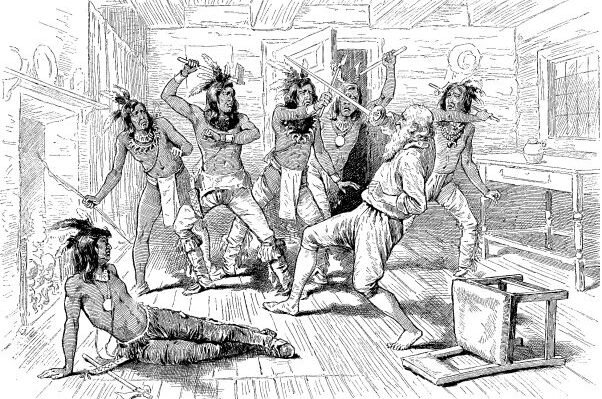
King William’s War (1688–1697) was the North American theater of the Nine Years’ War, also known as the War of the Grand Alliance or the War of the League of Augsburg. It is also referred to as the Second Indian War, Father Baudoin’s War, Castin’s War, or the First Intercolonial War (in French). Image: An illustration depicting major Waldrons fight.
What were the primary sides in the War?
The war was fought between New France and New England, with each side supported by their respective Indigenous allies. It was part of a broader conflict between England and France in Europe.
Why did neither England nor France prioritize their North American colonies during King William’s War?
Both England and France were more focused on conflicts in Europe, specifically the Nine Years’ War. As a result, they committed relatively limited military resources to the war effort in North America.
What role did the Wabanaki Confederacy play in the conflict?
The Wabanaki Confederacy, allied with New France, helped thwart New England’s expansion into Acadia. They played a key role in defending the French-defined border of Acadia along the Kennebec River in southern Maine.
How did King William’s War end, and what were the terms?
The war ended in 1697 with the signing of the Peace of Ryswick, which concluded the Nine Years’ War. The treaty restored the pre-war boundaries in North America, leaving the territorial claims of New France, New England, and New York largely unchanged.
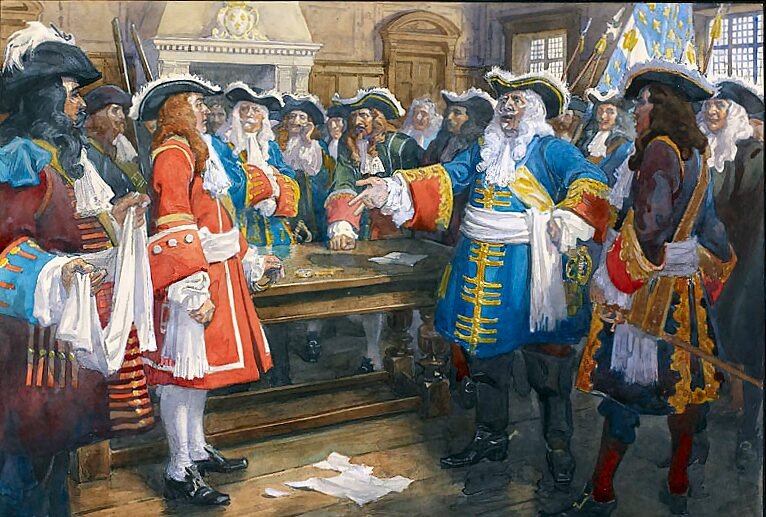
In a number of ways, the King William’s War exposed the vulnerability of the English frontier, demonstrated the importance of Indigenous alliances, and set the stage for future conflicts over control of the continent.
How did unresolved issues from King Philip’s War contribute to King William’s War?
The failure to honor treaties and agreements made at the end of King Philip’s War (1675–1678) created lingering tensions. Additionally, English fears that Indigenous nations were receiving support from the French or Dutch contributed to growing hostilities.
How did Indigenous nations manipulate European powers during the war?
Indigenous nations played off the rivalry between the French and English, manipulating both sides to their advantage. The English believed Indigenous groups were allied with the French, while the French thought they were aligned with the English.
What was at the heart of the conflict between the English and Indigenous nations?
The English believed that the Indigenous peoples were their subjects, a notion that Indigenous nations rejected. This misunderstanding, along with territorial disputes and rivalries with the French, contributed to the outbreak of the war.
What larger conflict was King William’s War a part of in Europe?
King William’s War was the North American theater of the Nine Years’ War, a European conflict primarily between France and the Grand Alliance, which included England, the Dutch Republic, and the Holy Roman Empire.
What was the significance of King William’s War for future colonial conflicts in North America?
King William’s War marked the beginning of a series of colonial conflicts between France and England in North America. These rivalries and unresolved tensions would lead to further wars, including Queen Anne’s War and the later French and Indian Wars.





