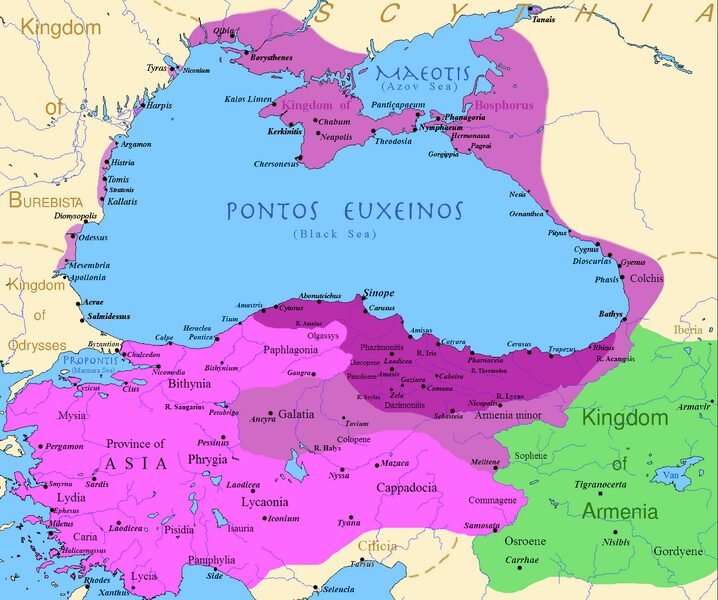
The Kingdom of Pontus at its peak: shown in dark purple before Mithridates VI’s reign, in purple after his initial conquests, and in pink representing his gains during the First Mithridatic War.
Pontus, originating from the Ancient Greek term Πόντος, was a prominent Hellenistic kingdom located in the northeastern region of modern-day Turkey. Established by the Mithridatic dynasty, the kingdom bore strong Persian roots, potentially linking its rulers to Darius the Great of the Achaemenid dynasty. Mithridates I officially founded the kingdom in 281 BCE, and it endured until its conquest by Rome in 63 BCE.
Geographical and Cultural Overview
Pontus was geographically divided into two distinct regions:
- Coastal Region: This area was heavily influenced by Greek culture and focused on trade along the Black Sea. Cities like Sinope, the capital under Mithridates VI, and Amastris were key economic hubs.
- Interior Region: Dominated by Anatolian tribes and ruled by an Iranian aristocracy, this region retained strong Persian cultural elements. Fertile river valleys supported agriculture, while the rugged Pontic Alps added a natural division.
The kingdom was a fusion of Greek, Persian, and Anatolian cultures, with Greek becoming the dominant language in the 3rd century BCE.
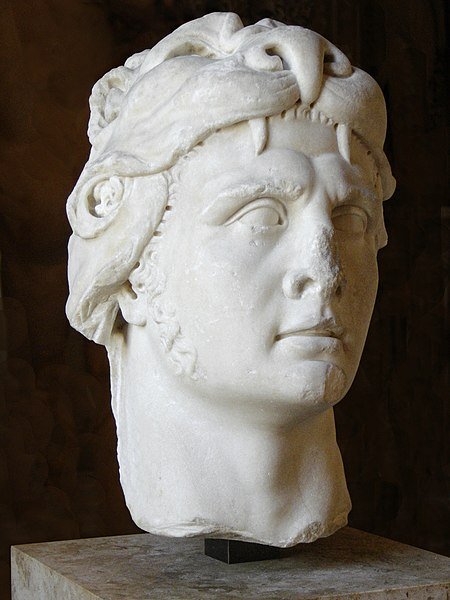
Portrait of the king of Pontus Mithridates VI as Heracles. Marble, Roman imperial period (1st century)
Economic and Natural Resources
Pontus was rich in natural resources:
- Agriculture: Fertile valleys produced millet, fruits like cherries and apples, and supported cattle herds.
- Mining: The region’s mountains were abundant in minerals, including iron, silver, and steel, which gained fame throughout Greece.
- Trade: The coastal cities thrived on maritime trade, exporting olives, timber, and other goods.
Religion and Syncretism
Religion in Pontus blended Persian, Anatolian, and Greek traditions. Major deities included:
- Ahura Mazda (Zeus Stratios): Revered by the royal family.
- Men Pharnacou: A moon god tied to local traditions.
- Ma (Cybele): A mother goddess associated with Anatolian fertility rites. Sun gods, such as Apollo and Mithras, were also popular, reflecting the kingdom’s Iranian heritage.
Origins in Persian Satrapy
The early history of Pontus traces back to its inclusion in the Persian satrapy of Cappadocia. Mithridates of Cius, the dynasty’s progenitor, established roots in the region during the 4th century BCE. His descendants expanded their influence, culminating in Mithridates I’s declaration of independence in 281 BCE.
Early Expansion
Under Mithridates I and his successors, Pontus expanded significantly:
- Captured key Black Sea ports like Amastris.
- Allied with the Galatians and resisted Seleucid and Ptolemaic influences.
Mithridates II strengthened ties with the Seleucid Empire by marrying Seleucus II’s sister, solidifying Pontus as a recognized power.
Rise Under Pharnaces I
Pharnaces I aggressively expanded Pontus:
- Conquered coastal cities, including Sinope, which became a major capital.
- Allied with northern Black Sea cities, extending influence into the Tauric Chersonesos.
Mithridates VI Eupator: The Zenith of Pontus
Mithridates VI, known as Mithridates the Great, marked the height of Pontic power. His reign (120–63 BCE) was characterized by:
- Territorial Expansion: Mithridates annexed Colchis, the Bosporan Kingdom, and parts of Cappadocia and Bithynia. His forces even briefly occupied the Roman province of Asia.
- Anti-Roman Campaigns: A staunch opponent of Roman domination, Mithridates led three Mithridatic Wars against Rome. His early victories showcased Pontic military prowess and strategic acumen.
- Cultural Patronage: A polyglot and advocate for Hellenistic culture, Mithridates encouraged the integration of Greek and local traditions.
The Mithridatic Wars
- First Mithridatic War (89–85 BCE): Mithridates achieved early victories, including the infamous Asiatic Vespers, where he orchestrated the massacre of Roman citizens across Asia Minor. Roman general Sulla ultimately forced him to retreat.
- Second Mithridatic War (83–82 BCE): A brief conflict, with no major territorial changes.
- Third Mithridatic War (75–63 BCE): Roman general Pompey decisively defeated Mithridates, who fled to the Crimea, where he later died.
Governance and Administration
Pontus was divided into administrative districts known as Eparchies. The kingdom’s governance combined Persian autocratic traditions with Hellenistic administrative practices:
- Capital Cities: Amasia served as the early capital, later replaced by Sinope.
- Infrastructure: Roads and trade networks connected the interior to coastal hubs, fostering economic integration.
Military Structure
The Pontic military reflected its diverse population, recruiting soldiers from various ethnic groups:
- Infantry: Modeled after the Macedonian phalanx, with units like the Chalkaspides (Bronze Shields).
- Cavalry: Included heavily armored cataphracts and scythed chariots.
- Navy: A strong maritime force supported by Greek cities and local tribes.
Decline and Fall
After Mithridates VI’s death, Pontus was absorbed into the Roman Republic:
- Western Pontus: Annexed directly into the province of Bithynia et Pontus.
- Eastern Pontus: Governed as a client kingdom under Pharnaces II and his successors. The region eventually became fully Romanized, marking the end of Pontic independence.
Legacy of Pontus
Despite its fall, Pontus left a lasting legacy:
- Cultural Synthesis: The blending of Greek, Persian, and Anatolian traditions influenced subsequent civilizations in the region.
- Resistance Against Rome: Mithridates VI’s campaigns became legendary, symbolizing resistance to imperial domination.
- Economic Contributions: Pontic steel and agricultural innovations were highly valued across the Mediterranean.
Frequently Asked Questions

Who ruled Pontus, and what was their origin?
The Mithridatic dynasty of Persian origin, potentially linked to Darius the Great of the Achaemenid dynasty.
What was the cultural composition of Pontus?
A fusion of Greek, Persian, and Anatolian cultures, with Greek becoming the official language by the 3rd century BC.
What were Pontus’s major geographical features?
It had a fertile coastal region rich in trade, timber, and mining, separated from the mountainous interior by the Pontic Alps.
What were the economic strengths of Pontus?
Pontus was rich in iron, silver, and timber. Its interior supported agriculture, while coastal cities thrived on fishing and trade.
What role did religion play in Pontic culture?
Pontic religion was syncretic, blending local, Persian, and Greek elements. Notable gods included Zeus Stratios (Ahuramazda), Men Pharnacou, and Ma.
What were the Mithridatic Wars?
A series of conflicts between Pontus and Rome during the reign of Mithridates VI, culminating in the kingdom’s defeat and integration into the Roman Republic.
Who was Mithridates VI, and why is he significant?
Mithridates VI was the most famous Pontic king, known for his resistance to Rome, territorial expansion, and cultural patronage.
How did the Kingdom of Pontus end?
After Mithridates VI’s defeat by Pompey in 66 BC, much of Pontus was annexed by Rome, while some parts became Roman client states.
What was the military structure of Pontus?
The army included diverse ethnic groups and adopted Macedonian and Roman tactics, while its navy supported regional dominance in the Black Sea.
What was the legacy of Pontus under Roman rule?
Parts of Pontus became the Roman province of Bithynia et Pontus, while the Bosporan Kingdom and other areas remained as client states.





