Krishna in Hindu Mythology – Origin Story & Death
Krishna is one of the most revered deities in Hinduism, worshipped as the eighth avatar of Vishnu and also as the Supreme God in his own right. Known as the god of protection, compassion, tenderness, and love, Krishna’s influence permeates various aspects of Hindu culture and spirituality. His birthday, Krishna Janmashtami, is celebrated annually in late August or early September according to the lunisolar Hindu calendar.

Krishna’s life and teachings offer rich lessons in spirituality, morality, and philosophy. His stories embody love, joy, guidance, and the divine’s closeness to humanity, continuing to inspire millions. Image: Krishna (center).
Krishna in Hindu Literature and Mythology
The life and exploits of Krishna, commonly referred to as Krishna Līlā, are central to several major Hindu texts. He is a pivotal character in the Mahabharata, the Bhagavata Purana, the Brahma Vaivarta Purana, and the Bhagavad Gita. These texts present Krishna in various roles: as a god-child, a prankster, a model lover, a divine hero, and the universal supreme being. His diverse portrayals underscore his multifaceted nature and the broad appeal he holds across different segments of Hindu society.
- Mahabharata: In the Mahabharata, Krishna is depicted as a wise and strategic charioteer to Arjuna, one of the Pandava princes. His counsel to Arjuna on the battlefield of Kurukshetra is documented in the Bhagavad Gita, where he imparts spiritual wisdom and guidance on duty, righteousness, and devotion.
- Bhagavata Purana: The Bhagavata Purana presents a comprehensive narrative of Krishna’s life, from his miraculous birth to his childhood pranks and his role as a protector and lover. It is in this text that many of Krishna’s popular stories, such as his playful exploits with the gopis (milkmaids) and his deep bond with Radha, are elaborated.
- Brahma Vaivarta Purana: This Purana emphasizes Krishna’s divine nature and his relationships with other deities. It explores his cosmic aspects and his supreme status among the gods.
- Bhagavad Gita: Within the Mahabharata, the Bhagavad Gita stands out as a critical philosophical text where Krishna explains the concepts of dharma (duty/righteousness) and bhakti (devotion) to Arjuna, providing a theological framework that has influenced Hindu thought profoundly.
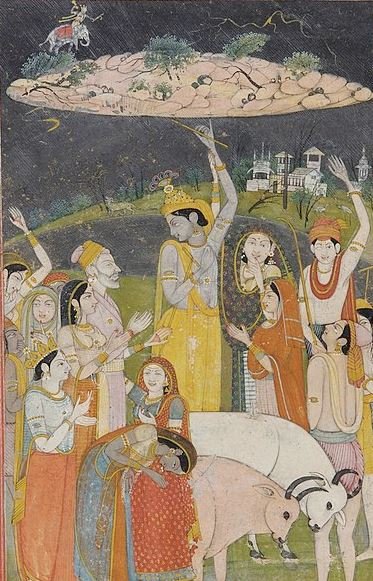
Krishnaism is a tradition where Krishna is worshipped as the Supreme God, Svayam Bhagavan. It gained prominence during the medieval Bhakti movement, emphasizing personal devotion to Krishna. Image: A painting depicting Krishna (center) holding Mount Govardhan.
Iconography and Symbolism
Krishna’s iconography reflects the various legends associated with his life, portraying him in multiple forms. Common depictions include:
- Infant Krishna: Often shown eating butter, this representation emphasizes his playful and mischievous nature as a child.
- Flute-playing Krishna: As a young boy playing a flute, Krishna is depicted as the divine lover, enchanting the gopis and embodying the joy and spontaneity of divine love.
- Krishna with Radha: This image captures the profound love between Krishna and Radha, symbolizing the union of the individual soul with the divine.
- Krishna as a charioteer: In this role, he is often depicted giving counsel to Arjuna, highlighting his aspect as a wise guide and philosopher.
Historical and Cultural Significance
The name Krishna and his various epithets have been traced back to literature and cults from the 1st millennium BCE. Over time, Krishna’s worship evolved, particularly during the medieval Bhakti movement, which emphasized personal devotion and saw the rise of Krishnaism, where Krishna is revered as the Supreme God and Svayam Bhagavan (God Himself).
Influence on Art and Culture
Krishna-related literature and stories have significantly influenced Indian performance arts. Classical dance forms like Bharatanatyam, Kathakali, Kuchipudi, Odissi, and Manipuri often depict episodes from Krishna’s life. These performances not only entertain but also serve as a medium to convey spiritual teachings and cultural values.
Regional Reverence
Krishna is a pan-Hindu deity, revered across India but particularly worshipped in certain regions:
- Vrindavan, Uttar Pradesh: Celebrated for his childhood and youthful exploits.
- Dwarka and Junagadh, Gujarat: Associated with his role as a king and statesman.
- Jagannatha, Odisha: Worshipped in a unique form, especially during the Ratha Yatra festival.
- Mayapur, West Bengal: Known for his connection with the Gaudiya Vaishnavism tradition.
- Pandharpur, Maharashtra: Worshipped as Vithoba, a form that emphasizes devotion and simplicity.
- Nathdwara, Rajasthan: Home to the deity Shrinathji, representing Krishna lifting the Govardhan Hill.
- Udupi, Karnataka: Revered as the central figure in the Udupi Krishna temple, established by the saint Madhvacharya.
- Parthasarathy, Tamil Nadu: Reflecting Krishna’s role as the charioteer to Arjuna.
- Guruvayoor, Kerala: Known as Guruvayoorappan, a significant pilgrimage site for devotees.
What role did Krishna play in the war between the Pandavas and the Kauravas?
Global Influence
Since the 1960s, Krishna worship has spread globally, largely due to the efforts of the International Society for Krishna Consciousness (ISKCON). Founded by A.C. Bhaktivedanta Swami Prabhupada, ISKCON has established temples worldwide and popularized the chanting of the Hare Krishna mantra, making Krishna devotion accessible to a global audience.

Questions and Answers about Krishna in Hindu Mythology

Krishna is a major deity in Hinduism, revered as the eighth avatar of Vishnu and also as the Supreme God in his own right. He is known for his roles as a protector, compassionate being, and god of love. Image: A statue of Krishna, located at the Sri Mariamman Temple in Singapore.
What is Krishna Līlā?
Krishna Līlā refers to the collective stories and exploits of Krishna’s life, which are central to Hindu mythology and have significantly influenced Indian culture, religion, and philosophy.
In which ancient texts are Krishna’s stories documented?
Krishna’s stories are documented in numerous ancient texts, including the Mahabharata, the Bhagavata Purana, the Brahma Vaivarta Purana, and the Bhagavad Gita.
How was Krishna born, according to Hindu mythology?
According to the Bhagavata Purana, Krishna was born in a prison cell to Devaki and Vasudeva in the city of Mathura. His birth was prophesied to end the tyrannical reign of his uncle, King Kansa.
How was Krishna protected from King Kansa?
To protect him from Kansa, Krishna was secretly transported across the Yamuna River to the village of Gokul, where he was raised by his foster parents, Yashoda and Nanda.
What are some of the notable deeds from Krishna’s childhood?
Krishna’s childhood was marked by miraculous and mischievous deeds, such as stealing butter, playing tricks on the gopis, defeating the serpent Kaliya, and lifting the Govardhan Hill to protect villagers from torrential rains.
What is the significance of Krishna’s relationship with the gopis and Radha?
Krishna’s relationship with the gopis, especially Radha, symbolizes divine love and devotion. Their romantic escapades are celebrated in Hindu lore and represent the soul’s yearning for union with the divine.

What role does Krishna play in the Mahabharata?
In the Mahabharata, Krishna serves as the charioteer and advisor to Arjuna, one of the Pandava princes, during the battle of Kurukshetra. He delivers the Bhagavad Gita, providing spiritual wisdom and guidance.
What did Krishna do after the events of the Mahabharata?
After the events of the Mahabharata, Krishna established his kingdom in Dwarka, a prosperous city on the western coast of India, where he continued to protect and lead his people.

The Bhagavad Gita is a 700-verse Hindu scripture that is part of the Mahabharata. It is a philosophical discourse where Krishna imparts teachings on duty (dharma), righteousness, devotion, and the nature of reality to Arjuna. Image: Krishna and Arjuna riding together on the chariot.
How did Krishna die according to Hindu mythology?
According to the Mahabharata, Krishna was accidentally shot by a hunter named Jara, who mistook him for a deer. This event marks the end of the Dvapara Yuga and the beginning of the Kali Yuga.
How is Krishna worshipped today?
Krishna is worshipped in various forms across India and beyond. Temples dedicated to him attract millions of devotees, and festivals like Janmashtami and Holi are celebrated with great enthusiasm.

The International Society for Krishna Consciousness (ISKCON), founded by A.C. Bhaktivedanta Swami Prabhupada, has established temples and communities worldwide, promoting Krishna devotion through the chanting of the Hare Krishna mantra and the study of the Bhagavad Gita. Image: ISKCON Temple in Uttar Pradesh, India.