Life and Major Accomplishments of Nicolaus Copernicus

By challenging the geocentric model and advocating for a Sun-centered cosmos, Copernicus not only changed the course of astronomy but also helped spark a broader shift in scientific thought that continues to shape the modern world. Image: Copernicus holding lily-of-the-valley: portrait in Nicolaus Reusner’s Icones (1587).
Nicolaus Copernicus (1473–1543) was a Polish astronomer, mathematician, and scholar who fundamentally changed humanity’s understanding of the cosmos by proposing that the Earth and other planets revolve around the Sun, rather than the Earth being the center of the universe. This heliocentric model marked a pivotal moment in the history of science, laying the groundwork for the Scientific Revolution.
Early Life and Education
Born on February 19, 1473, in the city of Toruń, part of the Kingdom of Poland, Copernicus was the youngest of four children in a wealthy merchant family. After the early death of his father, he was raised by his maternal uncle, Lucas Watzenrode, the Bishop of Warmia. Watzenrode played a significant role in Copernicus’ life, ensuring that he received an extensive education and guiding his career in both religious and academic fields.
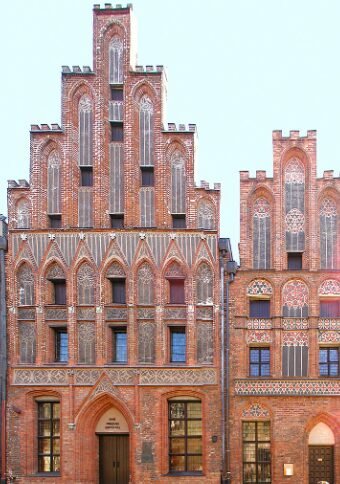
Born in Toruń, a city in northern Poland, Copernicus went on to study liberal arts at the University of Cracow. Later, he moved to Italy to study law at the University of Bologna and medicine at the University of Padua. This broad academic background provided him a solid foundation for his future astronomical work. Image: Copernicus’s Toruń birthplace in Poland
Copernicus began his studies at the University of Kraków in 1491, where he was introduced to the foundations of mathematics and astronomy. Although he did not graduate from Kraków, the education he received there inspired his future work in astronomy. He later moved to Italy, enrolling at the University of Bologna in 1496 to study law and continue his work in mathematics. It was during his time in Bologna that Copernicus met the prominent astronomer Domenico Maria Novara, who became his mentor and likely sparked his interest in questioning the prevailing geocentric model of the universe.
After completing his studies in Bologna, Copernicus attended the University of Padua, where he studied medicine, another field in which he would later make contributions. He earned a doctorate in canon law from the University of Ferrara in 1503, which helped secure his position as a church administrator in the Cathedral of Warmia, Poland, while simultaneously allowing him the freedom to pursue his astronomical studies.
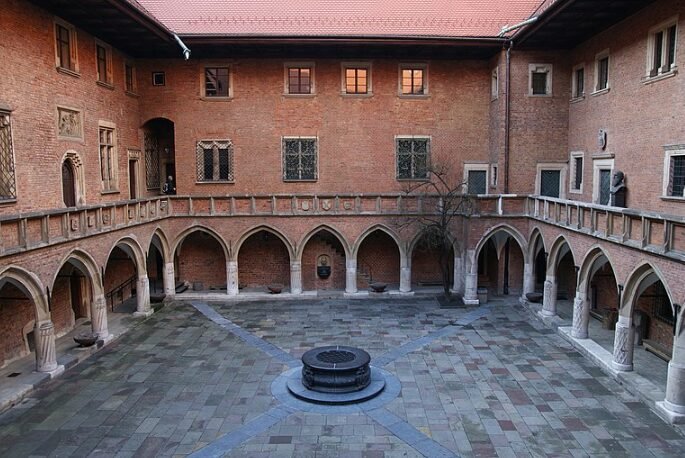
Image: Collegium Maius at Kraków University, Copernicus’s Polish alma mater
Heliocentric Theory
During Copernicus’ lifetime, the dominant cosmological model was the geocentric system proposed by Claudius Ptolemy in the 2nd century AD. According to this model, the Earth was the stationary center of the universe, with the Sun, planets, and stars revolving around it. This view was widely accepted by both scholars and the Church, as it aligned with theological perspectives.
However, Copernicus began to question the accuracy and complexity of the Ptolemaic system, particularly its reliance on epicycles (circular orbits within orbits) to explain the movements of planets. By the early 16th century, Copernicus had formulated an alternative model in which the Sun, not the Earth, was the center of the universe. He proposed that the Earth rotates on its axis once every 24 hours and revolves around the Sun once every year. This was a radical departure from centuries of accepted wisdom.
The development of Copernicus’ heliocentric theory was not a sudden breakthrough but a gradual process that unfolded over decades. He refined his model through careful observation, calculations, and the study of earlier astronomical works. In 1514, Copernicus circulated a handwritten manuscript, known as the “Commentariolus” (Little Commentary), to a few close friends and fellow scholars. In this document, he outlined the basics of his heliocentric model but did not yet publish it widely, likely due to concerns about the reaction of the Church and academic community.

By dislodging the Earth from the center of the universe, Copernicus also implicitly challenged prevalent religious and philosophical views of his time. The geocentric model had been harmonized with Christian theology, positing Earth’s central position as evidence of God’s human-focused creation. Copernicus’s heliocentrism initiated a departure from this worldview.
Publication of “De Revolutionibus Orbium Coelestium”
Copernicus’ most famous work, De Revolutionibus Orbium Coelestium (On the Revolutions of the Heavenly Spheres), was published in 1543, the year of his death. This groundbreaking book detailed his heliocentric theory and provided mathematical models to support it. Although the book did not instantly revolutionize astronomy, it set the stage for future scientists like Galileo Galilei, Johannes Kepler, and Isaac Newton to build upon his ideas.
De Revolutionibus was divided into six sections, addressing various aspects of his model. It presented evidence to show that the apparent retrograde motion of planets—where they seem to move backward in the sky—could be explained more simply by the Earth’s own motion around the Sun. The book also outlined the reasons for the daily rotation of the Earth and the seasonal variations in the Sun’s position. Copernicus’ work thus offered a more elegant and less convoluted explanation of planetary motions than the Ptolemaic system.
Despite its profound implications, the initial reaction to Copernicus’ work was mixed. Some astronomers accepted his mathematical models as useful tools for predicting planetary positions, but many still clung to the geocentric view for philosophical, religious, and observational reasons. The Catholic Church did not initially oppose Copernicus’ heliocentric model, but the eventual clash between heliocentrism and Church doctrine would come later, especially during the time of Galileo.
Legacy and Influence
Though Copernicus’ heliocentric model did not immediately displace the Ptolemaic system, its long-term impact was profound. It laid the foundation for the Scientific Revolution, a period of intense transformation in scientific thought during the 16th and 17th centuries. By proposing that the Earth was not the center of the universe, Copernicus fundamentally altered humanity’s conception of its place in the cosmos, setting the stage for a new era of scientific inquiry.
One of the most significant figures to build upon Copernicus’ work was Johannes Kepler, who in the early 17th century refined the heliocentric model by introducing the concept of elliptical planetary orbits. Kepler’s laws of planetary motion provided the empirical support that Copernicus’ theory lacked. Galileo Galilei, using his telescope, provided further observational evidence in favor of heliocentrism, although his support for the Copernican system eventually led to his conflict with the Catholic Church.
The heliocentric model also played a critical role in the development of Isaac Newton’s theory of universal gravitation. Newton’s work in the late 17th century not only explained the forces that governed planetary motion but also offered definitive mathematical proof for the heliocentric system. In this way, Copernicus’ initial ideas were essential in the evolution of modern physics and astronomy.
Copernicus’ Other Contributions
In addition to his contributions to astronomy, Copernicus made notable achievements in other fields. As a scholar with wide-ranging interests, he studied economics, medicine, and canon law, among other subjects.
In economics, Copernicus formulated what is now known as Gresham’s Law—though it was later attributed to the English financier Sir Thomas Gresham—which states that “bad money drives out good.” This principle explains how the circulation of debased or lower-value currency tends to push more valuable money out of circulation. His treatise on monetary policy, written in 1517, influenced economic thought and policy in Poland and other parts of Europe.
Copernicus also served as a physician in the Prince-Bishopric of Warmia, providing medical care to his uncle and other members of the clergy. His medical training from the University of Padua allowed him to practice medicine throughout his life, though he is better known for his astronomical work.

Copernicus is considered one of the most influential figures of the Renaissance and early modern science. His heliocentric theory reshaped humanity’s understanding of the universe and helped trigger the Scientific Revolution, influencing generations of scientists to come. Image: “Nicolaus Copernicus Tornaeus Borussus Mathemat.”, 1597
Death and Posthumous Recognition
Nicolaus Copernicus passed away on May 24, 1543, in Frombork, Poland, shortly after receiving the first printed copy of De Revolutionibus Orbium Coelestium. At the time of his death, his revolutionary ideas had yet to gain widespread acceptance, but over the following centuries, his work would be recognized as one of the most important contributions to science.
After Copernicus’ death, his book faced various reactions from religious and academic authorities. In 1616, the Catholic Church placed De Revolutionibus on its list of prohibited books until certain corrections could be made, as the heliocentric theory was seen as contradictory to Scripture. This ban was not lifted until 1822. Despite this opposition, Copernicus’ model gradually became the foundation upon which modern astronomy was built.
In the centuries following his death, Copernicus has been honored as one of the great minds of the Renaissance and the Scientific Revolution. His name has been immortalized in various ways, including in the naming of astronomical observatories, craters on the Moon and Mars, and scientific institutions. His legacy endures as a symbol of the transformative power of scientific inquiry and the courage to challenge established beliefs in the pursuit of knowledge.
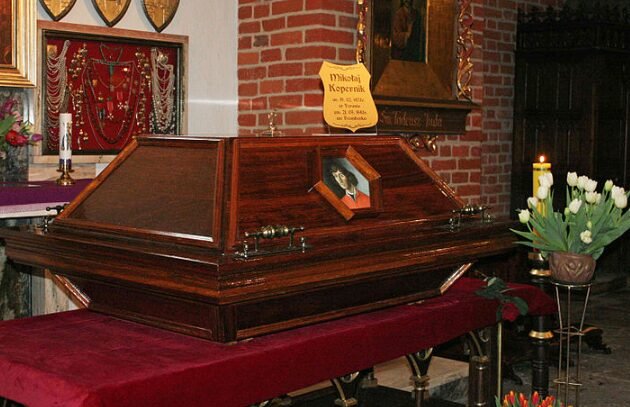
Nicolaus Copernicus was a Renaissance polymath known primarily for his work as a mathematician, astronomer, and Catholic canon. He is most renowned for revolutionizing astronomy by proposing a heliocentric model of the universe, which positioned the Sun, rather than Earth, at the center. Image: Casket with Copernicus’ remains on exhibit in Olsztyn
Questions and Answers

Nicolaus Copernicus, a Renaissance-era mathematician and astronomer, fundamentally transformed our understanding of the cosmos with his heliocentric model of the universe, in which the Sun rather than the Earth is positioned at the center. Image: Image: Nicolaus Copernicus portrait from Town Hall in Toruń – 1580)





